Agentic Enterprise / HEADLESS 360
Signal Opportunity: Greenlight an MCP-Enabled Agentforce Pilot Now
A practical, decision-focused guide for executives: greenlight a 60–90 day MCP-enabled Agentforce pilot to validate context fidelity, human‑agent handoff, and governance before scaling an agentic operating model.
THE DECISION PATH
Agentic Enterprise / operating model- 01Workflow
- 02Context
- 03Control
- 04Evidence
# Signal Opportunity: Why Enterprises Should Pilot MCP-Enabled Agentforce Now
Enterprises that want to operationalize AI agents at scale face two linked problems: providing reliable, auditable context to agents, and integrating agents into existing human workflows and business systems. Salesforce’s Agentforce product family positions agents alongside humans on the CRM and CX stack; the Model Context Protocol (MCP) provides a standard for delivering the context agents need. Together they form a practical path from experimentation to an agentic operating model. This Insight sets out a single, concrete decision executives can make this quarter and the practical steps to get there.
The problem at scale
AI agents are valuable only when they act on accurate, relevant, and current context — customer history, business rules, regulatory constraints, product catalogs, service levels, and ongoing conversations. Without a dependable channel for that context, agents drift, produce inconsistent outcomes, and create operational risk.
Two realities from the dossier: Salesforce’s Agentforce is positioned as a platform to put “humans with agents” to work across Sales, Service, Marketing, and industry clouds; MCP is an open protocol designed specifically to let AI applications discover, request, and receive context from specialized servers. Combining a platform that orchestrates agents and a protocol that guarantees consistent context exchange reduces integration friction and governance risk.
A single, high-impact decision for executives
Greenlight a targeted pilot: a production-focused, 60–90 day MCP-enabled Agentforce pilot that integrates one mission-critical context source (for example, contact center case data or a product master) with one front-line agent workflow (for example, contact-center assist or sales opportunity triage). The objective is not a research demo — it is to validate three operational questions: context fidelity (is the right context available when the agent needs it?), human‑agent handoff (can agents and people collaborate without friction?), and governance/traceability (can we audit decisions and roll back agent actions?).
Why this narrow, concrete pilot?
- It surfaces integration and governance issues quickly without broad platform rollout.
- It focuses engineering effort on a single discovery-and-execution loop (MCP discovery + Agentforce action), which greatly reduces risk and time to learn.
- It produces artifacts you can generalize: connector patterns, data‑handling rules, and user‑experience templates.
How MCP and Agentforce line up in practice
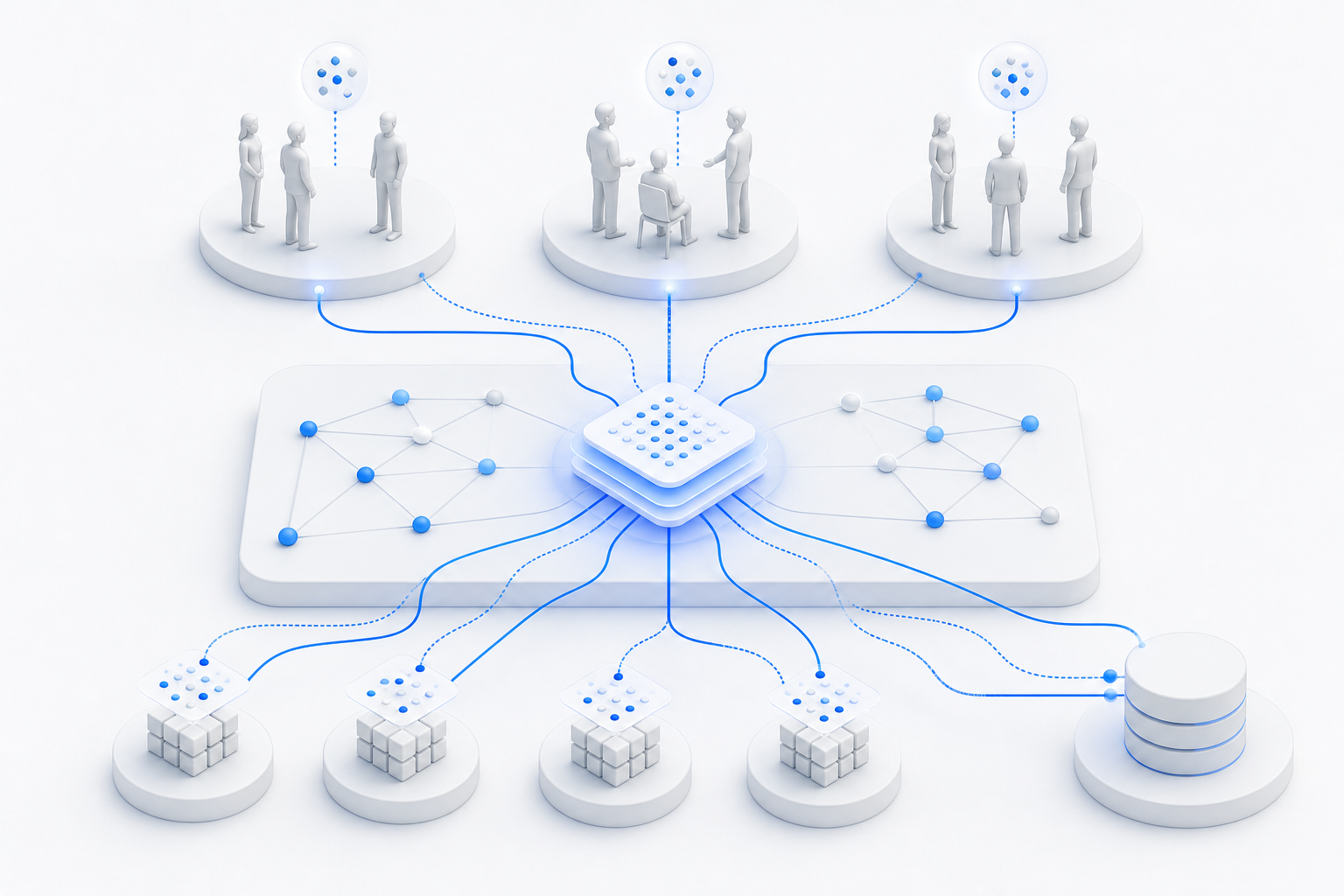
MCP is a client-server protocol that separates the data exchange layer (context primitives, tools, notifications) from transport concerns (stdio vs. HTTP streams). That separation lets teams build dedicated context servers — product catalogs, case history stores, HR systems — and expose them to agents in a consistent, discoverable way. Agentforce provides the platform, UI flows, and operational tooling to orchestrate agents alongside human teams on Salesforce’s stack.
Practically, an engineering plan for the pilot looks like:
- Select a single business workflow (e.g., contact center agent assist on high-value customer segments).
- Identify one canonical context server to expose via MCP (e.g., case history or SLA rules).
- Implement an MCP server adapter that publishes discovery info and exposes a small set of tools/resources that agents will call.
- Configure Agentforce to consume that context and map agent actions into existing Salesforce objects and flows.
- Run supervised production traffic, capture decision logs, and validate human handoffs and audit trails.
This plan mirrors the architecture goals described in MCP documentation (discovery, tools, resources, notifications) and the Agentforce product approach (builders, dev tools, operations) so the pilot is primarily an integration and governance exercise, not a foundational rewrite of your stack.
Headless 360 operating-model point of view
Headless 360 recommends an “incremental protocol-first” approach: treat context as a first-class, versioned product and use a stable exchange protocol (MCP) to publish it. Surface that context to agent platforms (Agentforce in this dossier) via small, well-scoped connectors. Operationalize three teams around the pilot: Context Product (owns the MCP server and data guarantees), Agent Ops (owns Agentforce policies, prompts, and handoffs), and Trust & Compliance (owns logging, retention, and rollback). This operating model keeps ownership clear and ensures agents scale without creating hidden technical debt.
Key governance guardrails we endorse:
- Minimal surface area: start with the fewest tools/resources required to operate the flow.
- Immutable context snapshots per interaction for auditability.
- Human-in-loop thresholds that require human confirmation above predefined risk bands.
What success looks like (qualitative measures)
- Consistent context availability when agents execute workflows (fewer failed lookups or manual lookups by humans).
- Predictable, low-friction handoffs between agents and humans with clear state transfer.
- Repeatable connector pattern and runbook that can be applied to other contexts.
Do not expect to prove long-term ROI in a single pilot; expect to de-risk the integration and governance assumptions so you can scale confidently.
Practical risks and mitigations
- Risk: Context divergence — two systems desync on critical values. Mitigation: Versioned context snapshots and reconciliation jobs that surface differences during the pilot, not after rollout.
- Risk: Overexposed data. Mitigation: Principle of least privilege in MCP discovery and resource access; redact or synthesize sensitive fields where possible for early testing.
- Risk: Unclear ownership. Mitigation: Charter the three teams (Context Product, Agent Ops, Trust & Compliance) before work begins and require a one‑page runbook for handoffs.
Quick implementation checklist (first 30 days)
- Choose workflow and context server.
- Stand up an MCP server endpoint for that context (discovery only to start).
- Assemble Agentforce configuration: prompts, policies, and mapping to Salesforce objects.
- Define audit logging and retention requirements with compliance.
- Run closed beta with a small set of agents and iterate.
FAQ (concise)
Q: Why MCP — isn’t a point-to-point API enough?
A: Point-to-point APIs scale poorly as agents and contexts multiply. MCP is designed for discovery, versioning, and tool/resource primitives so many agent hosts can reliably find and use the same context without bespoke integration every time.
Q: Do we need to replace existing middleware?
A: No. MCP can wrap existing systems as a context server. The pilot should focus on an adapter layer rather than a wholesale rewrite.
Q: What teams should be involved?
A: Product owners for the chosen workflow, an engineering lead to deliver the MCP adapter, Agent Ops to configure Agentforce, and legal/compliance for logging and retention rules.
References
- Salesforce — Agentforce MCP support: https://www.salesforce.com/agentforce/mcp-support/
- Model Context Protocol — Architecture overview: https://modelcontextprotocol.io/docs/learn/architecture
HEADLESS 360 OPPORTUNITY SESSION
Bring one workflow.
Leave with a clearer move.
KEEP READING