Data / HEADLESS 360
Data 360: The Trust Layer Behind Agentforce AI Decisions
Data 360 can ground Agentforce with governed context—but trustworthy AI decisions still require ownership, permissions, testing, monitoring, and human control.

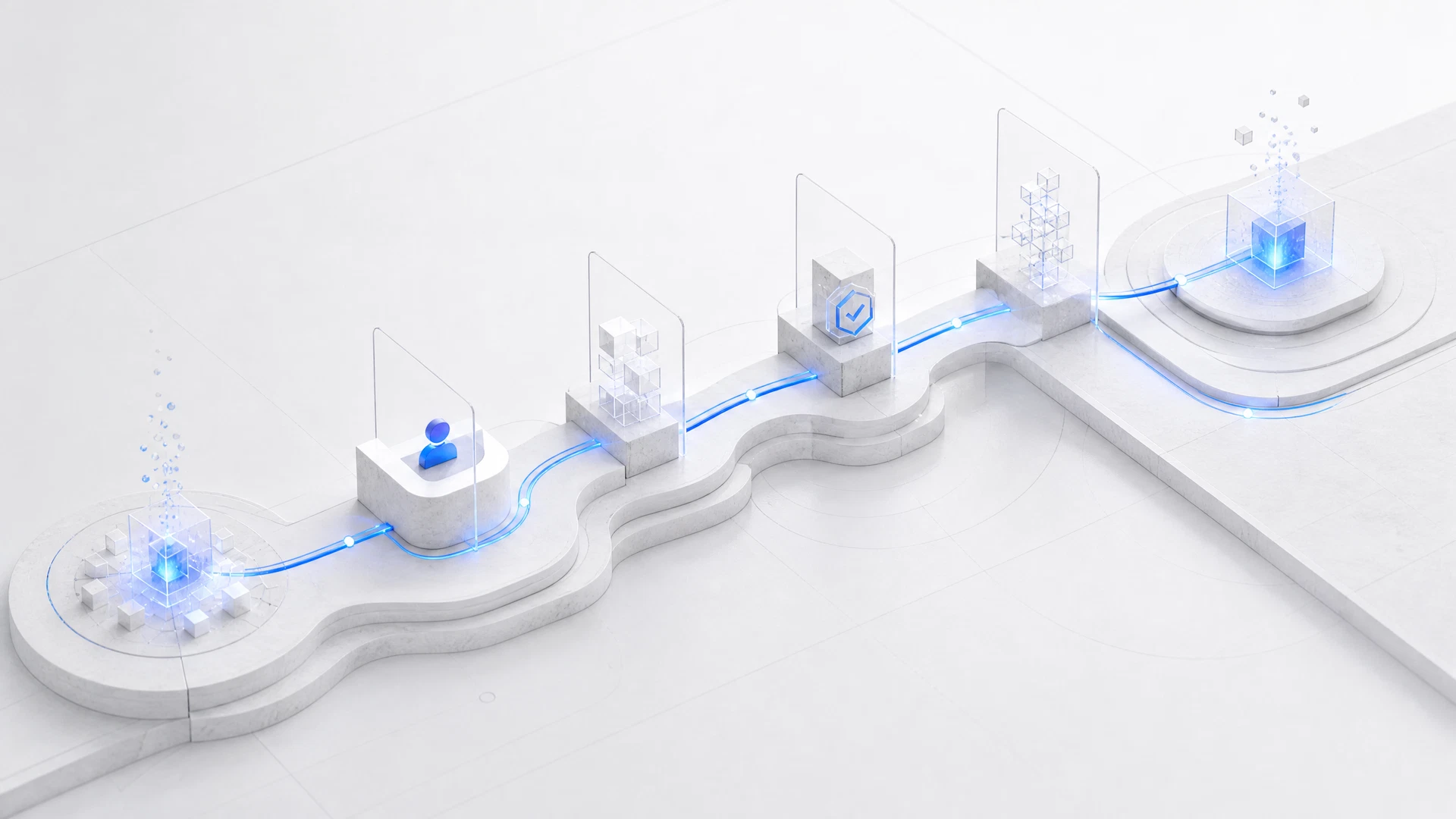
THE DECISION PATH
Data / operating model- 01Signal
- 02Trust
- 03Decision
- 04Evidence
# Data 360: The Trust Layer Behind Agentforce AI Decisions
Short answer: Data 360 can give Agentforce more relevant, governed enterprise context, but it cannot make an AI decision trustworthy by itself. Trust depends on the whole operating system around the agent: authoritative data, identity and permissions, policy enforcement, testing, monitoring, explainability, and a clearly defined human role. For executives, the architectural question is not simply whether an agent can answer. It is whether the organization can show why it acted, what it was allowed to use, and who remains accountable.
Why agent quality starts with data architecture
An agent is only as dependable as the context available at the moment of action. A polished response built on stale account records, duplicated identities, missing consent, or an unverified document can still produce a poor business outcome. This is why the data foundation is a leadership concern, not merely an implementation detail.
Salesforce describes Data 360, formerly Data Cloud, as a real-time data engine that unifies Salesforce and external data into a trusted business or Customer 360 view and supplies context to Agentforce.[1] That positioning is important, but “trusted” should be read as a design objective rather than a guarantee. The quality of an agent decision still depends on how an organization defines authoritative sources, resolves identities, manages access, and validates outputs in its own environment.
What Data 360 contributes to Agentforce context
According to Salesforce, Data 360 supports structured and unstructured data, identity resolution, a unified data model, calculated insights, triggered flows, and zero-copy connections to external platforms including Snowflake, Databricks, BigQuery, AWS, and IBM.[1] In practical terms, those capabilities can help an agent work from a richer picture than a single CRM record.
| Data foundation capability | Why it matters to an agent | Leadership control to establish |
|---|---|---|
| Unified data model | Gives records from different systems a common business shape | Define the system of record and ownership for each critical field |
| Identity resolution | Reduces the risk of treating one customer, account, or person as several | Set match rules, exception handling, and review ownership |
| Structured and unstructured context | Combines measurable facts with policies, correspondence, and documents | Classify sources by reliability, sensitivity, and freshness |
| Calculated insights and triggered flows | Converts data into signals or workflow events | Approve formulas, thresholds, and downstream actions |
| Zero-copy connections | Can reduce unnecessary replication of external data | Govern credentials, network paths, permissions, and failure behavior |
This is the difference between more data and usable context: information that is relevant, current enough, permissioned, and traceable.
Governance must sit before activation
Salesforce states that Data Cloud Governance became generally available in September 2025, with policy-based controls, AI tagging and classification, data spaces, dynamic masking, private connectivity, and governance across data and metadata.[2] These are potentially valuable control points, particularly when enterprise data is being activated by an AI system rather than merely displayed to a human analyst.
Yet governance features do not replace governance decisions. Leaders still need to define what an agent may retrieve or summarize, which actions require approval, how conflicting sources are handled, how records are retained, and who reviews exceptions.
A useful principle is to separate access from authority. An agent may be technically able to retrieve a contract, calculate a discount, or trigger a workflow, while still lacking the authority to make the final decision. The control plane should therefore distinguish read permissions, proposed actions, executable actions, and actions requiring a named human approver.
Mapping the architecture to trustworthy AI
NIST identifies several characteristics of trustworthy AI, including validity and reliability, safety, security and resilience, accountability and transparency, explainability and interpretability, privacy enhancement, and fairness with harmful bias managed.[3] Data 360 may support parts of this agenda, but no product deployment automatically satisfies it.
Identity resolution and source lineage can support validity and transparency; masking and private connectivity can support privacy and security; testing can reveal reliability problems. None proves that a recommendation is fair, a source is correct, or an agent should execute a consequential action.
The right question is therefore not “Does the platform have governance?” It is “Which trust characteristic is being controlled, by what mechanism, with what evidence, and under whose accountability?” That framing turns an abstract AI principle into an operating requirement.
A practical operating model for agent decisions
Start with a decision inventory rather than a technology inventory. Identify the workflows where Agentforce is expected to retrieve information, generate recommendations, or take action. Rank them by business value and consequence of error. Low-risk, reversible tasks may be suitable for early automation; financial, legal, employment, safety, privacy-sensitive, and customer-remediation decisions generally warrant stronger controls and human authority.
Then assign explicit ownership across five layers:
- Data ownership: business owners define authoritative sources, quality thresholds, freshness expectations, and permitted uses.
- Policy ownership: security, privacy, risk, and legal stakeholders define access, masking, retention, and approval requirements.
- Agent ownership: a product or operations owner maintains instructions, actions, escalation rules, and release decisions.
- Evidence ownership: teams preserve retrieval sources, decision context, test results, monitoring signals, and material changes.
- Outcome ownership: a named executive is accountable for whether the workflow improves the business without unacceptable harm.
Make escalation concrete rather than a vague fallback. Define triggers such as conflicting records, low-confidence retrieval, missing consent, unusual transaction size, policy exceptions, emotionally sensitive interactions, or irreversible actions.
Readiness checklist
Before expanding Agentforce decisions, confirm that the team can answer “yes” to most of the following:
- Is there an authoritative source and accountable owner for each data element used in the decision?
- Are identities, permissions, masking rules, and permitted purposes tested with realistic edge cases?
- Can the organization reconstruct the data, instructions, approvals, and actions behind a material outcome?
- Are high-impact or irreversible actions routed to a named human authority?
- Are quality, fairness, privacy, reliability, and business outcomes monitored after release—not just during a demo?
FAQs
Does Data 360 eliminate hallucinations?
No. It can provide richer and more governed context, but it does not guarantee factual accuracy or eliminate the need for retrieval quality controls, testing, monitoring, and human oversight.
Is zero-copy access automatically safer?
No. Avoiding data replication may reduce some movement and duplication, but credentials, network access, source permissions, data freshness, and failure modes still require explicit governance.
What should executives measure first?
Measure decision quality and control performance before celebrating volume. Track source-grounded accuracy, escalation appropriateness, policy exceptions, latency, rework, privacy incidents, and the business outcome of the workflow.
A clearer path to trustworthy agentic work
Data 360 can be a meaningful foundation for Agentforce because it addresses a central constraint on enterprise AI: fragmented context. The stronger strategic position, however, is to treat it as one layer in a governed decision architecture. Data must be authoritative; access must be least-privilege; actions must be bounded; evidence must be retained; and humans must keep authority where consequences demand it.
Headless 360 helps leadership teams translate that architecture into practical operating choices—what to automate, what to instrument, and where to keep a human in the loop. The next step is a decision and data readiness review tied to one measurable workflow, not a broad promise of autonomous transformation.
References
[1]: https://www.salesforce.com/in/data/ "Salesforce Data 360"
[2]: https://www.salesforce.com/blog/salesforce-data-cloud-governance-ga/ "Salesforce Data Cloud Governance Is Generally Available"
[3]: https://www.nist.gov/publications/artificial-intelligence-risk-management-framework-generative-artificial-intelligence "NIST AI Risk Management Framework: Generative Artificial Intelligence Profile"
HEADLESS 360 OPPORTUNITY SESSION
Bring one workflow.
Leave with a clearer move.
KEEP READING