Agentic Enterprise / HEADLESS 360
Pilot MCP with Salesforce Agentforce: A Decision Playbook for CX & Ops Leaders
A practical 90-day pilot playbook for enterprise leaders to connect Salesforce Agentforce with an external MCP server via AgentExchange, emphasizing governance, discovery, and measurable KPIs.
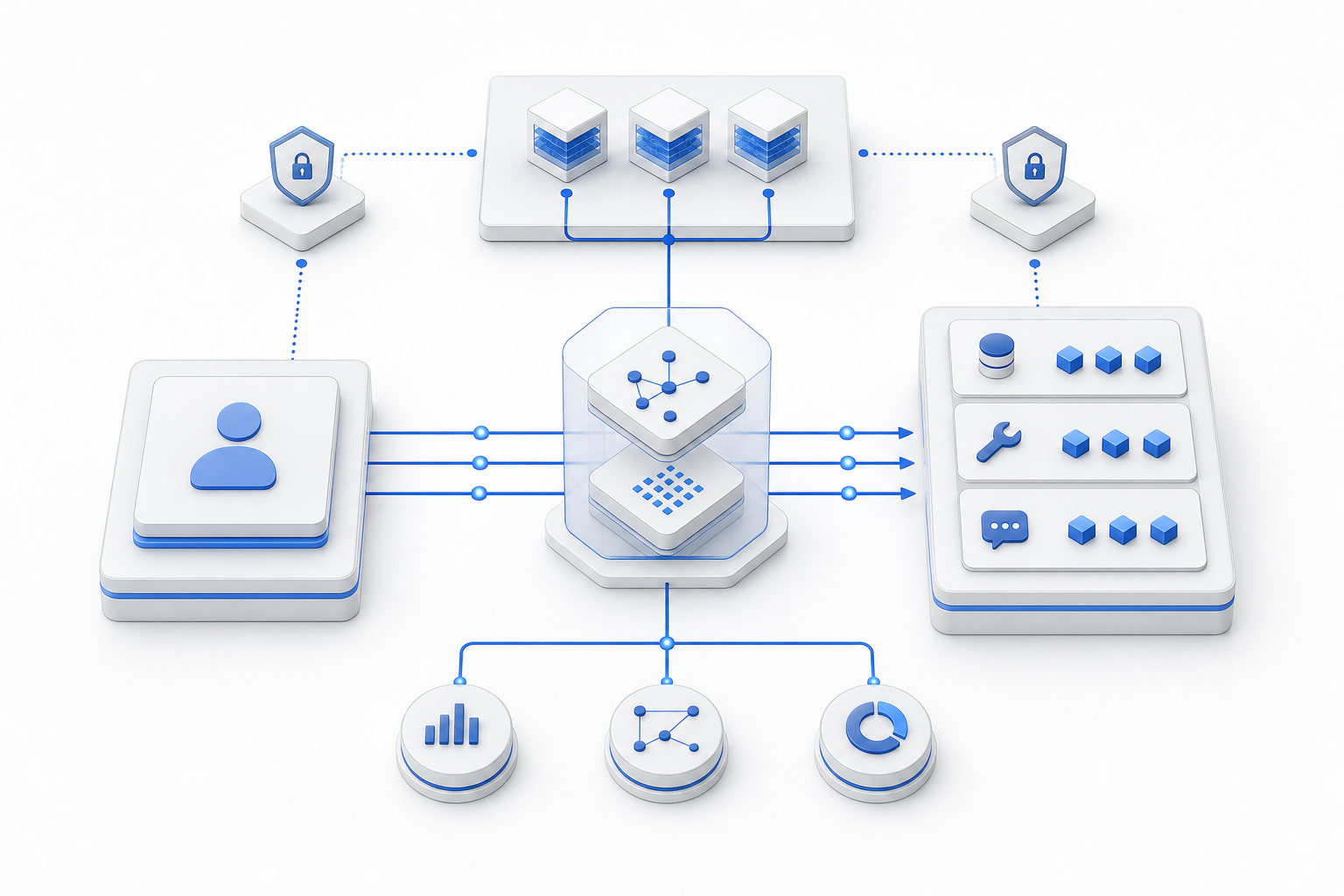
THE DECISION PATH
Agentic Enterprise / operating model- 01Workflow
- 02Context
- 03Control
- 04Evidence
Executive decision (recommended)
Authorize a focused, 90-day pilot that connects Salesforce Agentforce to a single trusted external MCP server (start with logistics or payments) discovered through AgentExchange, and evaluate operational impact on a narrow CX workflow (for example: delivery-window resolution in contact center handoffs). Use AgentBuilder to assemble the agent, register the MCP server in Agentforce’s centralized MCP registry, enforce granular tool permissions and OAuth-backed auth, and measure a small set of operational KPIs (time-to-first-response, percent of interactions resolved without escalation, and system errors). (salesforce.com)
Why this is the concrete decision now
Salesforce positions Agentforce as the enterprise-grade MCP client that will bridge internal agents and third-party MCP servers to access tools, prompts, and resources without bespoke integrations. That reduces engineering overhead for a single-use case while preserving control via a central registry, policy enforcement, and rate limiting. The Agentforce documentation gives the explicit example of a customer service agent using a logistics provider’s MCP server to provide an accurate delivery window — a direct, bounded pilot candidate. (salesforce.com)
Technically, MCP is a narrow, well-defined protocol focused on context exchange and action primitives (tools, resources, prompts) over a JSON-RPC 2.0 data layer and one of two transports (stdio for local, Streamable HTTP for remote). The spec explicitly supports discovery (server/discover), stateless per-request metadata, and notifications for real-time updates — capabilities you’ll need to operationalize a production pilot and to design observability and retry logic. (modelcontextprotocol.io)
Why a 90‑day, single‑server pilot
- Keeps scope small so security, governance, and error modes are observable before scaling.
- Lets Product, Security, and Platform teams validate a single transport/auth pattern (Streamable HTTP + OAuth is the recommended remote pattern) and confirm rate-limiting, monitoring, and trust controls behave as expected. (modelcontextprotocol.io)
8‑step pilot playbook (operational)
- Select the pilot workflow: pick one high-frequency, well-instrumented CX flow (e.g., delivery-window clarification). Use only channels already instrumented for analytics. (Business owner + Product)
- Choose an MCP server from AgentExchange with matching domain expertise (logistics/payments). Register it in Agentforce’s Centralized MCP Server Registry so discovery and cross-org controls are enforced. (salesforce.com)
- Technical onboarding: confirm the MCP server supports the JSON-RPC discovery pattern (`server/discover`) and exposes the required primitives (resources/tools/prompts). Prefer Streamable HTTP for remote servers and plan OAuth tokens for authentication as the protocol recommends. (modelcontextprotocol.io)
- Security & governance: define minimal tool permissions (allow resource reads, deny tool executions unless explicitly needed), enforce per-server policies in the central registry, and implement rate-limits to avoid cascade failures. Agentforce documentation describes granular controls and rate limiting as built-in governance features. (salesforce.com)
- Build and test: use AgentBuilder to assemble the agent, include explicit prompts/templates pulled from the MCP server where available, and run integration tests for discovery, tool invocation, and notifications. (salesforce.com)
- Observability: instrument logging for discovery exchanges, tool calls, response latencies, and notification events; collect metrics on errors, retries, and policy rejections. Leverage Agentforce’s registry metadata to map calls to business owners. (salesforce.com)
- Security review and compliance signoff: validate that no sensitive PII is exposed via MCP resources and that token lifecycles are auditable. Use the registry to limit cross-org discovery where required. (salesforce.com)
- Business validation and go/no‑go: after 90 days, run a decision review against the defined KPIs and a security incident checklist. If green, plan phased rollouts by adding one MCP server category at a time through AgentExchange. (salesforce.com)
Risk profile and mitigations
- Data exfiltration: mitigate by restricting resource scope and using read-only resources where possible; require security review for any tool that can change remote state. (salesforce.com)
- Cascading failures: enforce conservative rate-limits and circuit-breaker logic; MCP notifications and stateless request metadata allow safe retries and idempotency patterns. (modelcontextprotocol.io)
- Unintended agent actions: default to deny for tool executions; require explicit permits for any agent action that performs side effects. Agentforce emphasizes granular access controls and governance. (salesforce.com)
Headless 360 operating-model point of view
Headless 360 believes enterprises should treat MCP endpoints as first-class operational products: give each MCP server a product owner, SLAs, and runbooks inside the centralized MCP registry. Operationalize discovery metadata (protocol version, capability set) into your incident playbooks and capacity planning. Start with conservative, read-oriented integrations before enabling tools that perform remote state changes. The combination of MCP’s primitives model (tools/resources/prompts) and Agentforce’s registry + governance is the practical surface where risk meets velocity — manage the surface area deliberately. (modelcontextprotocol.io)
Success metrics (examples to track)
- Reduction in time-to-resolution for the chosen workflow (relative baseline).
- Percentage of interactions that avoided escalation to human-only paths.
- Number of policy rejections or governance events (should trend toward zero as policies stabilize).
- Incidents attributable to MCP integrations (goal: zero). Note: choose metrics you already report so you don't invent measurement work.
Concise FAQ
Q: What is MCP?
A: MCP is an open protocol for AI agents to discover and consume tools, resources, and prompts from internal or external MCP servers using a JSON-RPC data layer and transport mechanisms like stdio or Streamable HTTP. (modelcontextprotocol.io)
Q: Why use Agentforce for MCP?
A: Agentforce is the native Salesforce MCP client that provides a centralized MCP server registry, policy controls, rate limiting, and integration with AgentBuilder and AgentExchange, lowering the integration lift for enterprises. (salesforce.com)
Q: How do we authenticate remote MCP servers?
A: For remote servers, MCP recommends Streamable HTTP with standard authentication — OAuth is the recommended token method. Ensure token lifecycles and scopes are audited. (modelcontextprotocol.io)
Q: Which primitives matter most for pilots?
A: Start with Resources (read-only data) and Prompts (templates). Move to Tools (executable actions) only after governance and tests are fully validated. (modelcontextprotocol.io)
References
- https://www.salesforce.com/agentforce/mcp-support/ (salesforce.com)
- https://modelcontextprotocol.io/docs/learn/architecture (modelcontextprotocol.io)
HEADLESS 360 OPPORTUNITY SESSION
Bring one workflow.
Leave with a clearer move.
KEEP READING