
Agentic Enterprise / HEADLESS 360
Operationalizing Agentforce with MCP: a decision for CX and platform leaders
A prescriptive decision brief for enterprise CX and platform teams: pick a default MCP transport (stdio vs Streamable HTTP) for Salesforce Agentforce agents, with an operational checklist, risks, and Headless 360 platform POV.
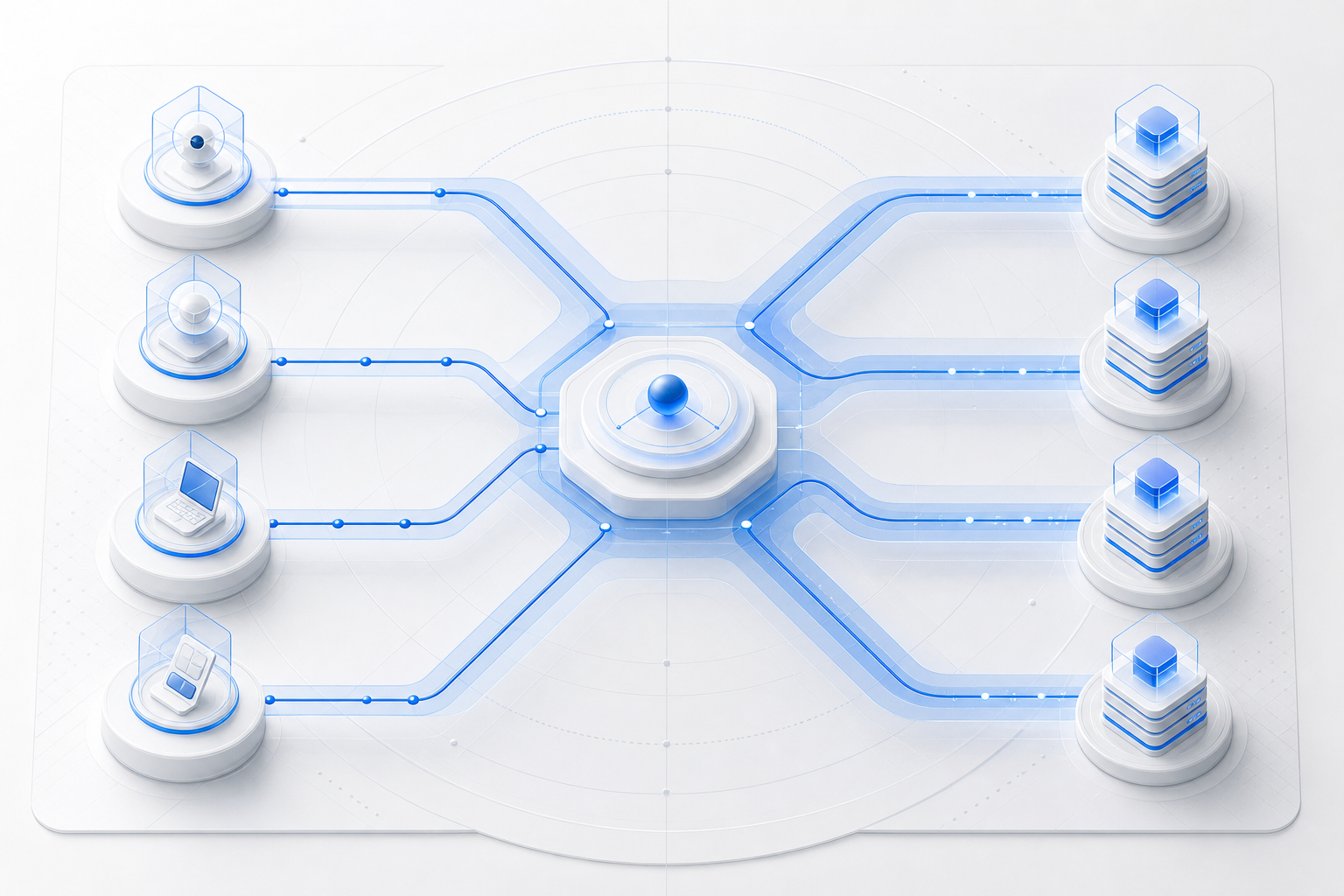
THE DECISION PATH
Agentic Enterprise / operating model- 01Workflow
- 02Context
- 03Control
- 04Evidence
# Operationalizing Agentforce with MCP: a current decision for CX and platform leaders
Published October 4, 2026 — Headline decision: choose the MCP transport and deployment model that matches your data residency, latency, and scale needs before you standardize on Agentforce agents.
Why this matters now
Salesforce Agentforce positions humans and AI agents to operate together across sales, service, marketing and industry clouds. The Agentforce product family (Builder, Voice, Dev Tools, AgentExchange, Operations) provides the tooling and marketplace surface for building agent-driven experiences. Meanwhile, the Model Context Protocol (MCP) defines how AI applications discover context, enumerate tools/resources, and exchange data between an AI host and context servers using a small set of transport patterns. Those two surfaces intersect at a single decision point that materially affects architecture, security posture, and time-to-value: which MCP transport and server deployment pattern will you standardize on for Agentforce agents?
This Insight walks through a targeted enterprise decision: adopt a local (stdio) MCP server strategy for regulated, latency-sensitive Agentforce workloads, or adopt a remote (Streamable HTTP + OAuth) MCP server strategy for scale and multi-tenant integrations — and what you must prepare to execute either choice.
What the dossier tells us (source facts)
- Salesforce Agentforce is a product family for combining humans and agents across Sales, Service, Marketing and industry clouds; Agentforce components include Builder, Voice, Dev Tools and AgentExchange. (Salesforce Agentforce product page).
- MCP is a client-server protocol with two layered concerns: (1) a JSON-RPC data layer that defines discovery, tools, resources, prompts and notifications; and (2) a transport layer that presently supports two transports: stdio (local process communication) and Streamable HTTP (remote with HTTP POST and optional Server-Sent Events). MCP recommends OAuth for authentication on remote transports. MCP also documents discovery, tool execution, notifications, and notes that sampling was deprecated as of 2026-07-28. (MCP Architecture overview).
The concrete decision (one thing to decide this quarter)
Choose your default MCP deployment pattern for production Agentforce agents and codify it as a platform standard.
- Option A — Default to stdio (local MCP servers) for regulated, PII/PHI workloads and ultra-low-latency contact-center/edge scenarios. Use remote MCP only for explicitly allowed integrations.
- Option B — Default to Streamable HTTP (remote MCP servers with OAuth) for multi-region scale, cross-cloud integrations, and managed-agent exchange scenarios. Use local stdio only for isolated, compliance-critical pockets.
Make the selection once and capture the implications across security, networking, CI/CD, and vendor relationships. This single choice will reduce friction when teams build agents with Agentforce Builder and Agentforce Dev Tools, and will determine how you operationalize AgentExchange connectors.
How to choose (practical criteria)
Evaluate each of the three dimensions below and map each Agentforce use case to the chosen transport:
- Data residency & compliance
- - If agents will surface or persist regulated data (financial PII, health PHI, GDPR-sensitive data) prefer stdio or on-prem MCP servers to retain local control of context exchange. MCP supports local stdio for single-machine, single-client deployments.
- Latency & availability
- - For contact-center voice agents and real-time routing where <100ms round-trip matters, prefer local MCP servers (stdio) colocated with the voice runtime. For asynchronous, batch, or analytic agents where throughput and cross-region scale matter, prefer Streamable HTTP.
- Scale & ecosystem connectivity
- - If your agents must call many external services, partner connectors, or third-party agent apps from AgentExchange, the Streamable HTTP transport with OAuth simplifies multi-tenant authentication and centralized token management.
Implementation checklist (30–90 day plan)
- Inventory agent use cases and classify them by: compliance sensitivity, latency tolerance, and third-party connectivity.
- Map each use case to a default MCP transport (stdio vs Streamable HTTP). Document exceptions and an exception approval process.
- Security & network design
- - For Streamable HTTP: design OAuth flows, token rotation, and secure ingress (WAF, mTLS where possible).
- - For stdio/local: design process isolation, filesystem protections, and CI/CD packaging for local MCP server deployment.
- Platform tooling
- - Standardize Agentforce Builder templates and Agentforce Dev Tools projects to produce MCP clients that match the chosen transport.
- - Publish internal AgentExchange connector pattern guidance tied to the transport choice.
- Observability & notifications
- - Instrument MCP notifications and tool-execution telemetry per MCP data-layer primitives so ops teams can subscribe to changes and track failures.
- Pilot two representative agents (one stdio, one Streamable HTTP) and run a 30-day production pilot.
- Lock the standard, update platform playbooks, and onboard teams.
Headless 360 operating-model point of view
Headless 360 recommends a “transport-by-default” operating model: make the MCP transport decision a platform-level policy, not a project-level one. That policy should be enforced through templates, CI/CD gates, and a single exception board. Doing so converts a many-to-many integration problem into a small, governable set of patterns — reducing security review time, simplifying connector certification for AgentExchange, and enabling predictable SLAs for business owners.
Key practices we prescribe:
- Ship two vetted reference implementations (stdio and Streamable HTTP) that include sample OAuth configs, notification wiring, and observability dashboards.
- Automate compliance checks in pipeline: detect whether an agent touches regulated fields and automatically flag it for stdio-only deployment unless a waiver is granted.
- Run a quarterly review of Agentforce connector inventory and MCP server versions to keep the platform current.
Risks and mitigations
- Risk: Choosing remote Streamable HTTP by default can widen your compliance surface.
- - Mitigation: Enforce data classification and automatic routing of regulated contexts to local MCP servers. Keep a hardened local reference implementation.
- Risk: Choosing local stdio by default reduces scale and increases operational overhead for multi-region deployments.
- - Mitigation: Provide a managed Streamable HTTP service for non-regulated workloads and automate cross-region failover for that service.
Concise FAQ
Q: What is MCP’s recommended auth for remote servers?
A: MCP documentation recommends using OAuth for authentication on the Streamable HTTP transport.
Q: Can I mix transports across agents?
A: Yes — MCP and Agentforce tooling support both patterns; the decision is about which pattern you make your default. Plan for mixed deployments but codify defaults.
Q: Where do notifications and discovery live in MCP?
A: Discovery, tools, resources, prompts and notifications are defined in MCP’s data layer (JSON-RPC based). Notifications are a first-class primitive for real-time updates.
Q: What Agentforce components should platform teams prepare?
A: Make standard templates and CI/CD pipelines for Agentforce Builder, Agentforce Dev Tools, and AgentExchange connectors so they emit the MCP client configuration that matches your chosen transport.
References
- Salesforce — Agentforce MCP support: https://www.salesforce.com/agentforce/mcp-support/
- Model Context Protocol (MCP) — Architecture overview: https://modelcontextprotocol.io/docs/learn/architecture
HEADLESS 360 OPPORTUNITY SESSION
Bring one workflow.
Leave with a clearer move.
KEEP READING


