
Agentic Enterprise / HEADLESS 360
Operationalizing Agentic CX: A Practical MCP Path for Enterprise Agentforce Deployments
A practical, quarter-driven decision playbook for CTOs: make the Model Context Protocol (MCP) your canonical context plane for Salesforce Agentforce deployments. Includes a three-phase implementation plan, operational controls, and an explicit Headless 360 operating-model point of view.
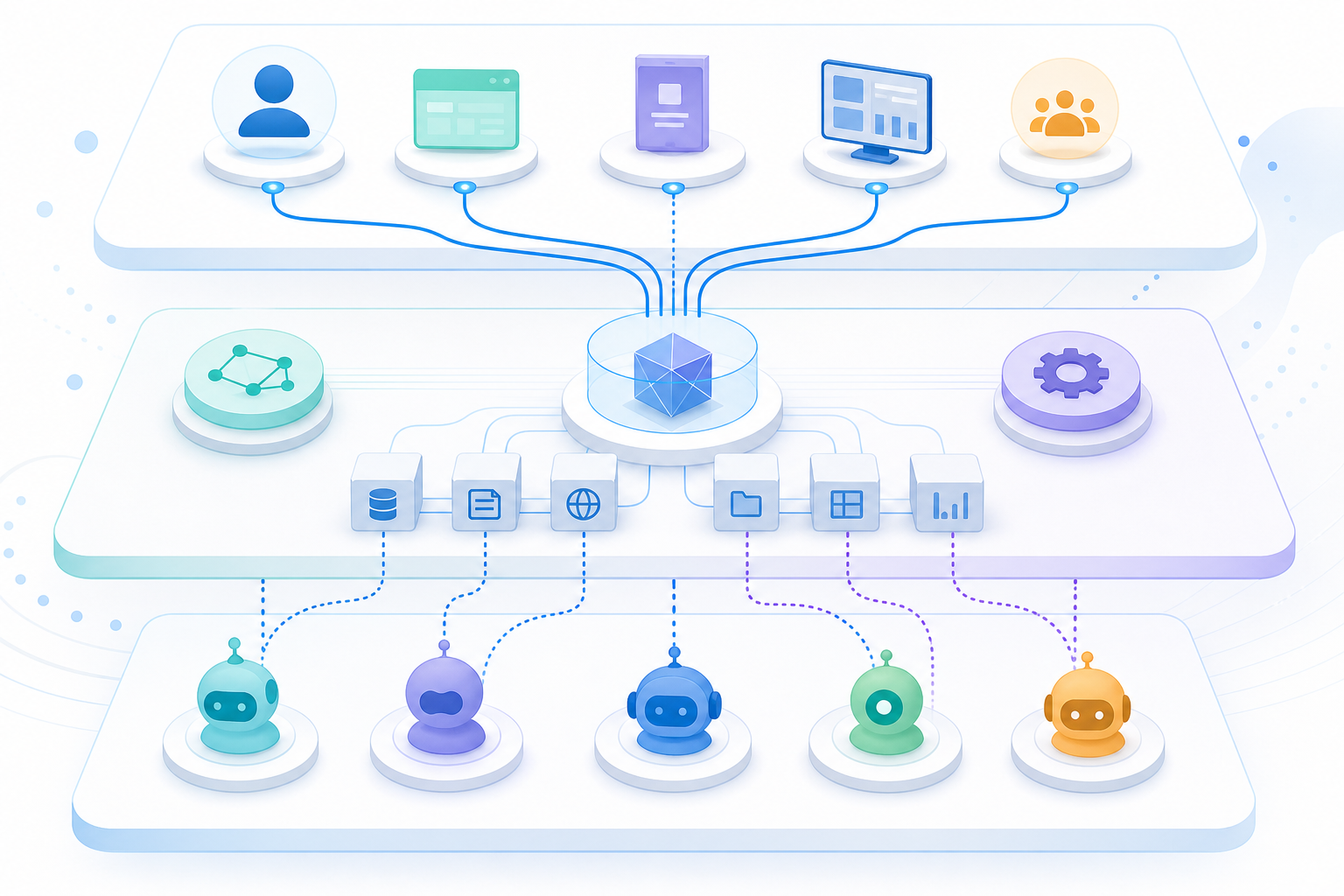
THE DECISION PATH
Agentic Enterprise / operating model- 01Workflow
- 02Context
- 03Control
- 04Evidence
# Operationalizing Agentic CX: A Practical MCP Path for Enterprise Agentforce Deployments
Enterprises adopting Salesforce Agentforce now face an architectural choice that determines whether AI agents are a brittle point solution or a durable, audit-able layer in the stack. The decision in front of CTOs and heads of Automation is concrete: make the Model Context Protocol (MCP) the canonical context-exchange plane for Agentforce agents, or accept bespoke integrations that will multiply integration cost, slow iteration, and complicate governance.
This Insight explains the practical decision, why it matters, and a three-phase implementation plan you can start this quarter using the capabilities documented by Salesforce and the MCP specification.
Why choose MCP as the canonical context plane?
- Salesforce’s Agentforce platform positions humans and agents together and exposes developer tooling (Agentforce Builder, Agentforce Dev Tools, Headless Toolkit) that targets platform-native integrations. The Agentforce documentation surfaces MCP-related support and developer paths for integrating agents and context services into the Salesforce ecosystem. (Source: Salesforce Agentforce MCP support).
- MCP is explicitly designed to separate how context is exchanged from how LLMs are run: it defines a data layer (tools, resources, prompts, notifications) and a transport layer (stdio for local servers; Streamable HTTP with OAuth support for remote servers). That separation lets engineering teams standardize a single, auditable context API that all agents consume, independent of model provider or hosting topology. (Source: Model Context Protocol architecture).
Combined, these two facts create a pragmatic path: use MCP servers as the enterprise-grade context service that feeds Agentforce agents, exposing consistent discovery, execution, and notification semantics that Salesforce tooling can consume.
The decision: adopt MCP as the enterprise context standard for Agentforce
Concretely decide to make MCP the company’s standard for agent-context exchange for all new Agentforce projects. That means:
- Require new Agentforce agent designs to integrate via an MCP server (local or remote) rather than embedding point-to-point API calls into agent logic.
- Surface MCP capability discovery and version metadata in your internal catalog so product teams can discover resources and tools before building.
- Operationalize two transports: stdio for local, experimental deployments and Streamable HTTP + OAuth for production, multi-tenant MCP servers.
Why this matters now: committing to MCP reduces later rework, enables consistent observability for agent actions, and lets data, privacy, and security teams centralize sensitive context handling rather than scattering it across many agent implementations.
Three-phase implementation plan (practical, quarter-driven)
Phase 1 — Fast pilot (4–8 weeks)
- Select a high-value, low-risk CX flow (e.g., triage of inbound support requests) and build a single Agentforce agent that gets context from a local MCP server using the stdio transport. Use Agentforce Builder + Dev Tools to wire the agent, and validate end-to-end behavior with real prompt templates.
- Deliverables: working pilot, documented discovery manifest for used tools/resources, a runbook showing how to run the MCP local server and attach Agentforce agents.
Phase 2 — Platform integration and hardening (8–16 weeks)
- Replace the local MCP pilot with a Streamable HTTP MCP server behind your API gateway. Use OAuth tokens for service authentication as recommended by MCP, and add TLS and per-resource ACLs.
- Integrate MCP resource access with your existing Salesforce data-plane connectors (MuleSoft, Flow Automation, or platform APIs referenced in Agentforce tooling) so MCP servers fetch canonical, governed context rather than copying data into agent prompts.
- Deliverables: production-capable MCP server, IAM policies, rate limits, and a CI/CD pipeline for MCP server deployments.
Phase 3 — Scale, governance, and lifecycle (ongoing)
- Treat MCP servers as platform products: maintain versioned discovery manifests, deprecation windows for tools/resources, and an approvals process for teams that want to publish new tools into the MCP catalog.
- Add observability: instrument discovery success rates, context latency, tool execution errors, and notification delivery. Use those signals to prioritize model and prompt re-training cycles.
- Deliverables: platform SLAs, audit logs for context access, and a catalog of MCP resources consumable by the business.
Operational details to lock down now
- Transport choice: use stdio only for developer/local debugging; use Streamable HTTP for production to enable centralized authentication, monitoring, and cross-team sharing. This aligns with the MCP transport guidance.
- Discovery and versioning: require every MCP resource and tool to publish a discovery manifest. That lets Agentforce instances programmatically know available capabilities and compatible protocol versions before runtime.
- Authentication: employ OAuth or your enterprise SSO-backed token flow for MCP server access, per MCP transport recommendations.
- Data minimization and governance: centralize sensitive context within the MCP server so that agents receive only the minimally required context via resources and tools; log requests for later review.
Headless 360 operating-model point of view
- Platform-first: treat MCP servers as a platform product owned by the automation team (productized context services), not as point integrations built by feature teams.
- Contract-driven integration: require a discovery manifest, schema, and SLA for any MCP resource published to the catalog — teams cannot embed raw data calls inside agent logic.
- Auditability and observability: enforce structured logging for tool executions and notifications; gate production rollouts on passing privacy and security checklists.
- Iteration cadence: prioritize short feedback cycles between CX owners, prompt engineers, and the MCP platform team; deploy small, measured changes to discovery manifests rather than large context schema shifts.
What success looks like (metrics to track)
- Discovery success rate (percentage of agent startups that find required resources without fallback).
- Average context fetch latency (ms) and 95th percentile SLA.
- Tool execution error rate and mean time to remediate.
- Number of Agentforce projects that consume shared MCP resources (adoption rate).
- Audit coverage: percent of agent interactions with logged context and execution traces.
Concise FAQ
Q: Does Agentforce support MCP?
A: Salesforce documents Agentforce MCP support paths and related developer tooling for agent and platform integration. See the Agentforce MCP support documentation for details. (Source: Salesforce Agentforce MCP support).
Q: Which transport should we use in production?
A: Use Streamable HTTP for production MCP servers to enable remote clients, OAuth-based auth, and streaming notifications. Use stdio only for local development and single-host deployments. (Source: Model Context Protocol architecture).
Q: Who should own MCP servers and catalogs?
A: Headless 360 recommends a central automation/platform team operate MCP servers as productized services with clear SLAs and a publishing workflow.
Q: How do we authenticate agents to MCP servers?
A: MCP recommends standard HTTP authentication mechanisms; the architecture notes OAuth as the recommended path for production tokens on Streamable HTTP transports. (Source: Model Context Protocol architecture).
Risks and mitigations
- Risk: Teams publish sensitive data to MCP resources without governance. Mitigation: require privacy reviews and RBAC for resource registration.
- Risk: Single MCP server becomes a bottleneck. Mitigation: horizontally scale MCP servers, shard catalogs by tenant, and monitor latency.
- Risk: Version mismatches between Agentforce agents and MCP discovery manifests. Mitigation: enforce discovery-based compatibility checks and deprecation windows.
References
- Salesforce — Agentforce MCP support: https://www.salesforce.com/agentforce/mcp-support/
- Model Context Protocol — Architecture overview: https://modelcontextprotocol.io/docs/learn/architecture
HEADLESS 360 OPPORTUNITY SESSION
Bring one workflow.
Leave with a clearer move.
KEEP READING


