
Agentic Enterprise / HEADLESS 360
Pilot MCP with Salesforce Agentforce: an operational playbook for enterprise agents
A practical, decision-focused playbook for piloting the Model Context Protocol (MCP) as the canonical context-exchange layer for Salesforce Agentforce deployments. Includes a recommended pilot plan, engineering checklist, operating-model point of view, and a short FAQ.
THE DECISION PATH
Agentic Enterprise / operating model- 01Workflow
- 02Context
- 03Control
- 04Evidence
# Integrating Model Context Protocol (MCP) with Salesforce Agentforce: a pragmatic operational decision
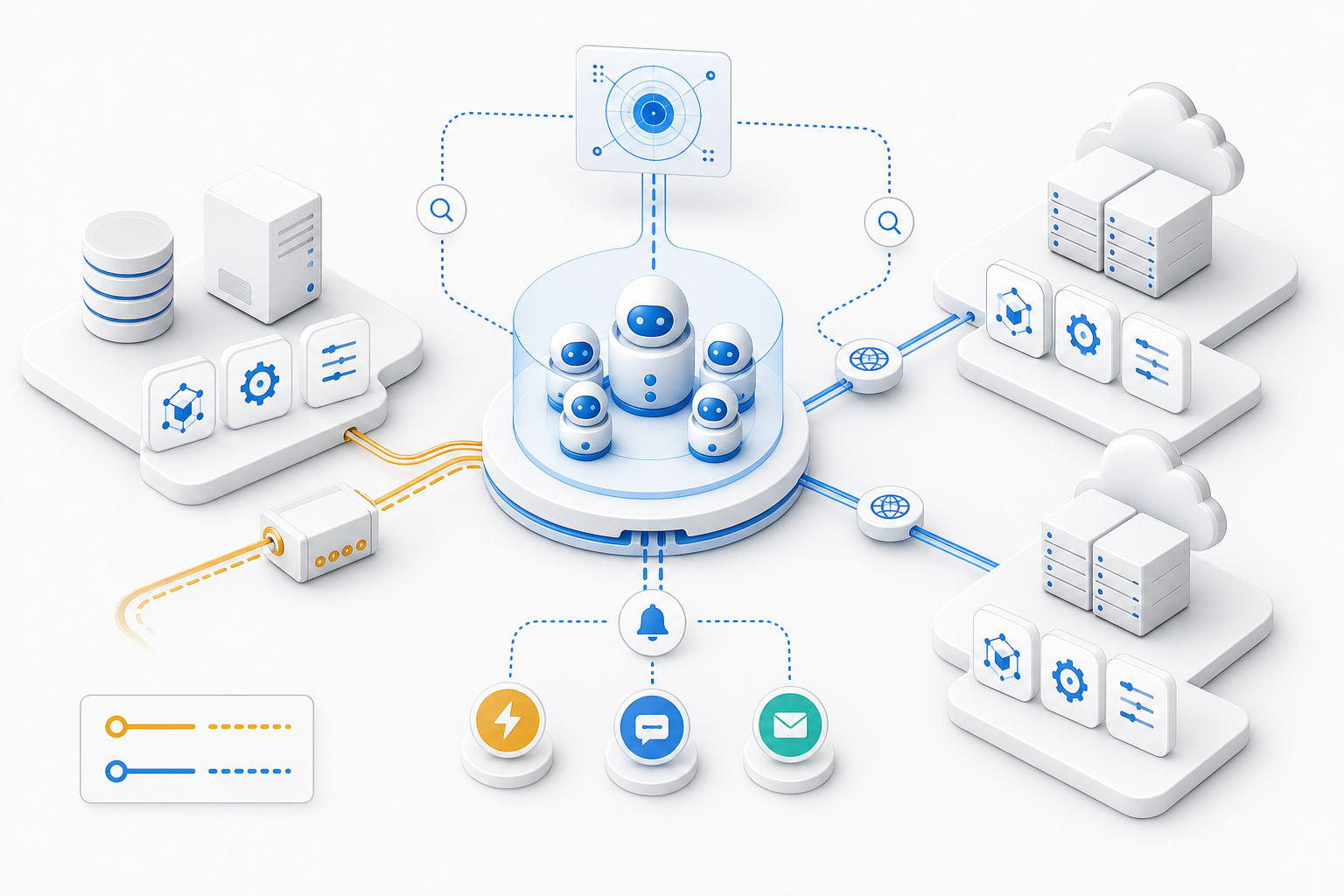
Enterprises moving from AI experimentation to agentic operations face an integration inflection: how to supply reliable, auditable context to AI agents without fragmenting platform governance. Two primary artifacts in the supplied dossier — Salesforce’s Agentforce product surface (Agentforce MCP support) and the Model Context Protocol architecture documentation — together define a practical integration path. This Insight frames a current, actionable decision for enterprise technology leaders: pilot MCP as the standard context-exchange layer for Agentforce agent deployments when you need multi-source, versioned, and transport-agnostic context delivery.
Why this decision matters now
Agentforce exposes a rich platform surface — builder tools, voice, dev tools, operations, and a Headless Toolkit — that aims to run humans and agents side-by-side. The Model Context Protocol (MCP) is a JSON-RPC based specification that separates the context-exchange data layer from transport choices (stdio or streamable HTTP), and defines discovery, tools, resources, prompts, and notifications. Choosing MCP as the canonical way to deliver context to Agentforce agents reduces bespoke integration work, clarifies security boundaries, and makes your context sources discoverable and versionable across local and remote services.
The concrete decision (recommended)
- Decision: Approve a six-to-nine week pilot to integrate MCP servers with a single Agentforce use case (for example: an internal service-desk or a B2B sales-assist agent). Use MCP to surface customer records, policy documents, and a small set of operational tools to Agentforce agents.
- Goal: Validate end-to-end context discovery, tool execution, secure transport, and live notifications without modifying Agentforce core logic.
- Success criteria: demonstrable context discovery across at least two context sources (one local MCP server and one remote MCP server), authenticated transport, agent action execution via defined MCP tools, and operational monitoring for latency and version conflicts.
Implementation checklist (practical steps)
- Scope the pilot (1 week)
- - Pick a single Agentforce-facing domain (service, sales, or marketing) with measurable KPIs (mean time to resolution, handle time, or pipeline velocity).
- - Identify context sources: internal document store, CRM customer records, and one third-party data feed.
- Build or select MCP servers (2–3 weeks)
- - Local server for high-trust, low-latency context (stdio transport is ideal for co-located components).
- - Remote server for shared services (use Streamable HTTP transport with OAuth or API-key authentication as described by MCP).
- - Implement discovery endpoints so Agentforce can enumerate tools, resources, and supported protocol versions.
- Wire Agentforce to MCP (2–3 weeks)
- - Use Agentforce Dev Tools and Headless Toolkit capabilities to register MCP clients and map Agentforce agent actions to MCP tool schemas.
- - Ensure prompts and resources returned by MCP match Agentforce expectations for tool inputs and outputs.
- Security, governance, and observability (parallel)
- - Use OAuth or enterprise API keys for remote transports; restrict scopes to necessary resources.
- - Log discoveries, tool executions, and notifications; include protocol-version metadata to catch drift.
- - Define retention and replay policies for notifications and context snapshots.
- Pilot run and evaluation (2–3 weeks)
- - Run the pilot in a controlled environment, capture KPIs, and iterate on tool schemas and latency budgets.
- - Produce a go/no-go recommendation for broader rollout based on measurable integration overhead and operational risk.
Engineering trade-offs to surface to stakeholders
- Transport choice: stdio offers performance for local services; streamable HTTP enables remote, multi-tenant services but adds network and auth complexity.
- Scope of context: MCP supports rich primitives (tools, resources, prompts). Limit initial scope to essential resources to reduce schema churn.
- Versioning discipline: MCP separates discovery and execution. Enforce semantic versioning for server capabilities and tools to avoid runtime mismatches.
Headless 360 operating-model point of view
Headless 360 recommends treating MCP as an operational contract: design your Agentforce integrations so MCP servers are first-class platform components with lifecycle management (deploy, version, deprecate). Operate MCP servers through the same change-control and SLO processes you use for internal APIs. This reduces brittle, point-to-point integrations, speeds onboarding of new agent skills, and enables safer experimentation because discovery and capability declarations make agent dependencies explicit.
Operational actions we endorse:
- Put MCP discovery and protocol-version checks in your CI gating for any Agentforce agent that consumes external context.
- Run automated compatibility tests that exercise tool execution across the latest MCP server versions before release.
- Treat notifications as business signals—hook them into your observability pipeline and build alerting for missed notifications or long-running executions.
Risks and mitigations
- Risk: Protocol drift between Agentforce clients and MCP servers. Mitigation: enforce discovery-time compatibility checks and semantic versioning.
- Risk: Sensitive data exposure over remote transports. Mitigation: use fine-grained auth scopes, TLS, and token rotation; prefer local MCP servers for high-sensitivity datasets.
- Risk: Operational complexity. Mitigation: start with a small pilot and codify an MCP server runbook as part of platform onboarding.
Concise FAQ
Q: Do we need MCP to use Agentforce?
A: No — Agentforce can work with direct integrations — but MCP adds a standardized, discoverable context-exchange layer that reduces bespoke wiring when multiple context sources and transports are required.
Q: Which transport should we pick first?
A: For pilots, use stdio transport for local, low-latency components and Streamable HTTP for remote shared services. The MCP spec explicitly supports both patterns so choose based on proximity and trust model.
Q: How does this affect security reviews?
A: MCP surfaces explicit discovery and authentication points. Treat MCP servers like other internal APIs: require auth tokens (OAuth recommended in MCP guidance), scope-limited access, and audit logs.
Q: What operational data should we collect?
A: At minimum: discovery latencies, tool execution success/failure rates, notification delivery rates, and protocol-version mismatches.
Q: When should we scale MCP across the enterprise?
A: Scale after you validate compatibility and operational runbooks in a pilot, and only when multiple Agentforce agents need to consume the same context sources reliably.
References
- Salesforce — Agentforce MCP support: https://www.salesforce.com/agentforce/mcp-support/
- Model Context Protocol — Architecture overview: https://modelcontextprotocol.io/docs/learn/architecture
HEADLESS 360 OPPORTUNITY SESSION
Bring one workflow.
Leave with a clearer move.
KEEP READING


