
Agentic Enterprise / HEADLESS 360
Decision: Run an MCP‑backed Agentforce Pilot to Gate Agentic AI Scale
A decision-focused guide for enterprise leaders: run an MCP-backed Agentforce pilot to validate context exchange, transport choices, and governance before scaling agentic AI.
THE DECISION PATH
Agentic Enterprise / operating model- 01Workflow
- 02Context
- 03Control
- 04Evidence
# Executive summary
Enterprises deploying agentic AI at scale face two linked problems: how agents access accurate, timely context, and how platforms coordinate agents, humans and governance. Salesforce’s Agentforce product family (exposed through the Headless 360 platform) pairs humans with agents to drive customer outcomes; the Model Context Protocol (MCP) specifies a vendor-agnostic, JSON-RPC-based contract for supplying runtime context to AI hosts. Together they offer a practical integration pattern: use MCP as the context exchange layer and Agentforce/Headless 360 as the agent orchestration and application layer. This Insight recommends a concrete, first-priority decision for enterprise leaders: launch a controlled MCP-backed Agentforce pilot that validates transport, discovery, and governance assumptions before broad rollout.
# Why this matters now
- Agentic AI depends on fresh, authoritative context. MCP defines a clear data-layer protocol (JSON-RPC primitives for tools, resources, prompts and notifications) and two transport patterns (stdio for local servers; Streamable HTTP for remote servers). This reduces custom adapter work and shortens time-to-safe-deployment for enterprise agents.
- Salesforce positions Agentforce and the Headless 360 platform as the business-facing layer to build, customize and operate agents with humans in the loop. Combining a standards-based context layer with an enterprise agent platform creates a reproducible architecture for safe, auditable agent actions.
# The concrete decision: run an MCP-backed Agentforce pilot
Decision: Approve a 2–3 month pilot that attaches one or two high-value Agentforce use cases to MCP-compliant context servers and evaluates operability, security and ROI triggers. The pilot must prove three things before scale: (1) reliable context discovery and delivery under production loads, (2) a working auth and token lifecycle using MCP-recommended patterns, and (3) human-in-the-loop controls and audit trails implemented via Headless 360/Agentforce features.
Why this decision? It focuses investment on the integration surface most likely to block enterprise agent adoption (context exchange and governance) while leveraging Salesforce’s product stack to minimize application development.
# How to run the pilot (practical steps)
1) Choose 1–2 workload epitopes
- Select narrow, high-value workflows (for example: agent-assisted contact-center responses or sales opportunity summarization). Keep scope limited to reduce variables.
2) Map context surfaces and MCP transport choices
- Inventory the context sources each agent needs (customer records, event logs, search indices, third-party tools).
- For on-prem or edge sources where latency and isolation matter, use the MCP stdio pattern (local MCP servers). For cloud-hosted context or multi-tenant services, use the Streamable HTTP transport with SSE for streaming updates. These transport options are core MCP primitives.
3) Implement MCP servers for each context type
- Use an MCP SDK or reference server to expose tools, resources and prompts in MCP’s JSON-RPC data-layer format. Ensure the discovery endpoint accurately reflects server capabilities so MCP clients (the Agentforce host) can query what’s available.
4) Integrate with Headless 360 / Agentforce
- Connect the Agentforce instance on Headless 360 to MCP clients that consume the context servers. Leverage Agentforce Builder, Voice and Dev Tools to wire context outputs into agent decision logic and human handoffs.
5) Secure and govern
- Follow MCP transport guidance for authentication: prefer OAuth flows for Streamable HTTP. Implement token rotation and least-privilege scopes for every MCP server and Agentforce client. Capture audit events at both the MCP layer (tool invocations, responses) and the Agentforce layer (agent actions, human overrides).
6) Measure and gate
- Define clear pilot success criteria: context freshness, average time-to-response, percent of agent actions requiring human confirmation, and completeness of audit trails. Use these gates to decide when to scale.
# Headless 360 operating-model point of view
Headless 360 recommends treating MCP as the canonical context contract and Agentforce as the orchestration and human-in-the-loop enforcement plane. Operationally, split ownership like this:
- Platform / Infrastructure team: host and secure MCP servers, manage transport endpoints (stdio and Streamable HTTP), and run the MCP discovery and monitoring stack.
- Product / Business teams: define agent goals, prompts and acceptance criteria, and own the Agentforce configuration (Builder, voice flows, human escalation rules) on Headless 360.
- Security & Compliance: manage OAuth clients, scope policies, logging retention, and perform threat modeling for each MCP-exposed tool/resource.
- SRE / Observability: instrument both MCP and Agentforce for latency, error rates and tool execution traces. Correlate agent actions to context versions for post‑incident analysis.
This separation keeps the context protocol stable and reusable across multiple agent initiatives while using Agentforce to rapidly assemble business workflows with human checkpoints.
# Risk checklist (what to watch for)
- Discovery drift: mismatches between MCP server-disclosed capabilities and actual tool behavior. Validate discovery responses in early tests.
- Transport misconfiguration: stdio vs Streamable HTTP choices can materially affect latency and isolation — test both where applicable.
- Token and scope sprawl: avoid broad tokens; prefer many narrowly scoped clients with short-lived credentials.
- Audit gaps: ensure both the MCP primitives and Agentforce actions are captured and correlated.
# FAQ (concise)
Q: What is MCP in one sentence?
A: MCP (Model Context Protocol) is a JSON-RPC–based protocol that standardizes how MCP servers supply tools, resources, prompts and notifications to AI hosts, with a clear discovery and transport model.
Q: Which transports does MCP support?
A: MCP supports stdio for local, single-client servers and Streamable HTTP (HTTP POST with optional Server-Sent Events) for remote servers — use the transport that matches your locality and security needs.
Q: How does Agentforce relate to Headless 360?
A: Agentforce is Salesforce’s agent platform and capabilities (Builder, Voice, Dev Tools, AgentExchange); Headless 360 is the platform surfaced to build and customize Agentforce and Customer 360 integrations.
Q: How should I authenticate MCP connections?
A: MCP recommends standard HTTP authentication methods for Streamable HTTP; enterprises should prefer OAuth flows for token issuance and rotation.
Q: Where should we start?
A: Start with a tightly scoped pilot that connects an MCP server for one context domain to an Agentforce flow on Headless 360, validate discovery, transport, and auditing, then iterate.
# References
- https://modelcontextprotocol.io/docs/learn/architecture
- https://www.salesforce.com/agentforce/mcp-support/
# Visual brief
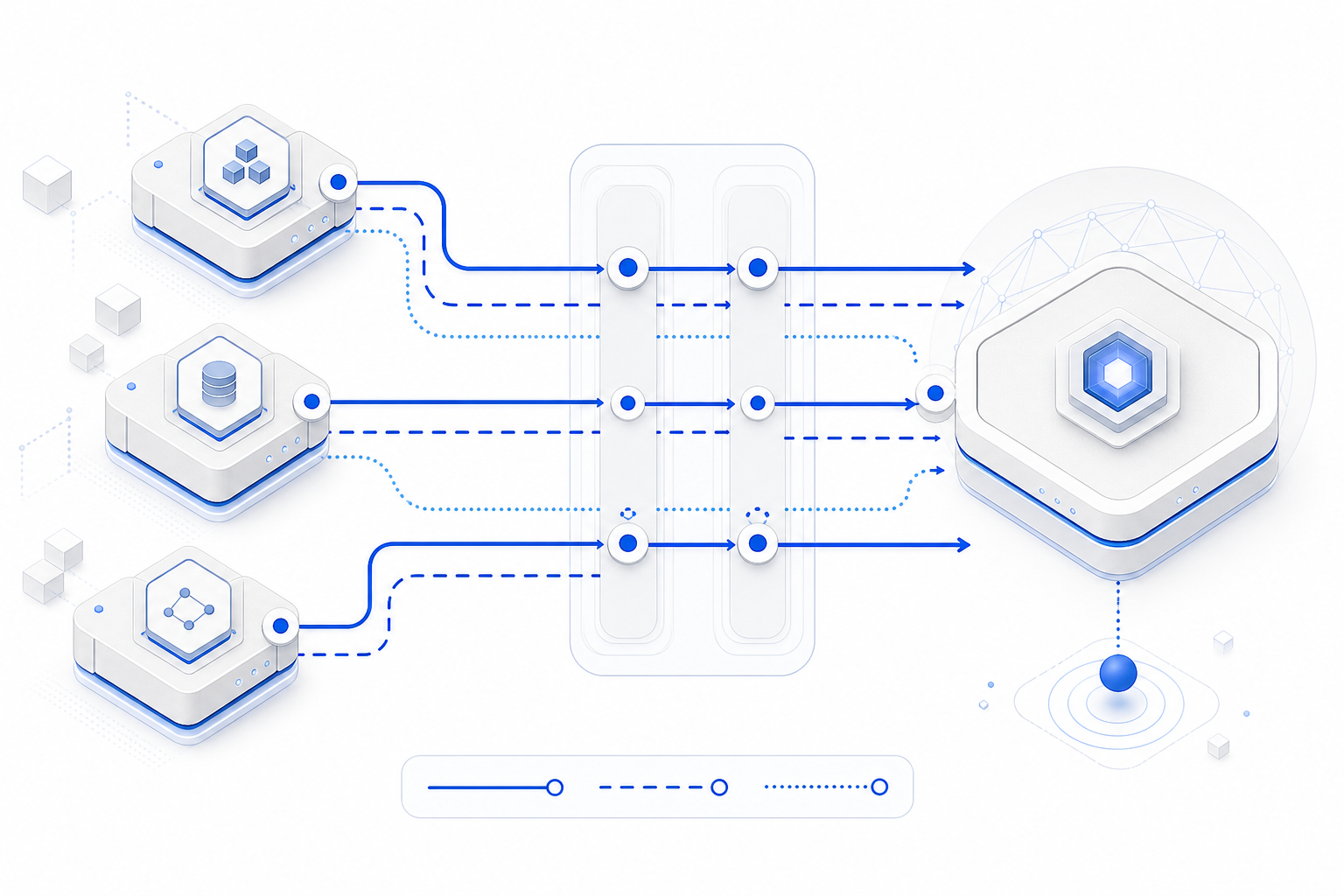
no-text, Signal Cartography: create a clean, abstract data-flow illustration that visualizes context exchange between MCP servers and the Agentforce/Headless 360 platform. Use clear nodes for "Context Servers (MCP)" and "Agentforce Host (Headless 360)" with directional lines for discovery, tool execution and notifications. Show optional transports (stdio, Streamable HTTP) as distinct lanes. Use a neutral, enterprise palette; avoid logos, words, and dark cyberpunk. No textual overlays other than minimal node labels; maintain open white space and a data-centric aesthetic.
HEADLESS 360 OPPORTUNITY SESSION
Bring one workflow.
Leave with a clearer move.
KEEP READING


