Agentic Enterprise / HEADLESS 360
Adopt MCP for Agentforce Interoperability: A 90‑Day Pilot Decision
A practical 90‑day decision: pilot the Model Context Protocol with one Salesforce Agentforce workflow to create a safe, discoverable context layer that reduces brittle integrations and preserves control over sensitive customer data.
THE DECISION PATH
Agentic Enterprise / operating model- 01Workflow
- 02Context
- 03Control
- 04Evidence
# Executive insight: Standardize agent context with MCP before you scale Agentforce
Enterprises adopting Salesforce Agentforce face a fork: treat each AI agent as a point product stitched to CRM, or invest in a standard context-exchange layer so agents — internal, third‑party, and customer personal agents — share the same live truth. The Model Context Protocol (MCP) is a practical specification for exactly that interoperability: a JSON‑RPC data layer and two transport options that let AI applications discover capabilities, fetch tools and resources, and subscribe to notifications. Use this insight to make a single near-term decision that creates optionality, reduces brittle integrations, and keeps sensitive customer context under your control.
Why this decision matters now
Salesforce Agentforce collects productized components you will use (Builder, Voice, Dev Tools, AgentExchange, Agentforce Operations). Those components are valuable, but they are only one part of the agent ecosystem you’ll operate. MCP defines a neutral way to publish and consume context, tools, prompts, and notifications so agents and platforms can interoperate without tight coupling.
Choosing to adopt MCP as your internal context bus does not require replacing Agentforce. Instead, it lets Agentforce instances act as MCP clients or servers in a larger architecture: Agentforce can be one participant among many, while your firm retains strict controls over data, discovery, and transport choices.
What MCP gives you (in enterprise terms)
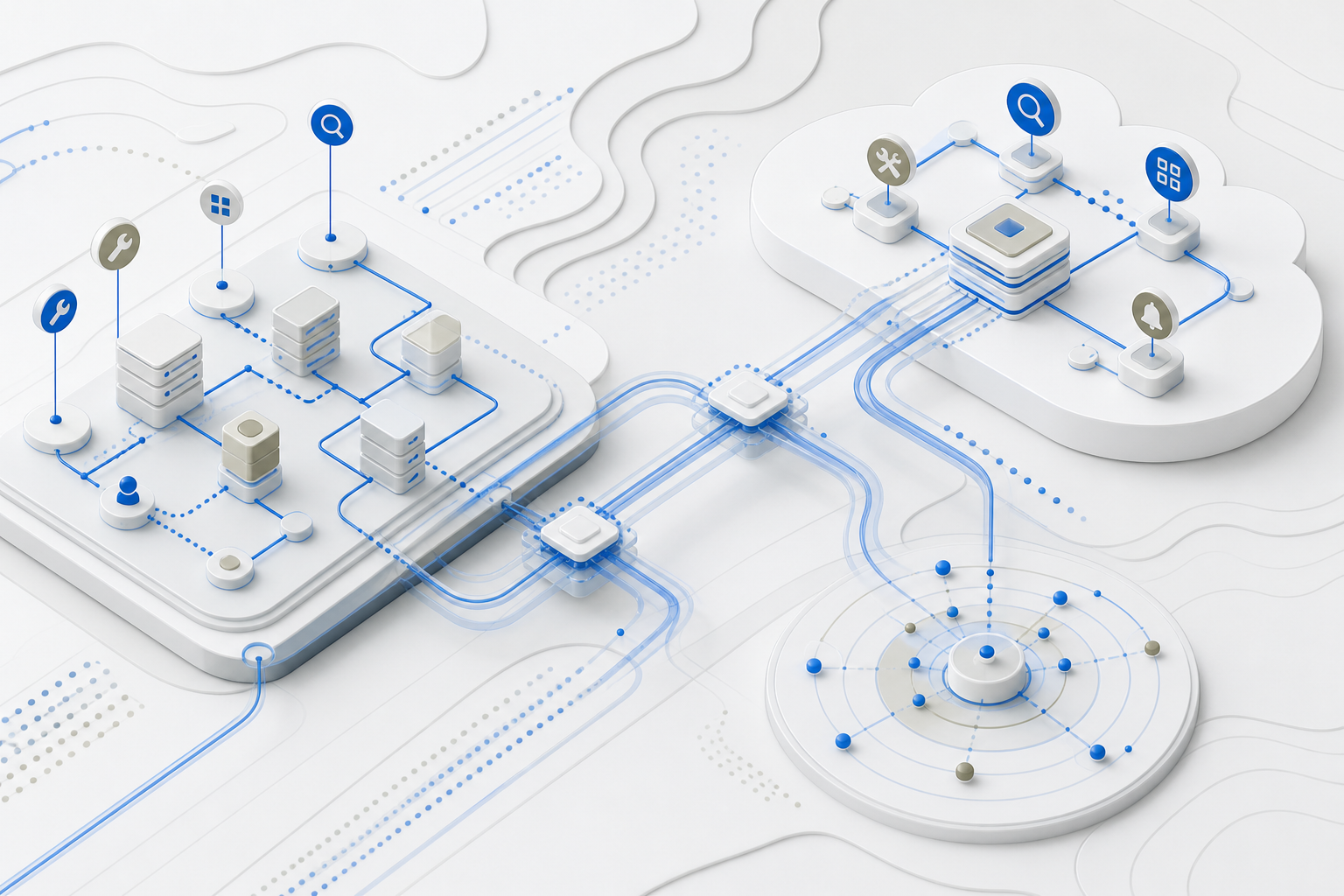
- A protocol-level separation of concerns: a JSON‑RPC data layer (discovery, tools, resources, prompts, notifications) and a transport layer (stdio for local, Streamable HTTP for remote). This split lets you standardize behavior while choosing the operational model that matches risk and latency requirements.
- Two transport patterns to map to enterprise constraints: local MCP servers (stdio) for high‑trust, low‑latency access to PII and internal systems; Streamable HTTP for managed, scalable remote services and third‑party providers (with standard HTTP authentication flows).
- Built‑in discovery and versioning primitives so clients can query server capabilities before running actions — a concrete control point for governance and compatibility testing.
These are not theoretical design ideas: MCP explicitly specifies discovery, primitives (tools, resources, prompts), notifications, and transport choices in its architecture documentation.
Headless 360 operating-model point of view
Headless 360 recommends a two‑track rollout for enterprise adoption of MCP alongside Agentforce:
- Ship a short, focused pilot that treats Agentforce as an MCP client. Use an operationally simple service (e.g., a managed knowledge resource) and connect it with Agentforce Builder and Dev Tools to validate discovery and tool execution workflows.
- Run your critical customer context stores behind a local MCP server (stdio transport) that you operate. Expose a separate Streamable HTTP MCP gateway only where business needs require scale or third‑party access, and protect it with OAuth as recommended by MCP.
This hybrid approach enforces a clear security boundary (local sensitive context vs remote, auditable services), enables gradual migration of existing integrations into MCP primitives, and centralizes interoperability tests so Agentforce instances can be swapped, upgraded, or augmented without rewriting every integration.
A concrete decision for executives (the one action to take this month)
Authorize a 90‑day MCP pilot that connects one high‑value Agentforce use case to a locally operated MCP server. Deliverables for the pilot:
- Select one contact‑center or sales workflow currently using Agentforce components.
- Run the MCP discovery flow to enumerate server features and tools used by that workflow.
- Implement the data‑layer primitives (one resource and one tool) and a simple notification subscription to validate real‑time updates.
- Use stdio transport for any PII or regulated data; use Streamable HTTP for non‑sensitive, external services.
- Produce an interoperability report and a list of operational controls (auth model, version policy, monitoring plan).
This decision is small enough to be executable quickly but large enough to reveal whether MCP will reduce long‑term integration cost and risk for your organization.
Mapping Agentforce components to MCP primitives (practical guidance)
- Agentforce Builder and Dev Tools: treat these as MCP clients that can discover and call tools and resources. Use them to validate tool execution flows exposed by MCP servers.
- AgentExchange: map third‑party agents and partner capabilities to MCP tools and resources so your platform can discover and authorize them with a consistent lifecycle.
- Agentforce Operations and Headless Toolkit: integrate these operational functions (deployment, monitoring, governance) with MCP notifications and discovery to centralize observability and reduce bespoke runbooks.
All of the above are feasible because MCP defines the data primitives and a discovery mechanism that enable clients and servers to coordinate capabilities and versions.
Risk profile and mitigations
- Complexity: introducing MCP adds a coordination layer. Mitigate by piloting a single use case and adopting a narrow set of primitives first.
- Security and compliance: transporting sensitive data requires strict controls. Mitigate by running a local MCP server (stdio transport) for PII and enforcing OAuth and HTTP auth for external endpoints as MCP recommends.
- Vendor lock‑in tradeoffs: standardizing on MCP is an investment. But it also reduces the long‑term cost of replacing or augmenting platforms, because MCP separates context from model execution.
How success looks at the end of the pilot (practical signals)
- Agentforce instances can discover and call at least one external tool or resource through MCP without bespoke adapters.
- Notifications flow from your context systems into Agentforce-driven workflows within SLA targets you set (e.g., sub‑second where required for UX; acceptable for business rules otherwise).
- Your platform team documents a reproducible pattern and an authorization model for local vs remote MCP servers.
These outputs create a repeatable blueprint for broader agent rollouts across sales, service, and product teams.
Concise FAQ
Q: Will this require replacing Agentforce?
A: No. Treat Agentforce as one participant in an MCP topology; it can be an MCP client, or consume MCP‑exposed services, so replacement is not necessary for value to accrue.
Q: Which transport should we use for regulated customer data?
A: MCP distinguishes stdio (local) and Streamable HTTP (remote). For regulated data, prefer a locally operated MCP server using stdio to avoid exposing PII over remote channels; use HTTP only when you have clear authorization and audit controls.
Q: Does MCP handle authentication?
A: The protocol supports transport‑level authentication patterns; MCP documentation recommends standard HTTP auth methods and OAuth flows for the Streamable HTTP transport.
Q: How much effort is the pilot likely to need?
A: Start with a narrow scope: one resource, one tool, and a notification subscription. The goal is validating discovery, execution, and notifications — not remaking all integrations.
References
- Salesforce Agentforce product and developer landscape: https://www.salesforce.com/agentforce/mcp-support/
- Model Context Protocol architecture and transport guidance: https://modelcontextprotocol.io/docs/learn/architecture
HEADLESS 360 OPPORTUNITY SESSION
Bring one workflow.
Leave with a clearer move.
KEEP READING