
Agentic Enterprise / HEADLESS 360
Deploy MCP-backed Agentforce: a 12-week pilot decision for enterprise leaders
A decision-focused 12-week pilot plan to integrate Model Context Protocol (MCP) with Salesforce Agentforce to prove secure, governed agent operations for one high-value workflow.
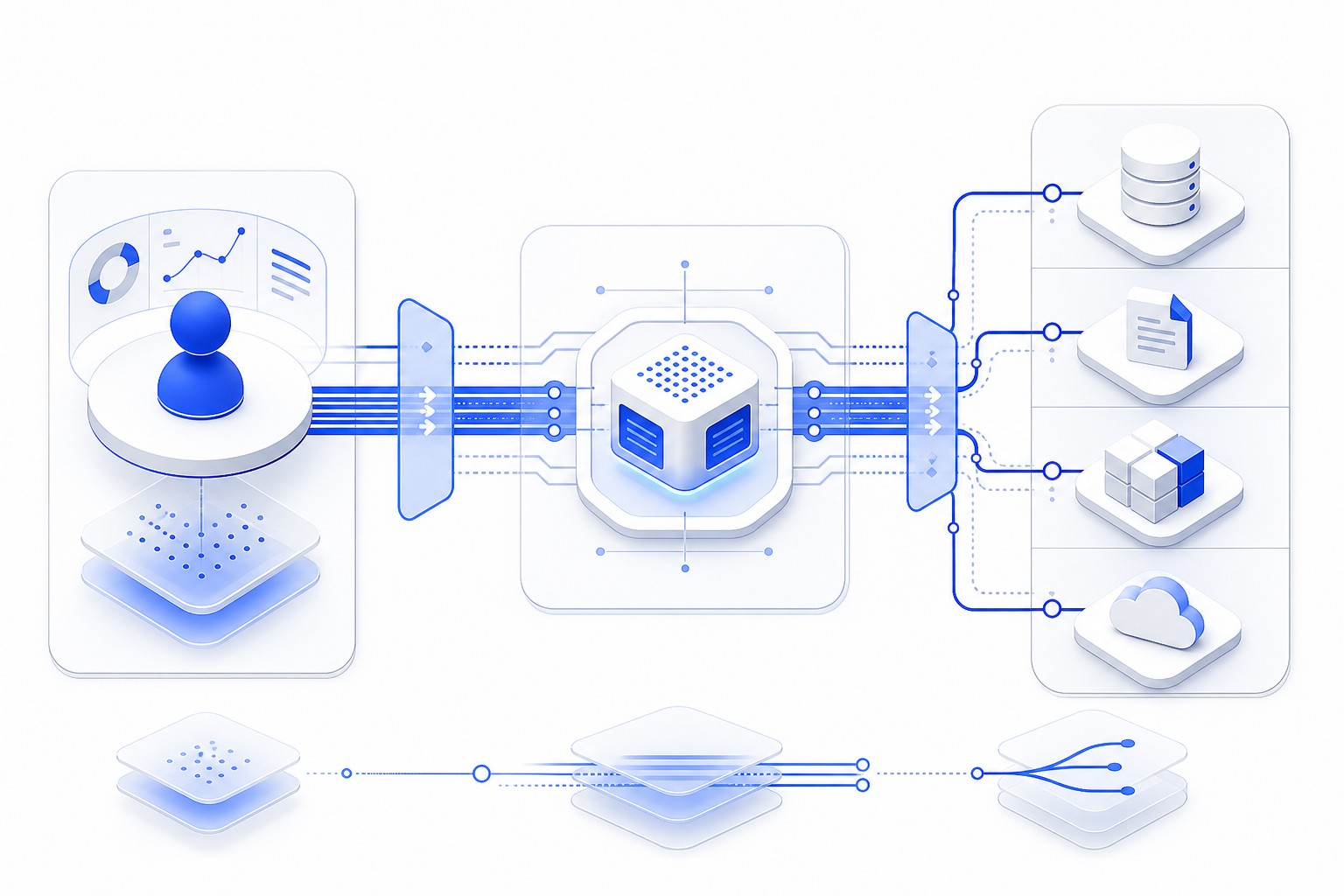
THE DECISION PATH
Agentic Enterprise / operating model- 01Workflow
- 02Context
- 03Control
- 04Evidence
# Today's Insight — Deploying MCP-backed Agentforce: a 12-week pilot decision for enterprise leaders
Enterprises that want to move from proof-of-concept agent experiments to dependable, auditable agent deployments face two practical gaps: a robust protocol for exchanging contextual data between systems and a productized orchestration layer that brings humans and agents together. The Model Context Protocol (MCP) provides a standardized JSON-RPC data layer and transport choices for context exchange. Salesforce’s Agentforce product line furnishes the platform features (Agentforce Builder, AgentExchange, Dev Tools, and data/security controls) to host and operate those agents inside Customer 360.
This Insight makes a single, concrete decision recommendation: launch a focused 12-week MCP-backed Agentforce pilot that proves secure context exchange, tool discovery, and governed agent operations for one high-value business workflow (for example: customer service triage, financial case intake, or claims intake). The pilot should demonstrate end-to-end connectivity, governance controls, and measurable operational improvement before scaling.
Why now (concise) - MCP provides a clear architecture for discovery, tool execution, resources, and notifications that are essential to enterprise-grade agent behavior — including guidance on transport choices (stdio for local, Streamable HTTP for remote) and authentication patterns. This reduces integration risk for agent workloads. - Salesforce Agentforce is explicitly positioned to combine humans and AI agents across Sales, Service, and industry clouds, and its product pages list developer and operational tooling (Agentforce Builder, Agentforce Dev Tools, AgentExchange) and platform controls for data security and privacy.
Together, these sources make a practical, low-friction path: use MCP as the context-exchange protocol and Agentforce as the orchestration and governance surface inside the CRM.
The recommended decision (one line) Authorize a 12-week enterprise pilot that integrates an MCP server with Salesforce Agentforce for one prioritized workflow, with go/no-go evaluation at week 12 based on connectivity, security posture, and operational KPIs.
Pilot scope and measurable gates - Scope: one high-value workflow (e.g., customer-service triage) implemented as an Agentforce agent that uses an MCP server to discover tools/resources and exchange contextual data with enterprise systems. - Duration: 12 weeks (3 phases: design & infra week 0–2; implementation & test week 3–8; live trial & validation week 9–12). - Gates: (a) secure connectivity and discovery working end-to-end; (b) agent can execute at least two enterprise tools via MCP; (c) audit/logging and role-based access controls enabled; (d) measurable operational impact (reduced time-to-resolve, reduced escalation rate, or throughput improvement) agreed in advance.
Minimal architecture (what to build) 1. MCP server instance (can be local for development or remote using Streamable HTTP for production-like testing). MCP’s architecture doc explains the data layer primitives (tools, resources, prompts, notifications) and transport options — choose Streamable HTTP for remote, multi-client testing and OAuth-based auth for production tokens. 2. Agentforce application and Agentforce Builder project inside your Salesforce org. Use Agentforce Dev Tools and AgentExchange to register and manage agents and any partner tools. 3. A narrow set of enterprise tools surfaced via MCP (e.g., a CRM lookup, a ticketing action, a knowledge retrieval endpoint) so the agent can demonstrate discovery and controlled execution. 4. Logging, notifications, and audit records to live in Customer 360 and your security/observability tooling.
Implementation choices explained (based on the dossier) - Use MCP discovery and tool primitives to let Agentforce-hosted agents learn available enterprise tools: MCP’s data layer formalizes discovery, tools, and resources so agents make reproducible decisions about what they can call. - Choose transport based on deployment topology: MCP documents stdio transport for tightly coupled local setups and Streamable HTTP for remote servers; for enterprise pilots, Streamable HTTP enables standard authentication (OAuth) and aligns with cloud deployments. - Keep the first pilot workflow deliberately small: fewer tools means you can validate tool execution semantics, notification handling, and failure modes before scaling.
Risk and mitigations (practical) - Data leakage: enforce Salesforce platform Data Security & Privacy controls, and ensure MCP transport is secured with OAuth/bearer tokens and TLS. - Unexpected tool execution: use MCP’s tool discovery semantics to allow explicit allowlists; run agents first in shadow mode where actions are suggested but not executed. - Observability gaps: instrument every MCP request/response and Agentforce action into centralized logs and add notification subscriptions for long-running operations.
Headless 360 operating-model point of view Headless 360 recommends an operations-led pilot structure: pair a product owner from the business with an engineering pod that contains a Salesforce Admin, one integration engineer familiar with MCP/HTTP transports, and a security engineer. Run the pilot as product-increment sprints with three deliverables: (1) a reproducible infra manifest for the MCP server and Agentforce configuration, (2) documented runbooks for incident and permission management, and (3) an audit pack proving data lineage and access. Our operating model treats MCP as the canonical context bus and Agentforce as the human+agent operating plane — this separation lets security and compliance own the context layer while the business owns agent behavior and outcomes.
Concrete next steps (first 30 days) 1. Approve pilot charter and select the prioritized workflow. 2. Assign the pod and secure a sandbox Salesforce org with Agentforce features enabled. 3. Stand up an MCP reference server (Streamable HTTP) and configure OAuth credentials for the Agentforce pilot. 4. Define three KPIs (connectivity, action success rate, operational impact) and the audit requirements.
Concise FAQ Q: What is MCP and why do we need it? A: MCP is a protocol for context exchange between AI application hosts and servers — it standardizes discovery, tools, resources, and notifications so agents can safely interact with enterprise systems. (See MCP architecture doc.)
Q: Can Agentforce talk to MCP out of the box?
A: Salesforce publishes an Agentforce MCP support surface and developer tooling (Agentforce Dev Tools, AgentExchange) that make it practical to integrate guided agent behavior with enterprise controls. The pilot will validate specific connectors for your environment.
Q: Which transport should we use?
A: For production-like, multi-client setups use Streamable HTTP (supports OAuth and SSE for streaming). For local development, stdio is fastest. MCP documentation explains both options.
Q: What is the minimum security requirement?
A: Mutual TLS/TLS and OAuth bearer tokens for the MCP Streamable HTTP transport, plus standard Salesforce platform data controls and logging. MCP recommends OAuth for token issuance.
Quick reading and References - Salesforce — Agentforce MCP Support: https://www.salesforce.com/agentforce/mcp-support/ - Model Context Protocol — Architecture overview: https://modelcontextprotocol.io/docs/learn/architecture
(End of Insight)
HEADLESS 360 OPPORTUNITY SESSION
Bring one workflow.
Leave with a clearer move.
KEEP READING


