Agentic Enterprise / HEADLESS 360
Agentforce + MCP: A Practical Playbook for Enterprise Agent Interoperability
A practical 90‑day playbook for adopting Agentforce with the Model Context Protocol (MCP), focused on secure registry, governance, and an actionable pilot to enable interoperable enterprise agents.
THE DECISION PATH
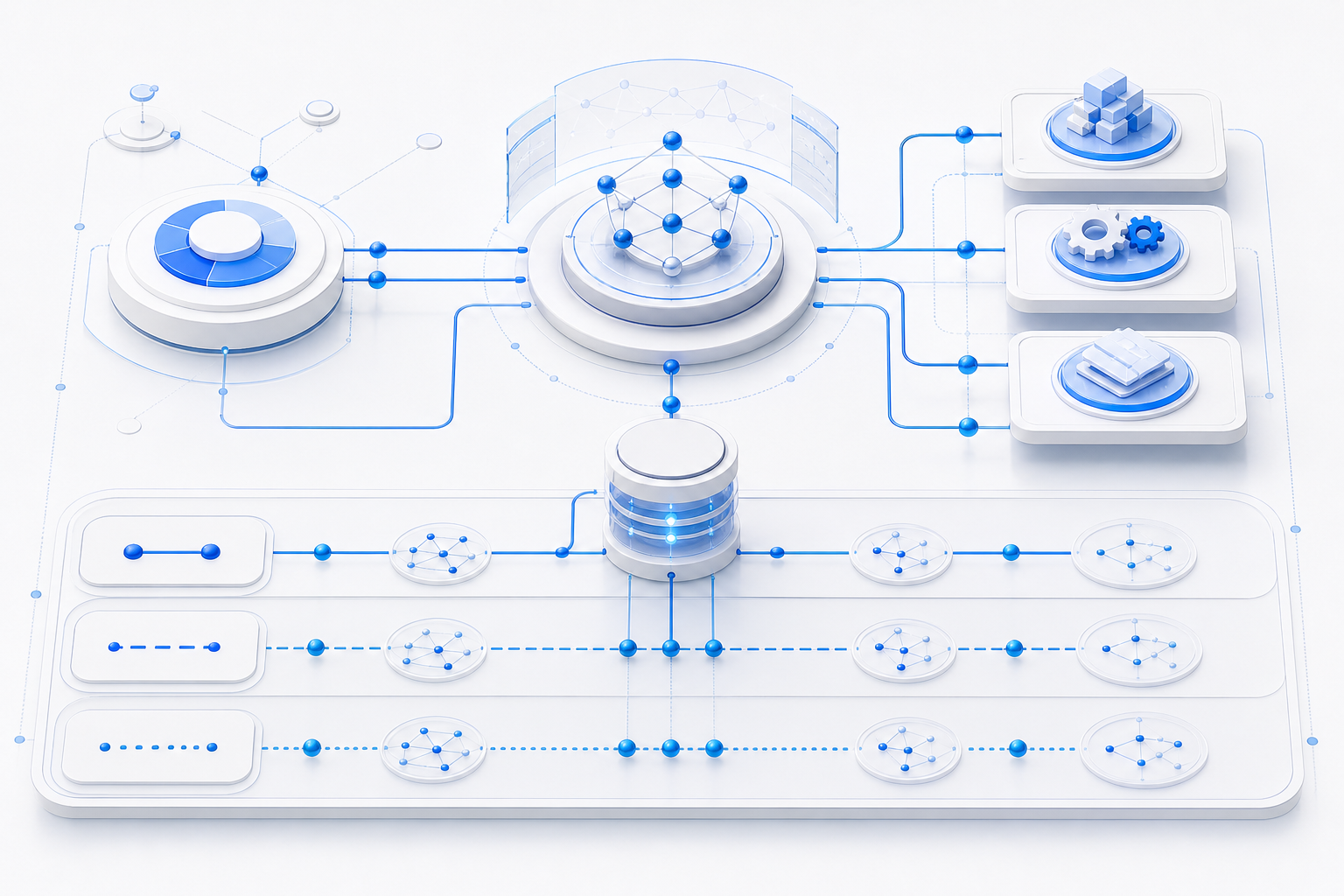
Agentic Enterprise / operating model- 01Workflow
- 02Context
- 03Control
- 04Evidence
# Agentforce + MCP: A Practical Playbook for Building an Enterprise Agent Gateway
Enterprises are shifting from isolated LLM pilots to agentic systems that must reliably call tools, fetch data, and take actions across heterogeneous systems. Salesforce’s Agentforce positions an "AI agent gateway" that uses the open Model Context Protocol (MCP) to connect agents to third‑party tools, resources, and prompt templates — effectively a vendor‑grade bridge for orchestrating digital labor across the business. (salesforce.com)
Why this decision matters now
MCP is an open, JSON‑RPC based protocol that standardizes discovery, capabilities, and execution primitives (tools, resources, prompts) between MCP hosts and MCP servers. The transport layer supports both local (stdio) and remote (Streamable HTTP) modes, with recommended authentication such as OAuth. That makes MCP suitable for enterprises that need both low‑latency local integrations and centrally managed, remote service integrations. (modelcontextprotocol.io)
Salesforce frames Agentforce as an enterprise‑grade MCP client and gateway: a centralized MCP server registry, granular governance controls, and optimized resource management (rate limiting, authentication, policy enforcement) so that agents can access only authorized capabilities. Agentforce also points to AgentExchange partners and no‑code AgentBuilder paths to discover and deploy MCP servers. (salesforce.com)
This combination matters for a concrete decision: if you are choosing how to surface agent capabilities to frontline teams (service, sales, operations), adopt an MCP‑centric gateway approach now — not as an abstract architecture exercise, but as a prioritized program to unlock trapped agents, unify data sources, and control agent actions enterprise‑wide. (salesforce.com)
Headless 360 operating‑model point of view
Headless 360 recommends treating an MCP gateway as a cross‑functional product with three accountable roles: (1) Platform Owner (security, registry, runtime limits), (2) Service Owners (MCP server providers for domain data/tools), and (3) Experience Owners (agent designers and workflow owners who compose prompts and actions). The platform is the system‑of‑record for allowed MCP servers, and every service integration must be registered and certified before an agent can discover it. This productized approach reduces bespoke integration drift and keeps governance attached to the runtime. (salesforce.com)
A 90‑day pilot playbook (concrete steps)
Phase 1 — Week 1–3: Inventory & register
- Inventory 6–10 candidate agent scenarios (start with customer service and one back‑office process).
- Identify the data and tool endpoints each agent needs and classify them as Resources, Tools, or Prompts under MCP primitives. (modelcontextprotocol.io)
- Register the chosen MCP servers in a central registry (Agentforce’s centralized MCP Server Registry) and define authentication modes (OAuth preferred). (salesforce.com)
Phase 2 — Week 4–8: Secure connectivity & governance
- Configure Agentforce controls: set granular access policies for agent groups, enable rate limiting and telemetry for the MCP endpoints, and enforce per‑request metadata for stateless discovery. (salesforce.com)
- Establish a lightweight certification checklist for MCP server partners discovered through AgentExchange and document acceptable prompts and tool actions.
Phase 3 — Week 9–12: Pilot & iterate
- Launch a narrow pilot (single queue or sales team) using AgentBuilder to compose agent tasks that use at least one external MCP server for a Resource and one for a Tool. Use telemetry to observe tool calls, errors, and latencies.
- Iterate on prompt templates (prompts are first‑class MCP primitives) to reduce ambiguous calls and add explicit safety checks for destructive actions. (modelcontextprotocol.io)
Engineering checklist (what to implement)
- Implement MCP discovery and server/discover flows for capability negotiation. (modelcontextprotocol.io)
- Support the two transport modes where appropriate: stdio for local, Streamable HTTP for remote services; document authentication (OAuth, API keys) per server. (modelcontextprotocol.io)
- Central registry that records allowed MCP servers, their capabilities, and policy attachments (rate limits, who can discover/invoke). (salesforce.com)
- Operational telemetry for tool execution, resource fetches, and prompt usage; surface those signals to Platform and Experience owners.
Risk controls and governance (practical guardrails)
- Enforce per‑agent capability least privilege through the registry and Agentforce’s governance model; require justification for enabling tools that perform write or destructive actions. (salesforce.com)
- Rate limit and quota MCP server calls to prevent cascading failures; make limits configurable per‑service from the registry. (salesforce.com)
- Use prompt templates (MCP Prompts) that include instruction‑level safety constraints and business policy snippets to reduce hallucination and unsafe actions. (modelcontextprotocol.io)
Operational metrics to track (qualitative to quantitative)
Track discovery success, tool execution success rate, average tool latency, policy violations blocked, and human escalation frequency. These are direct indicators of whether your MCP gateway is enabling reliable, safe agent behavior. (Instrument these through Agentforce telemetry and your APM/observability stack.) (salesforce.com)
When to choose an alternative
- If your environment cannot support secure token‑based authentication for remote services, favor local stdio MCP adapters initially, or postpone external MCP consumption until secure auth is available. (modelcontextprotocol.io)
- If you have a small, simple set of internal services and no plans for external partner distribution, a bespoke integration may be faster short term — but plan a migration path to MCP for scale and multi‑partner scenarios. (modelcontextprotocol.io)
Concise FAQ
Q: What does MCP standardize?
A: MCP standardizes discovery, primitives (Tools, Resources, Prompts), and a JSON‑RPC‑based data layer plus a transport layer (stdio, Streamable HTTP) so clients and servers can interoperate predictably. (modelcontextprotocol.io)
Q: How does Agentforce use MCP?
A: Agentforce acts as an enterprise MCP host/gateway with a centralized MCP server registry, governance controls (auth, access, rate limiting), and discovery paths through AgentExchange and AgentBuilder. (salesforce.com)
Q: Where do I start for compliance and security?
A: Register MCP servers through the Agentforce registry, attach granular access controls, require OAuth or equivalent for remote servers, and enforce rate limits and policy checks at the gateway. (salesforce.com)
Decision for this week
Authorize a scoped 90‑day pilot to integrate two MCP servers (one internal resource server and one partner tool server) with Agentforce, with Platform and Experience owners named and a registry entry created for each server. This produces a measurable, governed capability for agents to interoperate beyond siloed integrations and positions the business to scale agentic automation safely. (salesforce.com)
References
- https://www.salesforce.com/agentforce/mcp-support/
- https://modelcontextprotocol.io/docs/learn/architecture
HEADLESS 360 OPPORTUNITY SESSION
Bring one workflow.
Leave with a clearer move.
KEEP READING