
Agentic Enterprise / HEADLESS 360
Operational Decision: Run a Headless 360 + MCP Pilot to Deliver Governed Context to Agentic AI
A decision-focused playbook for running a Headless 360 + MCP pilot that turns enterprise data into governed, discoverable context for agentic AI.
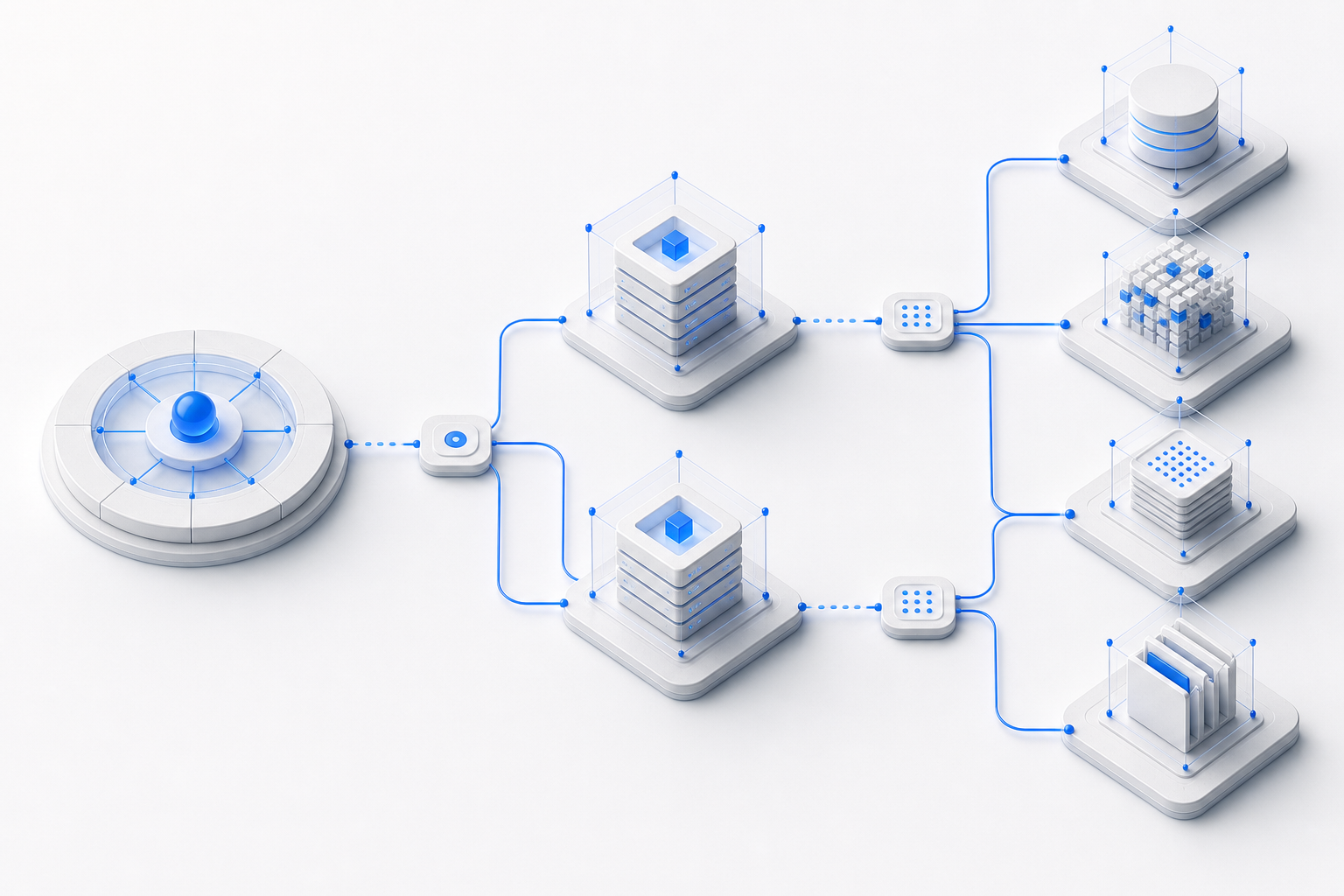
THE DECISION PATH
Agentic Enterprise / operating model- 01Workflow
- 02Context
- 03Control
- 04Evidence
# Insight — September 5, 2026
Executive summary
Salesforce’s Agentforce portfolio and the Model Context Protocol (MCP) architecture together describe a practical path for enterprises that want to operationalize agentic AI without rebuilding every integration: run Headless 360 as the orchestration layer, expose context through MCP-compatible servers, and treat tool discovery and transport as first-class design decisions. This Insight pulls directly from Salesforce’s Agentforce/Headless 360 materials and the MCP architecture specification to give an implementation-focused decision for IT and product leaders: launch a focused, time-boxed pilot that pairs a Headless 360 Agent environment with an MCP server (local or remote) and measure three operational KPIs (context latency, task handoffs, and governance traceability) before scaling.
Why this combination matters now
Salesforce’s Agentforce messaging positions “Humans with Agents” and Headless 360 as the platform construct for building agentic work — not just standalone chatbots but instrumented, composable agents that operate across systems. The MCP documentation defines a lightweight, transport-agnostic protocol for delivering context and tools to LLM-based clients (JSON-RPC 2.0, discovery, tools/resources/prompts, and two supported transports). Together they remove the classic blocking question for enterprise AI: how do agents access authoritative, up-to-date operational context and do so securely at scale?
Key architectural realities from the primary sources you should accept as given:
- MCP separates the data layer (JSON-RPC primitives: discovery, tools, resources, notifications) from the transport layer (stdio or Streamable HTTP). This is a concise contract you can implement or require of partners. (Model Context Protocol documentation.)
- Headless 360 (within Agentforce materials) is presented as the platform layer that assembles Agentforce components — builders, voice, dev tools, and operations — and connects them to enterprise systems and governance controls.
Concrete decision (what to do this quarter)
Design and run a 6–8 week pilot with the following constraints and success gates:
- Scope: 1 high-value workflow (e.g., customer-support escalation, field-service dispatch, or a finance approvals path) where agents must consult multiple systems of record.
- Architecture: Deploy a minimal MCP server that exposes the workflow’s authoritative context (e.g., tickets, asset records, approvals) and supports the MCP discovery and tool execution primitives. Connect that MCP server to a Headless 360 Agent environment using Agentforce integration points.
- Transport choice: Start with Streamable HTTP (remote MCP server) if you must centralize tokens and observability; choose stdio (local MCP server) if you need local, low-latency access inside a controlled execution environment. MCP’s documentation explicitly makes both transports available — pick the one that matches your security and latency profile. (Model Context Protocol documentation.)
- Governance and telemetry: Ensure the pilot captures notification events, tool execution traces, and discovery exchanges so you can answer: what context was requested, which tools were invoked, and what user approvals occurred? Headless 360 materials highlight platform governance and operations as core selling points.
- Success metrics (decision-gating):
- - Context latency: median time from agent request to context delivery under realistic load. Target depends on workflow; baseline and target are yours to set.
- - Handoff clarity: fraction of agent actions that include a clear tool-execution trace visible in logs/console.
- - Governance traceability: ability to reproduce the discovery+execution chain for at least one audited ticket.
If the pilot meets defined gates, expand to 3–5 additional workflows and shift MCP servers to a scaled deployment model (regional or federated) consistent with your data residency and token strategy.
Architecture implications and trade-offs
- Local vs. remote MCP servers: stdio transport (local) reduces network surface area and latency but requires deployment and lifecycle management on endpoints. Streamable HTTP (remote) centralizes auth and observability at the cost of network dependency. MCP’s transport-layer design intentionally abstracts this trade-off. (Model Context Protocol documentation.)
- Discovery as a control point: MCP discovery lets clients enumerate available tools and versions. Treat discovery as your security and compatibility gate — only expose a minimal, versioned toolset to production agent clients.
- Headless orchestration: Headless 360 sits above context and tool layers; design your Headless 360 flows to degrade gracefully if a tool is unavailable — e.g., show a human fallback or cached context snapshot.
Headless 360 operating-model point of view
Headless 360 is the enterprise operating model that treats agents as first-class workers whose inputs and capabilities are governed, observable, and composable. Operationalize this by:
- Creating a “context contract” team responsible for MCP server schemas, tool definitions, and discovery policies.
- Capturing runbooks as machine-readable prompts and resources exposed through MCP so agents execute against the same audited sources humans do.
- Applying a staged rollout: developer sandbox → controlled pilot → production ramp with telemetry gates.
This shifts responsibility from siloed app owners to a cross-functional platform team that manages context, tools, and governance while product teams own the workflow outcomes.
Implementation checklist (tactical)
- Select the workflow and identify systems of record.
- Build or configure a reference MCP server that exposes required resources and tools using the MCP data-layer primitives (discovery, tools, resources, notifications).
- Stand up a Headless 360 Agent environment and wire Agentforce connectors to the MCP endpoints.
- Define logging, notification, and audit collection; validate you can replay a discovery → tool-execution chain for one example case.
- Run user acceptance tests with agents and at least one human fallback scenario.
Concise FAQ
Q: Do I need MCP to use Headless 360?
A: No, but MCP is a protocol designed to standardize how context and tools are exposed to agent clients. Using MCP reduces bespoke integration effort and makes tool discovery and transport explicit.
Q: Which transport should we choose first?
A: If latency and local control matter, start with stdio (local). If centralized identity, observability, and multi-tenant hosting matter, start with Streamable HTTP. The MCP spec documents both options.
Q: What is the single most important governance control?
A: Control discovery: only expose production-ready tools and versions to production agent clients and require explicit vetting for any new tool in discovery.
References
- https://www.salesforce.com/news/stories/
- https://modelcontextprotocol.io/docs/learn/architecture
HEADLESS 360 OPPORTUNITY SESSION
Bring one workflow.
Leave with a clearer move.
KEEP READING


