
Agentic Enterprise / HEADLESS 360
Headless Agentforce: A 90-Day MCP Pilot to De-Risk Agent Scale
A practical, 90-day pilot decision for CIOs: deploy Salesforce Agentforce with Model Context Protocol (MCP) to implement headless, composable agents. Includes architecture guidance, a pilot plan, KPIs, and an explicit Headless 360 operating-model POV.
THE DECISION PATH
Agentic Enterprise / operating model- 01Workflow
- 02Context
- 03Control
- 04Evidence
# Headless Agentforce: A Practical Decision Guide for Enterprise Leaders
Enterprises that want to scale AI-driven operations face an integration choice: bolt agents into existing UIs or decouple them behind well-defined context and transport layers. Salesforce Agentforce plus Model Context Protocol (MCP) provides a clear pattern for the latter — a headless, composable model that treats agents as services rather than monolithic UI features. This Insight gives a concrete, actionable decision for CIOs and line-of-business leaders: run a 90-day headless Agentforce pilot using MCP as the integration backbone.
Why this decision matters now
Salesforce positions Agentforce as a platform-family (Builder, Voice, Dev Tools, AgentExchange, Operations) that connects humans and AI agents across the CRM and business systems. The Model Context Protocol gives an implementation-ready architecture for exposing context, tools, and prompts to agent hosts over standardized transports and primitives. Combining these two aligns product capability with a technical integration standard — enabling rapid, repeatable deployments without reworking every consumer UI.
The concrete choice to pilot a headless Agentforce on MCP reduces coupling, lowers downstream integration effort, and creates a reusable context layer for future agents, analytics, and platform services.
The decision (one sentence)
Authorize a 90-day pilot to deploy Agentforce agents in a headless architecture using MCP for context exchange and Streamable HTTP or Stdio transport, with the goal of proving a deployable pattern for 3 enterprise workflows.
What you’ll prove in the pilot (success criteria)
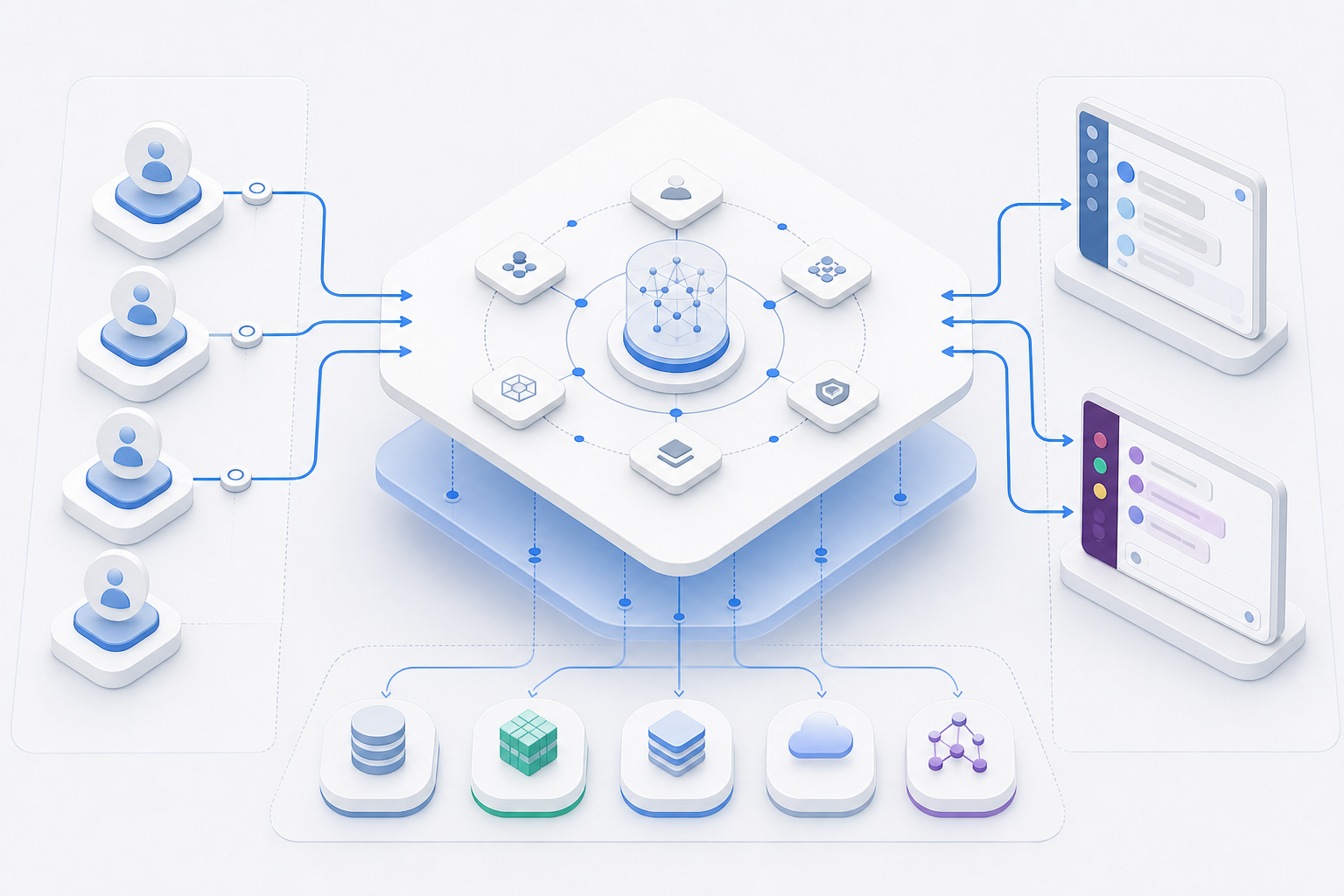
- A single MCP-backed context service delivers the required customer and operational context to Agentforce agents across two different consumers (for example, a contact center application and a Slack-based workflow).
- Agents can execute at least five distinct tool actions (data reads, updates, and one external action like ticket creation) through authorized MCP tool primitives without ad‑hoc adapters.
- Observability: end-to-end tracing from context change to agent action and a governance review demonstrating role-based access and token-based authentication work as intended.
Architectural guidance (concrete)
- Core pattern — headless agents behind MCP
- - Treat Agentforce components as MCP clients/servers: an MCP server exposes resources (customer records, conversation history, tools) and Agentforce agents consume that context through MCP clients. Use MCP's data-layer primitives (tools, resources, prompts, notifications) to model each integration point.
- Transport choice
- - For local runtime or on‑prem components where latency and security are prioritized, use STDIO transport. For cloud-hosted integrations across multiple services, use Streamable HTTP with Server-Sent Events for streaming updates. MCP explicitly supports both, and each has tradeoffs: STDIO favors single-host performance; Streamable HTTP favors scale and centralized auth management.
- Security and auth
- - Follow MCP guidance to use bearer tokens/OAuth for Streamable HTTP transport. Gate tool execution with the same RBAC and consent model you apply to any actuator that modifies customer data.
- Observability and governance
- - Emit structured notifications and progress events from MCP for every context exchange and tool execution. Capture audit trails at the MCP transport boundary for compliance reviews.
- Developer ergonomics
- - Model common agent actions as MCP tools and expose those tools once. Teams integrating new consumers (web UI, Slack, voice) should bind to the same MCP primitives rather than building custom connectors per consumer.
Pilot plan (90 days)
- Week 0–2: Align (stakeholders, three target workflows, success metrics, compliance OK).
- Week 3–6: Build MCP server prototypes that surface the required resources and tools; register Agentforce agents as MCP clients; implement auth and logging.
- Week 7–10: Integrate two consumer channels (one UI, one collaboration channel) and validate tool calls and prompts end to end.
- Week 11–12: Run controlled business traffic, collect metrics, conduct security and compliance review, and decide go/no-go for broader rollout.
Staffing: a small cross-functional squad (platform engineer, integration developer, security architect, product owner, and one Agentforce SME). Keep scope to three high-value workflows to ensure momentum.
Risks and mitigations
- Latency or transport mismatch — benchmark both STDIO and Streamable HTTP in your environment early. Use STDIO for single-host agent runtimes where you control the process lifecycle.
- Overexposed tools — model least privilege in your MCP tool definitions; require explicit enablement for write actions.
- Governance drift — enforce token lifetimes, scope-limited credentials, and a single owner for the MCP tool registry.
Headless 360 operating-model point of view
Headless 360 recommends decoupling agent capabilities from consumer interfaces by design. The operating model centers a shared context plane (MCP) that serves authorized clients and a catalog of well-scoped tools. This reduces duplicated integration effort, shortens time-to-value for new agent deployments, and creates a single place to apply governance, telemetry, and versioning. For organizations adopting Salesforce Agentforce, use the Agentforce Dev Tools and AgentExchange to package agent logic and MCP to publish the context those agents need. The result: faster experimentation, safer production rollouts, and a repeatable path from pilot to enterprise scale.
KPIs to track
- Time to first successful tool execution from a new consumer (goal: measured in days, not weeks)
- Number of adapter-free integrations (how many consumers reuse the same MCP tools)
- Incident rate for unauthorized tool calls (target: zero for pilot)
- Mean end-to-end latency for agent actions from context update to tool completion
Quick budget considerations
Keep the pilot constrained: expect most cost to be engineering time for MCP server and Agentforce agent wiring. Reuse existing platform logging and authentication services. Avoid heavy UI investments during the pilot — favor lightweight consumer prototypes.
FAQ (concise)
Q: Why not integrate Agentforce directly into each UI?
A: Direct integration creates duplicated adapters and governance gaps. A headless MCP approach centralizes context and tools so new consumers can onboard faster and more safely.
Q: Is MCP production-ready?
A: MCP defines a JSON-RPC-based data layer and supports both STDIO and Streamable HTTP transports; design intent and primitives (tools, resources, prompts, notifications) are specified for production integration patterns.
Q: Which transport should we pick first?
A: If your agent runtime will live on the same host as the MCP server, start with STDIO for low-latency tests. If your architecture is cloud-distributed, start with Streamable HTTP to leverage standard auth and scaling.
Q: Will this lock us into Salesforce?
A: Using MCP for the context plane reduces lock-in because MCP is a protocol for context exchange; Agentforce becomes a consumer of that layer. You can evolve agents or replace providers while keeping the same context contracts.
References
- Agentforce MCP Support — Salesforce: https://www.salesforce.com/agentforce/mcp-support/
- Model Context Protocol — Architecture overview: https://modelcontextprotocol.io/docs/learn/architecture
HEADLESS 360 OPPORTUNITY SESSION
Bring one workflow.
Leave with a clearer move.
KEEP READING


