
Agentic Enterprise / HEADLESS 360
Demand Interoperable Context: How to Align Salesforce Agentforce Pilots with Model Context Protocol Principles
An actionable 90-day decision playbook for enterprise leaders: require MCP-style context interoperability when piloting Salesforce Agentforce agents to keep data and tool execution secure, auditable, and scalable.
THE DECISION PATH
Agentic Enterprise / operating model- 01Workflow
- 02Context
- 03Control
- 04Evidence
# Today’s Insight — October 6, 2026
Executive summary
Salesforce Agentforce presents a practical, productized path to run humans and AI agents together across sales, service, and operations. Meanwhile, the Model Context Protocol (MCP) describes an explicit, production-ready architecture for exchanging context and tools between AI hosts and context servers. For enterprise leaders evaluating agent strategies today (October 6, 2026), the immediate decision is not whether to pilot agents — it’s how to require an interoperable context layer so agents can act safely, discover tools, and access sensitive data without centralized model re-training.
This Insight maps Agentforce capabilities to MCP concepts and gives a four-step decision playbook you can operationalize in the next 90 days.
Why this matters now
- Agent deployments scale complexity: agents need access to data, tools, and live signals while preserving security and auditability. Agentforce organizes agent products (Builder, Voice, Dev Tools, AgentExchange, Agentforce Operations) to solve that at the application layer. (Source: Salesforce Agentforce product overview.)
- MCP provides a production protocol for context exchange: a clear separation of concerns into a data layer (JSON-RPC primitives for tools, resources, prompts, notifications) and a transport layer (stdio and streamable HTTP with OAuth and bearer tokens) so AI hosts can safely consume context without centralizing it. (Source: MCP Architecture documentation, version noted below.)
Taken together, the practical choice for an enterprise is to demand MCP-style context governance when selecting agent platforms or to require adapters that offer the same guarantees (discovery, versioning, constrained tool execution, and transport controls). This preserves control over PII, compliance, and latency-sensitive systems while enabling rapid agent innovation.
Concrete decision for the next 90 days
Mandate MCP-style context interoperability for any agent pilot or procurement RFP. Specifically, make the following requirements non-optional in you pilot procurement and architecture signoff:
- Tool and resource discovery: the platform must support programmatic discovery of available tools and resources, and a developer / ops surface for registering and de-registering those capabilities in runtime.
- Local or federated context servers: sensitive data must be exposed to agents via contextual adapters (local or in-tenant) rather than moving data wholesale into third-party models.
- Transport controls and auth: the platform must support auditable authentication and support secure transports (tokenized HTTP or local stdio-like connectors) and clear token lifecycle management.
- Notifications and change subscriptions: the system must support evented updates so agents can subscribe to changes without polling or opaque caches.
Why these four? They match the core MCP primitives and address the three most common enterprise risks — data leakage, silent tool execution, and brittle integrations — while keeping the developer experience friendly for Agentforce Builder and AgentExchange-style ecosystems.
How Agentforce maps to MCP concepts (practical alignment)
- Agentforce Builder & Dev Tools -> MCP client/host surface: these are where agents are composed and orchestrated; they should be able to instantiate MCP clients that connect to context servers.
- AgentExchange -> Tool registry: AgentExchange-style marketplaces should expose not only artifacts but discovery metadata (capabilities, inputs/outputs, auth scopes) so runtime can surface safe tool execution.
- Agentforce Operations -> Observability & governance: combine runtime notifications with audit trails and change subscriptions that align to MCP notifications.
Note: Salesforce Agentforce provides the product surfaces for building and operating agents; MCP is an explicit architecture to make those agent surfaces safer and composable across internal and third-party context servers. Demand adapters or integration patterns that bridge the two rather than assuming a vendor lock-in.
Headless 360 operating-model point of view
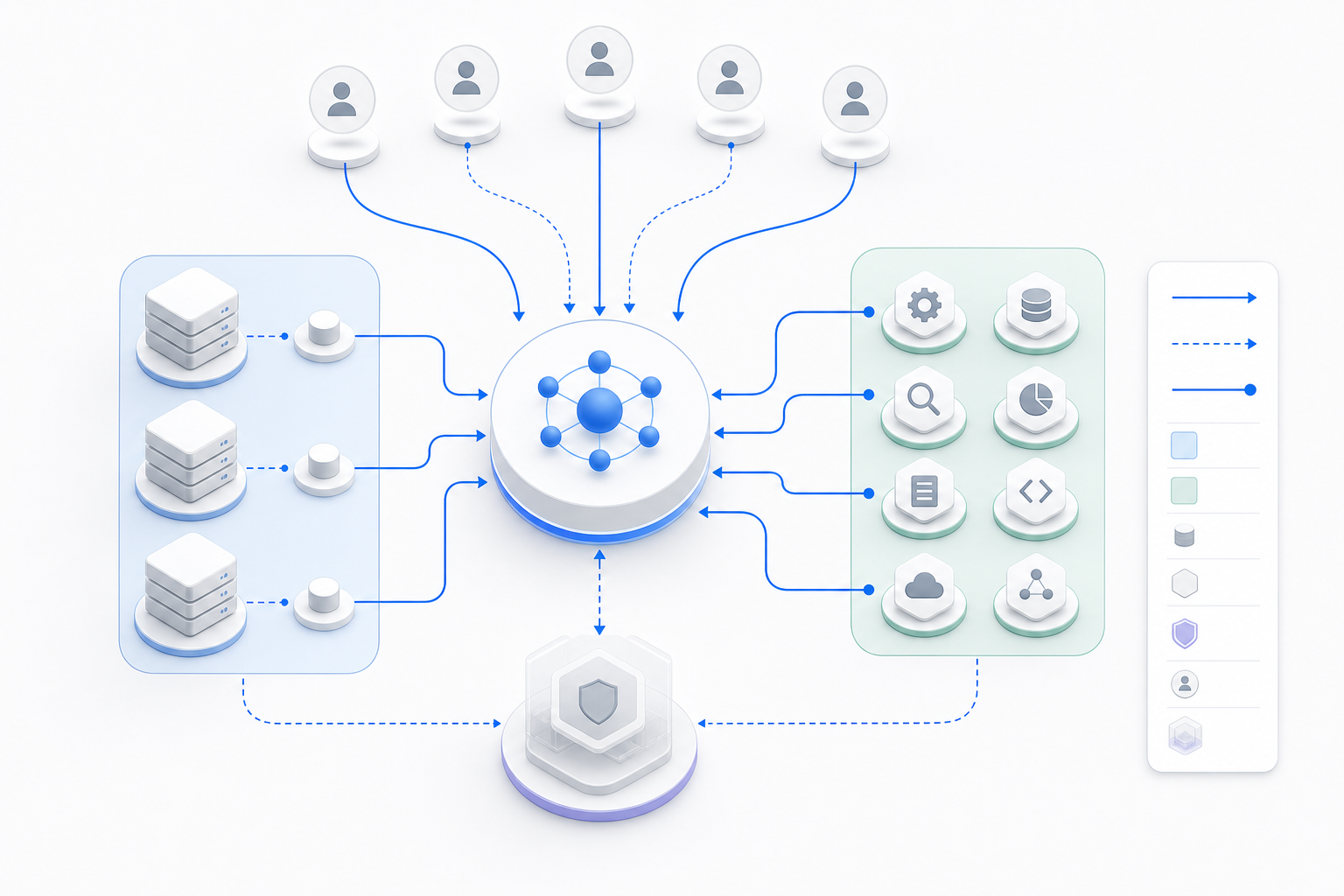
Headless 360 recommends a hybrid control model: deploy Agentforce (or any enterprise agent platform) as the application layer while building or adopting MCP-compatible context servers for domain data and tools. The operating model has three pillars:
- Signal Cartography first: map data and tools to signals and required execution scopes. Don’t guess which systems an agent needs; catalogue them with the same rigor as identity providers.
- Localize context: keep high-sensitivity context behind tenant-controlled MCP servers (stdio or private HTTP transports) and require runtime discovery and scoped tokens for each agent action.
- Productize governance: create a single Platform Product team that owns the MCP adapter layer, the AgentExchange onboarding checklist, and runtime observability (notifications, progress, audit logs). This team supplies certified connectors for lines of business to reuse.
This operating model reduces vendor lock-in, shortens compliance review cycles, and lets lines of business iterate safely with Agentforce Builder while your platform team maintains controls.
Four-step implementation playbook (90-day plan)
- Assess (Weeks 1–2): inventory agent use cases and map required signals (data, tools, webhook endpoints). Produce a Signal Cartography map cataloging sensitivity and latency needs.
- Pilot architecture (Weeks 3–6): select one pilot (e.g., service automation) and require the vendor or internal team to demonstrate a context adapter pattern: tool discovery, scoped auth, and subscription notifications.
- Build the MCP-compatible adapter (Weeks 7–10): implement a small server that exposes discovery, execution, and notifications (JSON-RPC primitives or equivalent). Use local transport for high-sensitivity data during the pilot.
- Operate and measure (Weeks 11–13): validate audit trails, mean time to revoke tokens, and developer onboarding time for new tools. Gate wider rollout on meeting security and observability thresholds.
Concise FAQ
Q: Must we adopt MCP itself?
A: Not necessarily. The decision is about adopting MCP-style guarantees (discovery, scoped auth, transport choices, notifications). If your vendor offers these primitives, you can require equivalent SLAs and behaviors.
Q: Does this require re-architecting existing CRM systems?
A: No — start with a single pilot and expose only the minimal tools and resources through an adapter. The goal is incremental adoption, not a rip-and-replace.
Q: Will this slow innovation?
A: Short-term friction increases (governance and adapter work), but it prevents rework and costly data migration later. The platform team should provide certified connectors to speed up line-of-business projects.
Q: Who should own the MCP-compatible adapter?
A: A central Platform Product team (security, APIs, and integrations) that works with lines of business and vendor partners to certify connectors.
References
- Salesforce Agentforce product overview and capabilities — https://www.salesforce.com/agentforce/mcp-support/
- Model Context Protocol — Architecture overview (MCP v2026-07-28) — https://modelcontextprotocol.io/docs/learn/architecture
HEADLESS 360 OPPORTUNITY SESSION
Bring one workflow.
Leave with a clearer move.
KEEP READING


