Agentic Enterprise / HEADLESS 360
Pilot decision: Run Agentforce with an MCP context server — 90‑day plan for CX and sales
A decision-focused 90-day pilot plan to pair Salesforce Agentforce with an MCP-compatible context server. Practical architecture checklist, organizational roles, risk mitigations, and Headless 360 operating-model guidance for enterprise leaders.
THE DECISION PATH
Agentic Enterprise / operating model- 01Workflow
- 02Context
- 03Control
- 04Evidence
# Executive summary
Salesforce’s Agentforce product line and the Model Context Protocol (MCP) describe two complementary pieces of an enterprise agent strategy: a platform for orchestrating human-plus-agent workflows (Agentforce) and an open protocol for serving context and tools to AI applications (MCP). Together they enable a concrete pilot decision every enterprise IT and CX leader should evaluate this quarter: run a controlled Agentforce pilot that uses an MCP-compatible context server to deliver real-time, auditable context to customer-facing agents and automated assistants.
This Insight walks through a single, concrete decision — "launch a 90-day Agentforce + MCP pilot for contact-center and sales-assist workflows" — and gives an operational roadmap, architecture checklist, stakeholder responsibilities, and a short FAQ so leaders can decide and act this week.
Why this decision (and why now)
- Salesforce’s Agentforce messaging and product structure surface a clear platform approach: Agentforce bundles Builder, Voice, Dev Tools, AgentExchange and operations support for mixing humans and agents on the same platform. The product pages show Agentforce is intended as the operational layer where humans and agents drive customer success together. (Source: Salesforce Agentforce product overview).
- MCP is an explicit, production-oriented protocol for delivering contextual data, tools, and notifications to AI hosts. It standardizes discovery, tool execution, notification semantics, and two transport modes (stdio for local, streamable HTTP for remote), and recommends OAuth for authentication. This is the operational glue you need to supply deterministic, auditable context to agents and to the service layer that calls them.
Put plainly: pairing Agentforce as the orchestration and experience layer with MCP as the context-delivery protocol reduces integration risk and gives you predictable behavior for agent actions, tool calls, and real-time updates.
The concrete decision we recommend now
Authorize a 90-day pilot with these boundaries:
- Scope: two workflows — (1) inbound contact-center escalation where an Agentforce agent augments human reps, and (2) a sales-assist workflow inside CRM where an Agentforce sales agent drafts follow-up messages.
- Architecture: an MCP-compatible context server (local or remote) provides canonical context (customer profile, recent interactions, compliance flags, relevant tools). Use streamable HTTP for remote servers and STDIO for local test harnesses as appropriate to latency/security needs, and protect connections with OAuth tokens (MCP-recommended). (Source: MCP architecture doc).
- Success metrics: time-to-resolution for escalations, agent handle-time when assisted, quality of first draft responses for sales (human edit distance), and integration stability (errors per 1000 tool calls).
- Timeline: 2 weeks design and data prep; 4 weeks build and integration; 4 weeks operation and measurement; 1 week retrospective and roll/no-roll decision.
Implementation checklist (technical)
- Confirm data boundary and context model
- - Inventory the context elements Agentforce agents will need (profile, recent tickets, entitlement, regulatory flags). Map each item to an MCP resource or tool primitive.
- Choose MCP transport
- - Local dev/test: MCP STDIO transport for a single-host server (low-latency, no network).
- - Production pilot: Streamable HTTP (remote) to support scaling and standard HTTP auth flows; follow MCP guidance to use OAuth tokens. (Source: MCP architecture doc).
- Define tool primitives and prompts
- - Use MCP primitives (tools, resources, prompts, notifications) so Agentforce actions are auditable and testable. Treat tool execution responses as first-class data.
- Instrument observability
- - Log discovery requests, tool executions, and notification events. Track tool error rates and latency.
- Human-in-the-loop guardrails
- - Require human approval for any agent action that sends customer-facing messages or modifies entitlements.
- Security and compliance
- - Limit which context resources are returned by MCP servers to the pilot Agentforce instances; enforce least privilege and audit token use.
Organizational checklist
- Sponsor: Head of CX (authorizes pilot and KPIs).
- Delivery lead: Product manager for contact center or sales.
- Integrators: Platform/Cloud engineering team to host MCP server and manage OAuth.
- Agent builders: Developer team to map Agentforce actions to MCP tools and resources.
- Legal/Trust: Review logging, explainability, and retention policies.
Known guardrails and expected tradeoffs
- Latency vs. security: STDIO is lowest-latency for local testing; streamable HTTP is more operationally flexible but needs careful auth and network controls.
- Scope creep: keep an inventory small (<= 10 distinct context resources) for the 90-day pilot to avoid entanglement.
- Auditability: treat MCP tool responses as source-of-truth for why an agent made a recommendation — keep those responses retained for compliance review.
Headless 360 operating-model point of view
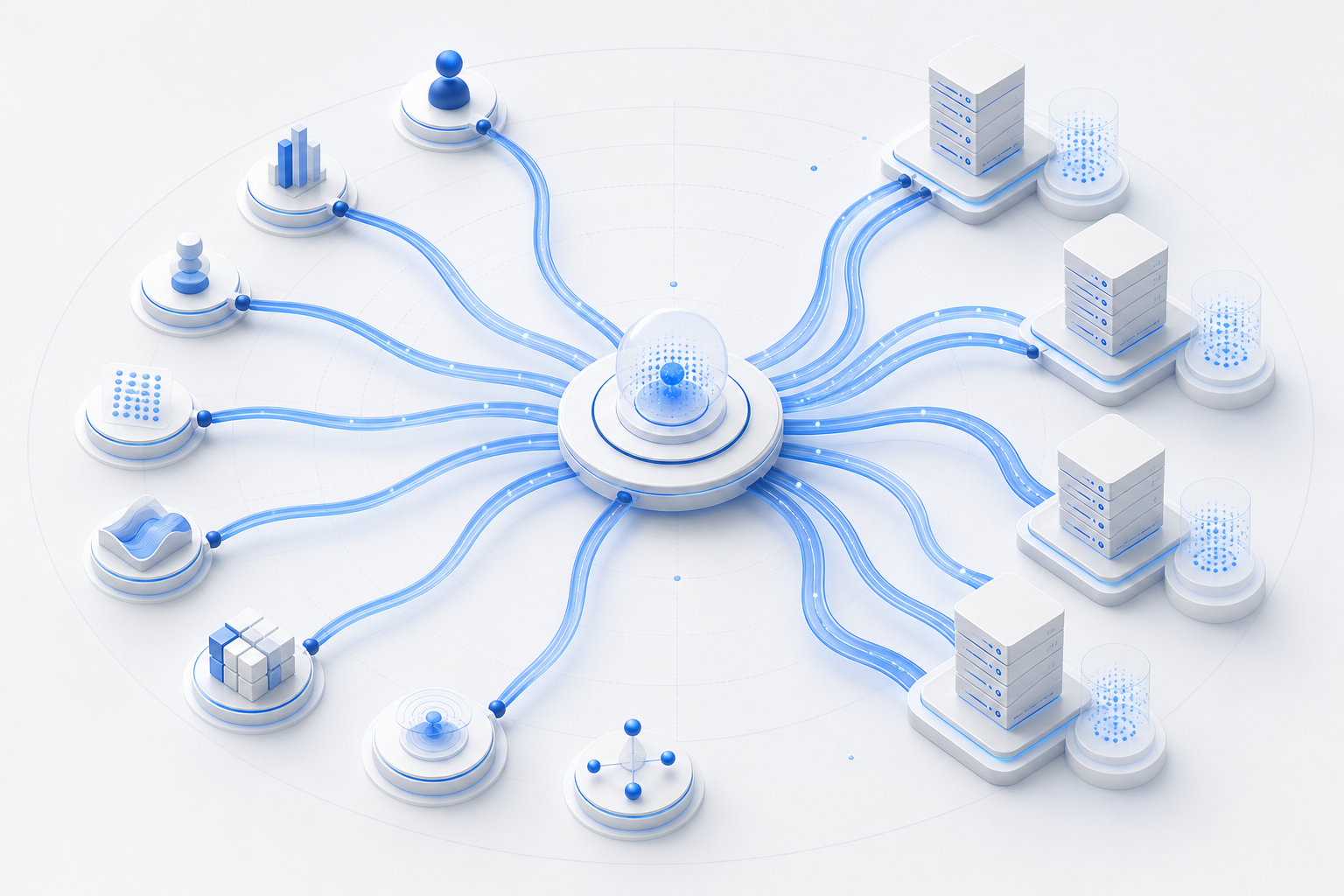
Headless 360 recommends treating signals as first-order assets and building a Signal Cartography practice (a lightweight registry that maps each customer and system signal to an MCP resource key). For the pilot, publish a no-text Signal Cartography diagram (visual artifact that maps sources to MCP resources without embedding legal text in the visual), and version the registry with simple semantic versioning. Operationally, run Agentforce agents against MCP-provided resources only and avoid ad-hoc context extraction in the Agentforce layer; this keeps responsibility boundaries clear: MCP provides context, Agentforce executes workflows and captures human approvals.
This approach short-circuits costly rewrites later: when you need to swap a data source or add a new compliance rule, you update the MCP server mapping and the agents read the new behavior immediately.
FAQ (concise)
Q: Do we have to use MCP to run Agentforce?
A: No — Agentforce can be used in other integration patterns. The decision here is to pilot Agentforce with an MCP-compatible context server because MCP standardizes discovery, tool execution, and transport modes which reduces long-term integration risk.
Q: Which MCP transport should we use for production?
A: Use the Streamable HTTP transport for remote servers. Use STDIO only for local, single-host deployments or dev harnesses. MCP documentation describes both modes and recommends OAuth for secure production tokens. (Source: MCP architecture doc).
Q: How many workflows should we test in the pilot?
A: Start with two focused workflows (one CX/service escalation, one sales-assist) to validate both synchronous and asynchronous interactions.
Q: Will this change existing agent jobs?
A: The pilot is designed for humans-with-agents: humans approve customer-facing actions and control escalation. Plan for role-based training and job-scope clarifications rather than headcount reductions in the pilot.
References
- Salesforce — Agentforce product and support pages: https://www.salesforce.com/agentforce/mcp-support/
- Model Context Protocol — Architecture overview (MCP documentation): https://modelcontextprotocol.io/docs/learn/architecture
- Salesforce News & Stories (context on Agentic Enterprise themes): https://www.salesforce.com/news/stories/
HEADLESS 360 OPPORTUNITY SESSION
Bring one workflow.
Leave with a clearer move.
KEEP READING