Agentic Enterprise / HEADLESS 360
Adopt an MCP context layer before scaling Agentforce agents
A practical decision-maker guide: why and how to combine Salesforce Agentforce with a Model Context Protocol (MCP) context layer before scaling agent deployments, with a three-phase rollout, operating-model POV, and governance guardrails.
THE DECISION PATH
Agentic Enterprise / operating model- 01Workflow
- 02Context
- 03Control
- 04Evidence
# Why adopt a protocol-driven context layer for Agentforce deployments?
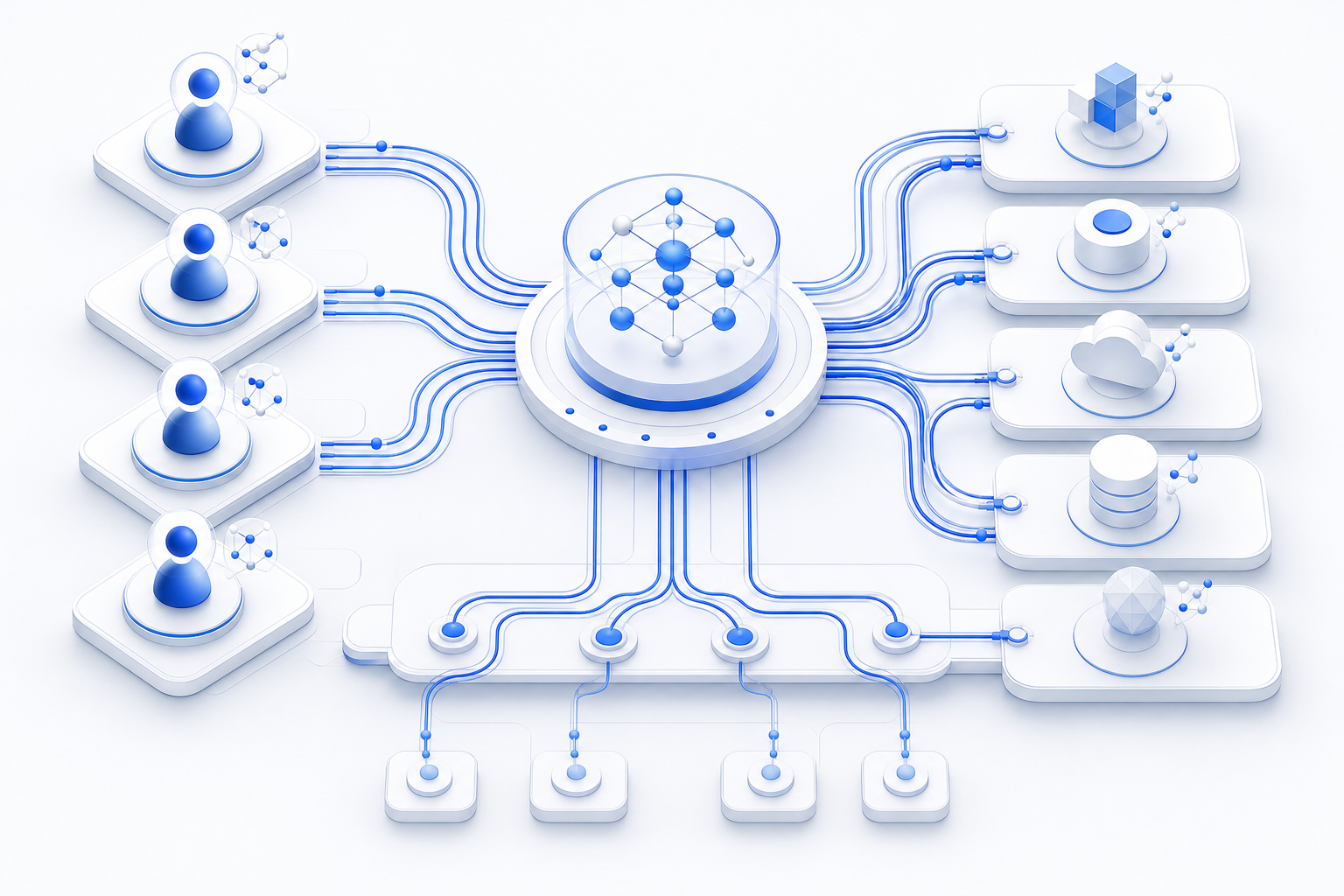
Enterprises choosing Salesforce Agentforce today face a practical integration decision: run agents as isolated application logic inside CRM workflows, or introduce a protocol-driven context layer that standardizes how agents discover tools, fetch state, and surface notifications. The Model Context Protocol (MCP) architecture provides a clear, implementation-agnostic pattern for that context layer; Agentforce provides the agent platform, builders, and runtime where those agents will operate. Combining the two lets organizations separate agent behavior (Agentforce) from context provisioning and lifecycle (MCP servers), reducing brittle point-to-point integrations as agent use expands.
What the two source documents say, at a glance
- Salesforce Agentforce product pages catalogue the Agentforce product family — Builder, Voice, Dev Tools, AgentExchange — and position Agentforce as a unified platform that brings humans and AI agents together on the Salesforce platform. The product surface points to platform tooling, connectors, and a headless toolkit for embedding agents into customer, sales, and service workflows. (Salesforce Agentforce documentation).
- The Model Context Protocol documentation describes an explicit client–server architecture for context exchange: a small JSON-RPC data layer (discovery, primitives such as tools/resources/prompts, notifications) layered over transport choices (stdio or streamable HTTP). MCP is intentionally transport-agnostic and focused on how context is discovered, requested, and streamed to LLM-driven hosts; it separates the data model from how LLMs are invoked. (MCP architecture documentation).
Taken together: Agentforce provides the agent runtime and Salesforce integration surface; MCP provides a well-scoped contract for exposing the external context and tools agents need in a predictable, versioned way.
A concrete decision for enterprise leaders
Decision: For any enterprise planning to deploy Agentforce agents beyond narrow pilots (multiple agent types, cross-product actions, or multi-team consumption), require an MCP-compatible context layer as part of the architecture before scaling.
Why this decision matters:
- Predictability: MCP's discovery and primitives create a standard how agents find available tools, resources, and prompts. That reduces ad-hoc tool wiring as new agent types are introduced.
- Operational separation: Agents can be developed and updated in Agentforce (agent logic, dialog flows, UI affordances) while MCP servers evolve separately to add, secure, or throttle context sources without changing agent code.
- Transport flexibility: MCP's layered design allows teams to deploy local high-performance context servers (stdio) for latency-sensitive operations and remote servers (streamable HTTP) for shared corporate contexts, while keeping the same JSON-RPC semantics.
This is not a call to rip and replace: start with a pilot where a single Agentforce agent uses a lightweight MCP server to provide one or two critical resources (for example, customer profile snapshots and a curated action tool) and validate latency, governance, and observability before broad rollout.
Recommended three-phase rollout (practical steps)
Phase 1 — Pilot (4–8 weeks)
- Select a high-value agent workflow (e.g., a service triage agent) already on Agentforce Builder.
- Stand up a minimal MCP server that exposes the two primitives the agent needs: a resource (customer profile view) and a tool (a single action such as create-case or suggest-resolution). Use MCP discovery to register those capabilities.
- Measure end-to-end latency, incident paths, and governance controls (who can add/modify tools) during real interactions with a small set of users.
Phase 2 — Harden (8–16 weeks)
- Expand the MCP server to provide notifications and progress tracking primitives for long-running actions, and add role-based access controls on the transport.
- Integrate observability: request/response logs, schema versioning checks from MCP discovery, and automated tests that exercise tool contracts.
- Define lifecycle policies: how tool changes are discovered by Agentforce agents and how rollbacks are handled.
Phase 3 — Scale (ongoing)
- Promote MCP servers to shared services: local low-latency servers for agentic UIs, remote streamable HTTP servers for enterprise-shared read-only context.
- Publish an internal registry of MCP-hosted tools and resources (use MCP discovery responses) so product teams can self-serve.
- Embed governance checkpoints in the buying model: any new Agentforce agent that invokes external business actions must be certified against MCP contracts and observability requirements.
Headless 360 operating-model point of view
Headless 360 recommends adopting a “protocol-first” operating model for agent scale: treat the context layer as a product with its own roadmap, SLAs, and consumer contract. Build a small cross-functional team (platform engineering, security, and the Agentforce product owner) that owns MCP server releases, the discovery registry, and the observability pipeline. This separates delivery velocity (Agentforce teams shipping agent behavior and UX) from platform stability (MCP servers controlling context quality and access policies). In Headless 360’s view, success is measured not just by number of agents launched but by the reduction in integration failures, time-to-onboard-new-agent, and the number of tool contract violations detected in preproduction.
Practical guardrails (compliance, security, and governance)
- Version everything: use MCP discovery versioning for server capabilities; require Agentforce agents to fail closed on incompatible versions.
- Limit action surfaces: expose write-capable tools only behind audit and approval gates.
- Observe and alert: capture tool executions and resource fetch times so platform teams can tune transport choices (stdio vs streamable HTTP) where latency matters.
Concise FAQ
Q: What is MCP, in one sentence?
A: MCP is a JSON-RPC–based protocol and architecture for exposing discovery, tools, resources, prompts, and notifications to AI hosts; it separates context provisioning from LLM/agent logic.
Q: Does Salesforce Agentforce already require MCP?
A: Agentforce provides builder, voice, dev tools, and runtime surfaces; MCP is an architectural standard enterprises can adopt alongside Agentforce to standardize context exchange. The Agentforce product surface is the natural place to host agents that consume MCP-provided context.
Q: When should we introduce MCP into our Agentforce roadmap?
A: Introduce MCP at the point where you plan more than a single-agent pilot — specifically when multiple teams, tools, or workflows will share context or when you expect to manage tool contracts and governance centrally.
Q: Which transport should we choose first?
A: Start with the transport that matches your latency and deployment model: local stdio-style servers for low-latency UI experiences, streamable HTTP for shared remote context. MCP explicitly supports both.
References
- Salesforce — Agentforce MCP support: https://www.salesforce.com/agentforce/mcp-support/
- Model Context Protocol — Architecture overview: https://modelcontextprotocol.io/docs/learn/architecture
HEADLESS 360 OPPORTUNITY SESSION
Bring one workflow.
Leave with a clearer move.
KEEP READING