Agentic Enterprise / HEADLESS 360
Adopt an MCP-backed Agentforce Pilot — A November 27, 2026 Enterprise Decision
A November 27, 2026 Headless 360 Insight recommending a concrete 3–6 month Agentforce pilot that uses an internal Model Context Protocol (MCP) server as the canonical context and governance plane for agentized workflows.
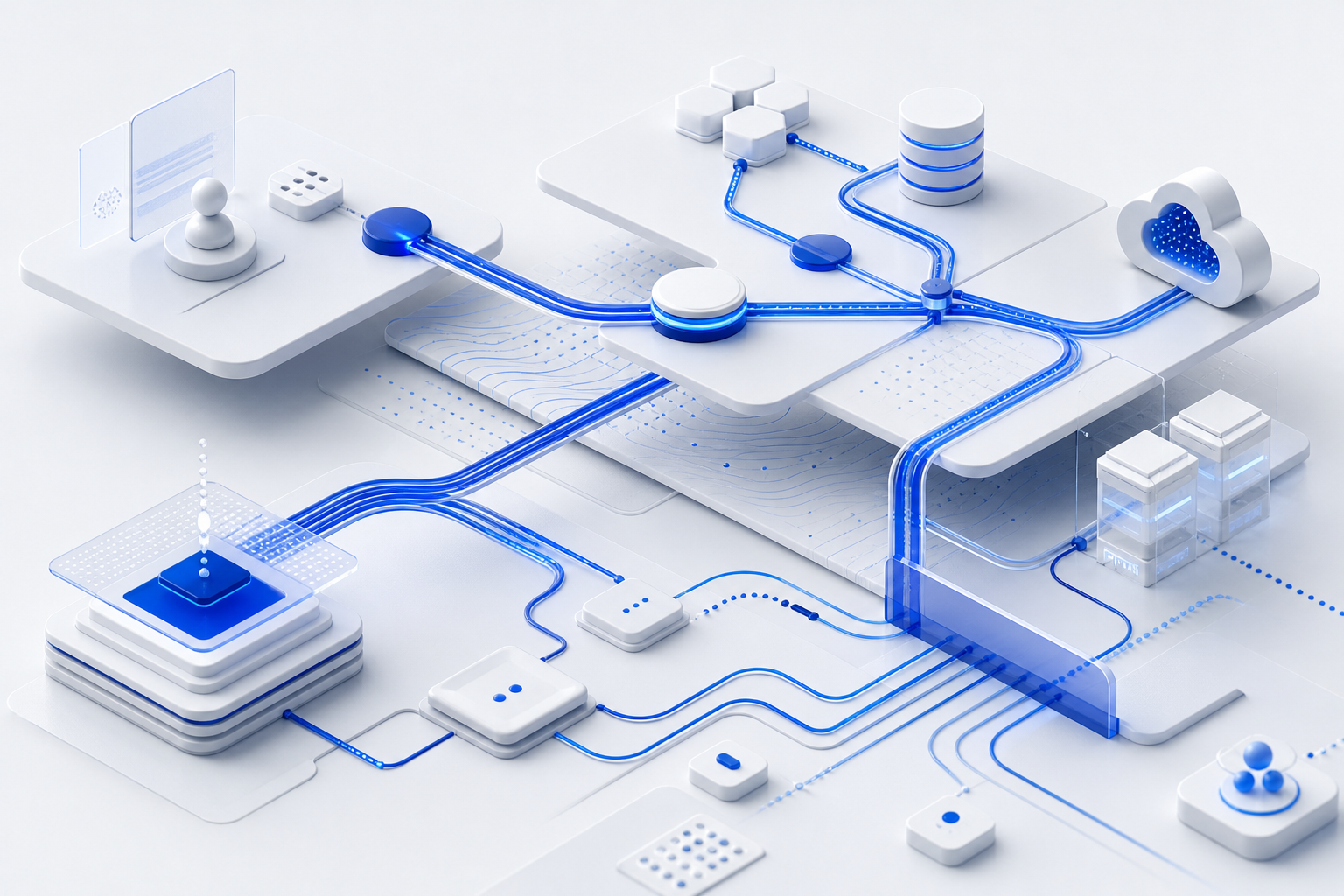
THE DECISION PATH
Agentic Enterprise / operating model- 01Workflow
- 02Context
- 03Control
- 04Evidence
# Today’s Insight — Agentforce, MCP, and the enterprise decision you must make (Decision date: November 27, 2026)
Enterprises are at an inflection point: platform vendors such as Salesforce are shipping “humans + agents” products (Agentforce) that push AI agents into revenue, service, and operations workflows, while open protocols like the Model Context Protocol (MCP) define how context, tools, and signals are exchanged between models and external systems. This Insight translates those primary sources into a concrete, executable decision for enterprise leaders: adopt an internal MCP-backed Agentforce pilot to gain operational control and measurable business value while preserving governance.
Executive summary
- What changed: Salesforce is productizing agent-enabled workflows across sales, service, and commerce (Agentforce). Separately, MCP is maturing as a lightweight JSON‑RPC-based protocol that codifies discovery, context, and tool execution for AI applications.
- The short, concrete decision: launch a 3–6 month Agentforce pilot that uses an internal (or securely hosted) MCP server as the canonical context-provider for agents tied to a single high-value domain (for example, contact-center triage or a top-selling commerce category). Aim to validate operability, governance, latency, and outcome change before scaling.
- Why now: Agent-enabled work is live on major vendor roadmaps and MCP provides a practical contract for context exchange. Delaying the decision forces teams to improvise integrations that compromise auditability, vendor portability, and security.
What the primary sources tell us (and what they don’t)
- From Salesforce Agentforce materials: there is a productized stack and ecosystem orientation — builders, voice, dev tools, AgentExchange, Slack integrations, and vertical manifests. The product framing emphasizes humans working with agent software across sales, service, and commerce workflows.
- From the MCP architecture documentation: MCP defines a focused, transport-agnostic data layer (JSON‑RPC 2.0) and two transport modes (stdio for local, streamable HTTP for remote). Key MCP primitives include discovery, tools, resources, prompts, and notifications—exactly the primitives enterprises need to make agent behavior auditable, observable, and composable.
- Gap to acknowledge: neither source promises plug‑and‑play readiness for every enterprise use case. Integration work (connectors, mapping of enterprise identity and policies, instrumentation) still sits with the customer and their partners.
A Headless 360 operating-model point of view
Headless 360 takes a vendor-agnostic, platform-first posture: treat Agentforce as an application layer and MCP as the contract layer. Your operating model must separate three responsibilities:
- Platform ownership (central cloud/platform team): operates the MCP server(s), authentication, audit logs, and service-level agreements for context delivery.
- Product ownership (line-of-business product manager): defines the success criteria for the pilot use case, maps business processes to agent actions, and owns the outcome metric (e.g., handle time, conversion step, rework avoided).
- Risk & governance (security, privacy, legal): enforces data minimization, retention, and model-use policies at the MCP boundary (resources and discovery layers).
Concretely: run Agentforce agent instances as applications that request context from your MCP server. Use an internal MCP host for initial pilots (stdio or HTTPS depending on placement) so you can assert discovery control, implement access policies, and measure latency and fidelity before relying on vendor-hosted context flows.
Recommended 6-step pilot plan (3–6 months)
- Select a bounded domain (single queue in contact center or a commerce category) where outcomes map clearly to one or two KPIs.
- Stand up an MCP server (reference implementation) in a staging environment and register the minimal set of resources and tools your agents need (customer profile fetch, order lookup, escalation tool).
- Configure Agentforce to use the MCP discovery endpoint for tool/resource lists and enforce least privilege on tool execution.
- Instrument observability: latency per tool call, tool failure rates, and an audit trail of discovery responses and executed tool inputs/outputs.
- Run a controlled experiment that routes a percentage of traffic through agents with human-in-loop escalation; compare outcome metrics to baseline.
- Review governance and model behavior: data retention, PII flows through MCP resources, and any unexpected tool interactions.
Key evaluation criteria
- Security & compliance: Can MCP interactions be authenticated and audited without leaking PII? (MCP’s transport choices enable local and remote hosting models.)
- Latency & reliability: Does the transport layer (stdio vs. streamable HTTP) meet SLA needs for real-time workflows? Use streamable HTTP for multi-tenant remote MCP servers; use stdio or close-proximity hosting for ultra-low-latency needs.
- Discoverability & control: Are tool lists and resources exposed by the MCP server granular enough to prevent agent overreach?
- Observability: Is every tool execution and notification logged to feed your model‑ops and SRE workflows?
What success looks like (outcomes to expect)
- Operable control over which tools and data contexts agents can access.
- Repeatable deployment pattern for new agent applications using MCP discovery and resource primitives.
- Clear governance boundaries and auditable trails for incident investigation and compliance.
Risks and mitigations
- Risk: Poorly scoped pilots let agents touch sensitive data. Mitigation: enforce data minimization at MCP resources and require explicit authorization for PII access.
- Risk: Vendor lock-in by wiring business logic into a single agent product. Mitigation: keep MCP as the canonical context layer and implement connectors so agents remain replaceable.
- Risk: Latency surprises. Mitigation: measure transport performance early and choose the transport (stdio vs HTTP) appropriate to the workflow.
Quick rubric for “go/no-go” after pilot (3 months)
- Go: agent workflows yield measurable outcome improvements, MCP-based controls pass security review, and integration work estimates for scale are linear.
- No-go: unresolved PII leakage, unfixable latency for real-time traffic, or inability to instrument tool-level behavior.
FAQ (concise)
Q: Do we have to implement MCP to use Agentforce?
A: No — Agentforce can operate without MCP. But adopting MCP gives you a standardized contract for discovery, resources, and tool execution that improves governance and portability.
Q: Should the MCP server be internal or hosted by a partner?
A: Start internal (staging) to assert control and visibility. Evaluate secure hosted options only after governance and latency requirements are validated.
Q: Which transport should we choose?
A: Use stdio for single-node, low-latency local integrations; use streamable HTTP for remote or multi-tenant MCP servers.
Q: What teams must be involved?
A: Platform (MCP ops), product (use-case owner), SRE/observability, security/privacy, and the line-of-business SMEs.
References
- Salesforce — Agentforce product & support overview. Exact source: https://www.salesforce.com/agentforce/mcp-support/
- Model Context Protocol — Architecture overview. Exact source: https://modelcontextprotocol.io/docs/learn/architecture
- Salesforce — News & Stories (Agentic Enterprise coverage and product posts). Exact source: https://www.salesforce.com/news/stories/
HEADLESS 360 OPPORTUNITY SESSION
Bring one workflow.
Leave with a clearer move.
KEEP READING