
Agentic Enterprise / HEADLESS 360
Pilot decision: Integrate Salesforce Agentforce with MCP (Headless 360 playbook)
A decision-focused playbook for piloting Salesforce Agentforce with Model Context Protocol (MCP). Recommend a time-boxed pilot, technical checkpoints, risk mitigations, and Headless 360 operating-model guidance.
THE DECISION PATH
Agentic Enterprise / operating model- 01Workflow
- 02Context
- 03Control
- 04Evidence
# Executive insight: When to plug Salesforce Agentforce into MCP
This brief helps enterprise technology and product leaders decide whether to standardize their agentic stack around Salesforce Agentforce and the Model Context Protocol (MCP). It draws only on two primary sources: the Salesforce Agentforce product pages (Agentforce MCP support / Headless 360 platform) and the MCP architecture documentation. Use it to make a clear, operational decision: run a constrained pilot that validates shared context delivery and safe tool execution before expanding to production.
Why this decision matters now
Agentic applications — collections of humans, AI assistants, and tool integrations working together — require reliable, discoverable context and a secure way for agents to invoke actions. Salesforce positions Agentforce as a platform that combines humans with Agents on a Headless 360 platform; MCP provides an open protocol for exchanging context and tool capabilities with AI hosts. Choosing to integrate Agentforce with MCP changes how you manage context, security boundaries, and developer velocity. The right first move is not to rip-and-replace: it’s to prove whether MCP-style context delivery materially improves agent effectiveness and operational safety in your environment.
The concrete decision I recommend
Authorize a time-boxed pilot (8–12 weeks) that connects a scoped Agentforce deployment to a local or remote MCP server. Objectives:
- Validate context fidelity: deliver the specific CRM, user, and session context an Agent needs through MCP primitives (tools, resources, and prompts) and measure task completion accuracy.
- Validate action safety: use MCP’s execution primitives and transport controls to ensure only approved tools and actions are discoverable and callable by agents and models.
- Measure developer and operator effort required to wrap internal systems as MCP servers and to register those capabilities with Agentforce’s Headless 360 platform.
Gate the pilot on three go/no-go criteria: context completeness for target workflows, demonstrable guardrails for tool execution, and acceptable engineering cost to reach the required level of integration.
Practical pilot plan (roles, scope, and deliverables)
- Scope: one high-value customer-facing workflow (for example: guided customer support resolution or a sales opportunity qualification path). Limit tool surface area to 2–3 internal services (CRM read, case update, and a knowledge search).
- Team: product owner, one integration engineer, one ML/agent developer, one security/ops engineer, and two frontline users for validation.
- Deliverables:
- - MCP server wrappers for the selected internal services exposing discovery and execution primitives.
- - Agentforce configuration in Headless 360 to consume MCP-discovered tools and resources.
- - Playbook and acceptance tests demonstrating end-to-end execution and human override.
- - A short evaluation report against the three pilot criteria.
- Timeline: 8–12 weeks: weeks 1–2 design and authorization, weeks 3–7 integration and user testing, week 8 evaluation and decision.
Key technical checkpoints (what to validate from MCP and Agentforce docs)
- Discovery and identity: verify the MCP discovery exchange can enumerate service capabilities and supported protocol versions for each wrapped service. This ensures the agent runtime knows what tools exist and their inputs/outputs before invocation.
- Context primitives: confirm the data-layer primitives (tools, resources, prompts, notifications) carry the required session and customer context into the agent runtime so the agent can act with minimal latency and maximum accuracy.
- Transport and auth: test both local (stdio) and remote (Streamable HTTP) transports where appropriate. Confirm token and header-based authentication aligns with your corporate identity and audit requirements.
- Execution and notifications: validate tool execution semantics (request/response and long-running progress notifications) and ensure Agentforce can surface progress and errors to humans in the loop.
These checkpoints mirror MCP’s architecture claims about discovery, the data layer, and the transport layer and align to the Headless 360 / Agentforce messaging about platform capabilities.
Risk profile and mitigations
- Integration complexity: wrapping legacy APIs as MCP servers requires engineering time. Mitigation: limit pilot to 2–3 services and reuse existing API gateways where possible.
- Security and compliance: exposing tools increases risk surface. Mitigation: enforce least privilege discovery, require tokenized transport, and implement a manual approval step for any agent-initiated state changes during the pilot.
- Operational ownership: who runs MCP servers? Mitigation: start with local or team-run MCP servers under dev ops ownership and plan for a phased handoff to platform or SRE teams if the pilot succeeds.
Measurable success metrics (examples you should adopt)
- Task success rate (human-verified) for the selected workflow.
- Mean time to resolution (or to qualified opportunity) compared to baseline.
- Number of unsafe or unexpected tool executions prevented by discovery-and-authorization controls.
- Engineering hours to productionize each additional MCP-wrapped service (to estimate scaling cost).
Headless 360 operating-model point of view
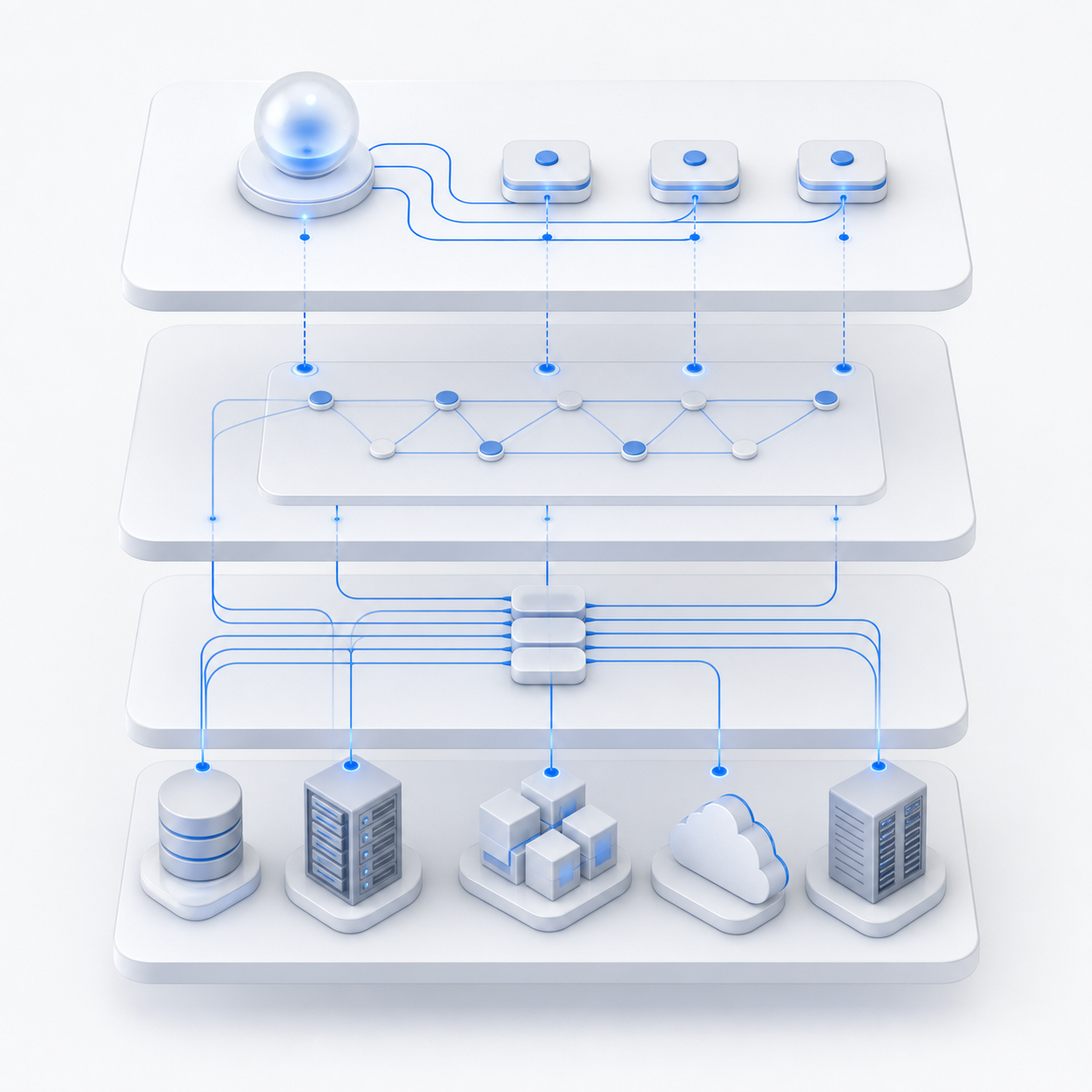
Headless 360 assumes a separation between surface (where humans and chat surfaces interact) and the contextual engine that supplies tools and data. From our operating-model standpoint, integrate MCP at the boundary between your runtime (Agentforce/Headless 360) and your enterprise systems. Treat MCP servers as first-class platform products: version them, secure them, and catalog their capabilities. Operationalize a small MCP developer experience (SDKs, templates, CI checks for tool registration) so wrapping the next service becomes low-friction. Finally, make governance operational — require security review for any MCP-exposed tool that changes state and include observable audit trails for all discovery and execution calls.
Decision checklist (approve expansion when all true)
- Pilot met the three go/no-go criteria for context, safety, and acceptable engineering cost.
- Ops can run or broker MCP servers with the required SLAs and observability.
- Security and compliance have sign-off on transport/auth patterns and audit logging.
- Business stakeholders accept the measured ROI or have a clear path to it.
If these are satisfied, move from Headless 360 pilot to a staged rollout: add 2–3 workflows per quarter, formalize MCP SDKs, and automate tool registration for new services.
Short FAQ
Q: Does integrating MCP force us to replace our current agent runtime?
A: No. MCP is a context and tool-exchange protocol — it sits at the boundary and enables your existing Agentforce/Headless 360 runtime to discover and safely call tools. Start with adapters rather than runtime replacement.
Q: Which transport should we use first, stdio or HTTP?
A: For single-team experiments or local dev, stdio minimizes network complexity. For scalable, multi-tenant production deployments, Streamable HTTP offers better manageability and integrates with existing auth and observability tooling.
Q: Who should own MCP servers?
A: Platform or SRE teams should own production MCP servers; product or feature teams can operate local MCP servers during early experiments.
Q: How do we prevent agents from taking unsafe actions?
A: Use MCP’s discovery and execution primitives to present only approved tools, require human approval for state-changing actions during the pilot, and enforce transport-level auth and auditing.
References
- Salesforce Agentforce MCP support / Headless 360 platform — https://www.salesforce.com/agentforce/mcp-support/
- Model Context Protocol architecture overview — https://modelcontextprotocol.io/docs/learn/architecture
HEADLESS 360 OPPORTUNITY SESSION
Bring one workflow.
Leave with a clearer move.
KEEP READING


