Agentic Enterprise / HEADLESS 360
When Agentforce Meets the Model Context Protocol: A Practical Decision for CX Leaders
A decision-focused playbook for piloting an MCP-backed Agentforce deployment: scope, transport choice, primitives to expose, and operational controls.
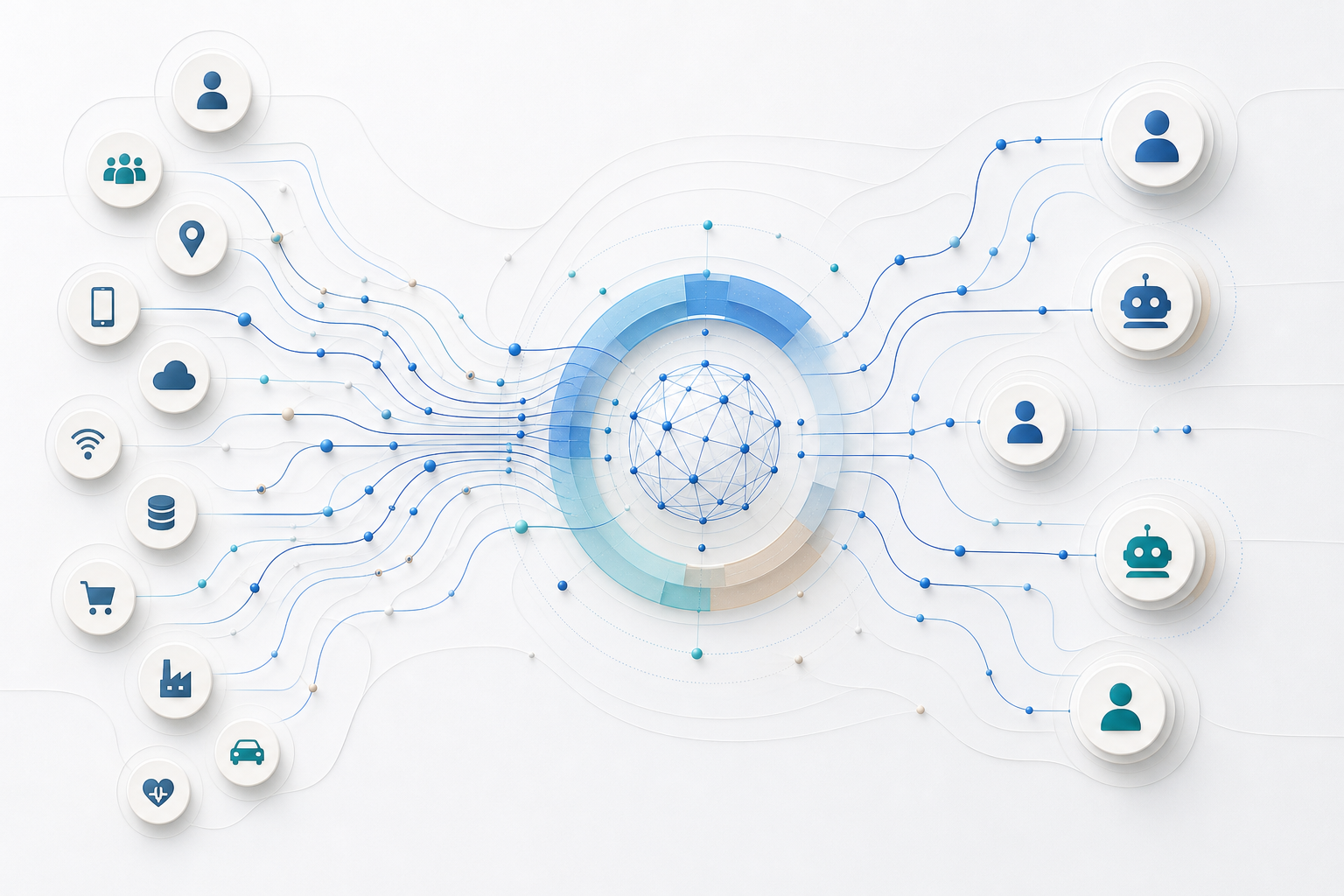
THE DECISION PATH
Agentic Enterprise / operating model- 01Workflow
- 02Context
- 03Control
- 04Evidence
# When Agentforce Meets the Model Context Protocol: A Practical Decision for CX Leaders
Enterprises planning to operationalize agentic customer experience (CX) face a concrete integration choice: adopt an Agentforce-first stack that natively exchanges runtime context using a standardized protocol, or stitch proprietary connectors and risk brittle context hygiene. This Insight translates two primary sources — Salesforce’s Agentforce MCP support overview and the Model Context Protocol (MCP) architecture documentation — into a decision-ready recommendation for CIOs, head of CX, and platform owners.
Executive summary
- What the dossier shows: Salesforce positions Agentforce as a platform where “humans with agents drive customer success together,” and lists Agentforce Builder, Agentforce Dev Tools, AgentExchange, Headless Toolkit, and supporting platform services for building agentic workflows. (Salesforce Agentforce MCP support).
- What MCP provides: a JSON-RPC–based, client/server protocol for exchanging context between AI hosts (clients) and context servers (MCP servers), with a clear separation between a data layer (primitives such as tools, resources, prompts, and notifications) and a transport layer (stdio for local, Streamable HTTP for remote). (MCP architecture docs).
- Decision for leaders: Pilot an MCP-backed Agentforce proof of value that treats context as a first-class service — not as ad-hoc payloads — and optimize for deterministic discovery, secure transport, and operational notifications.
Why this matters now
Agentforce bundles building blocks (Builder, Dev Tools, AgentExchange, Headless Toolkit) that make it realistic to deploy mixed human/agent workflows across sales, service, and marketing. But the value of those workflows depends on reliable, low-latency, auditable context: which agent has what customer state, what tools are available, and which prompts or resources to surface next.
MCP is explicitly a protocol for that problem: it standardizes discovery of server capabilities, the primitives used to represent tools and resources, and two transport modes that map to clear operational choices (local vs remote). Using MCP removes the need to invent bespoke context APIs for every agent integration and gives you a repeatable on-ramp for third-party partner agents (AgentExchange) and internal microsystems.
A concrete decision (what to do this quarter)
Adopt an MCP-first integration approach for new Agentforce pilots. Concretely:
- Pick one high-value customer-interaction flow (e.g., contact-center escalation or agentic self‑service) and scope it tightly. Keep the initial domain narrow to shorten iteration cycles.
- Stand up a single MCP server that exposes the minimal context primitives required for the flow: customer profile, conversation state, available tools (e.g., billing lookup), and a small set of prompts or templates. Use the MCP discovery endpoint as your integration contract.
- Choose transport according to deployment topology: for latency-sensitive on-prem agent runtimes, start with STDIO; for cloud-hosted or partner agents, use Streamable HTTP with OAuth tokens as described in the MCP architecture notes.
- Integrate that MCP server with Agentforce via Agentforce Dev Tools and Agentforce Builder so that Agentforce agents and humans can consume the same context model and tool list. Register partner agents through AgentExchange when appropriate.
- Instrument notifications and progress primitives in MCP to create operational dashboards (who is using which tool, where notifications are failing, which prompts are invoked). Treat notifications as the signal layer for incident detection and capacity planning.
- Lock governance and security around the transport layer: enforce mutual TLS or OAuth for Streamable HTTP, and apply the same data-access controls Agentforce expects in your Salesforce tenancy.
This sequence prioritizes a small-but-complete context loop (discover → execute → notify) that makes the value of agentic CX measurable without rewriting back-end systems.
Implementation notes tied to the sources
- From Agentforce: leverage the Headless Toolkit and Agentforce Dev Tools to embed agent runtimes where your agents already live (contact center, Slack channels, or bespoke web UIs). The platform language in the Agentforce support page frames Agentforce as the integration surface for both builders and operational teams.
- From MCP docs: treat the data layer as the canonical schema for context primitives and use the transport choices deliberately. MCP explicitly delineates discovery, tools/resources, prompts, and notifications — these map directly to the capabilities you should expose from your context service to Agentforce agents.
Headless 360 operating-model point of view:
Headless 360 recommends organizing three capabilities before you write a single integration:
- Product: Define the interaction contract (the minimal set of tools, resources, and prompts) and map it to MCP primitives so product owners can iterate on behavior independent of runtime.
- Platform: Provide an MCP server as a platform service (discoverable, versioned, TLS/OAuth protected). Treat the MCP discovery response as the platform contract for all agents and partner integrations.
- Operations: Build a small operations playbook that uses MCP notifications and progress reporting for alerting, runbooks, and capacity forecasting. Signal hygiene (clear event semantics and owner) is as important as model choice.
These three workstreams keep teams aligned on scope, security, and observability while enabling experimentation.
Quick technical checklist
- Implement MCP discovery for capability/versioning.
- Expose a minimal tools list and resource endpoints mapped to Agentforce use cases.
- Select STDIO for local, latency-sensitive agents; Streamable HTTP with OAuth for remote/partner agents.
- Wire MCP notifications to your monitoring stack for real-time observability.
- Use Agentforce Dev Tools and Builder to surface the same primitives in agent UIs and handoffs.
Concise FAQ
Q: What is MCP, in one line?
A: MCP is a JSON-RPC–based protocol that standardizes how AI hosts (clients) obtain context from MCP servers, separating a data layer of primitives from a transport layer for communication. (See MCP architecture docs.)
Q: Why pair MCP with Agentforce?
A: Agentforce provides the platform and developer tooling to run agents and human workflows; MCP gives you a repeatable, discoverable way to deliver the runtime context those agents need without bespoke APIs.
Q: Which transport should we use first?
A: For a tight pilot inside your environment or an embedded runtime, use STDIO (local). For cloud or partner scenarios, use Streamable HTTP. The MCP docs call both out as explicit supported transports.
Q: Does adopting MCP replace data governance?
A: No — MCP standardizes context exchange; governance (access controls, PII policies, auditing) still must be implemented on top of the transport and server configuration.
Q: How do we scale beyond a single pilot?
A: Use MCP’s discovery and versioning to support multiple MCP servers (per-domain or per-tenant), and register partner agents via your AgentExchange process so each agent consumes a stable contract.
References
- Salesforce — Agentforce MCP Support: https://www.salesforce.com/agentforce/mcp-support/
- Model Context Protocol — Architecture overview: https://modelcontextprotocol.io/docs/learn/architecture
HEADLESS 360 OPPORTUNITY SESSION
Bring one workflow.
Leave with a clearer move.
KEEP READING