
Agentic Enterprise / HEADLESS 360
Agentforce + MCP: Operationalizing Agentic Interoperability — a 90‑day Playbook
A 90‑day playbook to pilot Salesforce Agentforce integrated with MCP — practical steps to achieve governed, composable agent interoperability.
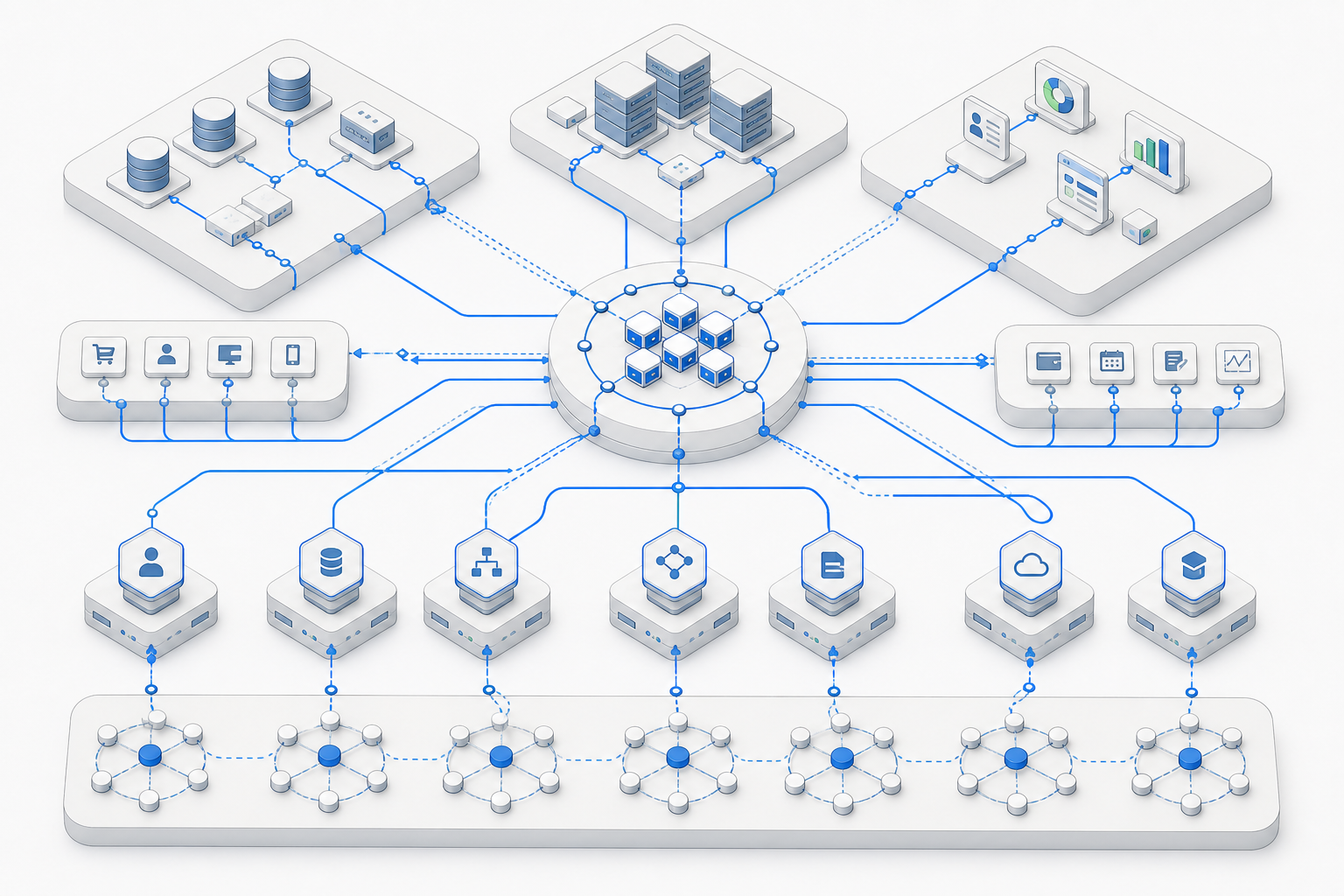
THE DECISION PATH
Agentic Enterprise / operating model- 01Workflow
- 02Context
- 03Control
- 04Evidence
# Agentforce + MCP: A Practical Playbook to Make Agentic Interoperability Enterprise-Grade
Enterprises that want to move beyond point‑integrations and one-off agent capabilities face two practical problems: brittle, bespoke connectors that slow new feature launches, and inconsistent trust controls that increase compliance risk. Salesforce’s Agentforce now pairs a native MCP client with enterprise controls; the Model Context Protocol (MCP) provides the technical standard for discovery, capabilities (tools/resources/prompts), and transport. Together they create a path to safely unlock third‑party capabilities for AI agents without rewriting integration logic for every new vendor. (salesforce.com)
Why this matters right now (decision framing)
If your organization is evaluating where to place a 2026–27 AI investment, the concrete decision is not "whether to use agents" but "how to make agent capabilities composable, observable, and governed." Choosing a platform that uses MCP as the interoperability layer buys two things: a consistent discovery/execution model for runtime capabilities, and an auditable surface for governance controls that must live between enterprise policy and external services. The Agentforce implementation documents a vendor path for enterprises to adopt MCP while adding centralized registry, rate limiting, and granular policy enforcement. (salesforce.com)
What MCP brings to the enterprise stack (technical summary)
MCP is a focused protocol that separates two concerns: the data layer (JSON‑RPC based primitives and discovery) and the transport layer (how messages move). The protocol defines three core primitives an MCP server can expose to an MCP client: tools (actions), resources (data/context), and prompts (templates). Discovery is explicit: clients call server/discover to learn versions and capabilities; stateless requests carry per‑request metadata so servers can process each request independently. For transport it supports both STDIO for local servers and a Streamable HTTP transport for remote servers (with OAuth recommended for auth). Those primitives and discovery semantics are precisely the building blocks Agentforce says it will use to orchestrate agents across internal and partner systems. (modelcontextprotocol.io)
Headless 360 operating‑model point of view
- Treat MCP as the enterprise service bus for agents, not as another proprietary SDK. The protocol’s primitives give you predictable contracts: design governance, auditing, and SLAs around tools/resources/prompts rather than around individual connectors. (modelcontextprotocol.io)
- Centralize registry and policy enforcement in the Agentforce layer. Agentforce’s centralized MCP server registry and gateway concept are the correct control plane: they prevent "shadow MCP servers" from being discovered across org boundaries and let security teams enforce granular access. Operationally, this means the platform team owns the registry, policy configuration, and rate limits; product teams request capability enablement via that registry. (salesforce.com)
- Assume mixed transport modes. Some MCP servers will be local (STDIO) for internal tooling; many will be remote using Streamable HTTP. Plan authentication templates (OAuth flows) and observability (per‑request _meta fields) into your identity and monitoring stacks. (modelcontextprotocol.io)
A concrete 90‑day decision (recommended next step)
Decision: Run a scoped Agentforce + MCP pilot that connects Agentforce to two MCP servers (one internal, one vetted partner from AgentExchange) and demonstrates visibility, governance, and recovery controls.
Minimum scope and milestones
- Week 0–2: Register scope, name owners, and select two MCP servers (an internal data resource and one AgentExchange partner). Configure the centralized MCP registry in Agentforce. (salesforce.com)
- Week 3–6: Implement discovery and execution tests. Validate server/discover responses, test tool execution, and confirm the transport (STDIO for the internal server; Streamable HTTP + OAuth for the partner). Instrument logs to capture per‑request _meta and capability versions for auditability. (modelcontextprotocol.io)
- Week 7–10: Enforce policy. Apply granular access controls, rate limits, and policy‑driven deny/allow rules in the Agentforce gateway. Run adversarial and failure‑mode tests (revoked tokens, network partition). (salesforce.com)
- Week 11–12: Measure outcomes and decide next action. Measure time‑to‑resolve for agent tasks, percent of actions executed by agents vs. humans, and incidents where governance blocked unsafe actions. Make a go/no‑go decision to expand to a broader AgentExchange catalog. Avoid shipping more than you can monitor: expand only when registry and policy telemetry are stable.
This is an engineering + platform decision, not a pure procurement one: you need platform owners, security, and the first product team aligned on success metrics.
Practical integration pointers (ops & engineering)
- Use the discovery handshake (server/discover) as your gate: only registry‑approved servers should be discoverable by Agentforce clients. This reduces runtime surprises and is the simplest place to enforce cross‑org authorization. (modelcontextprotocol.io)
- Treat primitives as contracts. Map each MCP tool to a named capability in your internal catalog; version those capabilities and record the server’s reported protocol version in your change logs. (modelcontextprotocol.io)
- Plan for mixed transports and authentication. Streamable HTTP + OAuth enables remote MCP servers; STDIO is useful for high‑performance local connectors. Make OAuth client lifecycle and token revocation part of your incident runbooks. (modelcontextprotocol.io)
Risks and mitigations
- Risk: Over‑privileged tools. Mitigate by scoping tools to least privilege and enforcing policy at the Agentforce gateway. (salesforce.com)
- Risk: Uncontrolled discovery across org boundaries. Mitigate by using the centralized MCP registry and cross‑org scoping features in Agentforce. (salesforce.com)
- Risk: Version skew between clients and servers. Mitigate by recording protocol versions from server/discover and by automated compatibility tests during CI. (modelcontextprotocol.io)
Headless 360 decision checklist (one page)
- [ ] Register two MCP servers in Agentforce registry. (salesforce.com)
- [ ] Validate server/discover responses and primitive lists. (modelcontextprotocol.io)
- [ ] Configure Streamable HTTP + OAuth for remote server. (modelcontextprotocol.io)
- [ ] Apply rate limits and policy rules in Agentforce gateway. (salesforce.com)
- [ ] Instrument per‑request _meta and capability version in telemetry. (modelcontextprotocol.io)
Concise FAQ
Q: What is MCP in one line?
A: MCP is an open protocol that standardizes how AI agents discover and use external tools, resources, and prompts via a JSON‑RPC based data layer and transport abstraction. (modelcontextprotocol.io)
Q: How does Agentforce use MCP?
A: Agentforce embeds an MCP client and provides a centralized registry, policy enforcement gateway, rate limiting, and curated AgentExchange discovery to make MCP consumption enterprise‑grade. (salesforce.com)
Q: Which transport should I plan for?
A: Expect both STDIO for local servers and Streamable HTTP for remote servers; Agentforce expects enterprises to use OAuth for remote auth. (modelcontextprotocol.io)
Q: What governance controls are essential?
A: Centralized registry scoping, granular tool‑level access control, rate limits, and per‑request metadata auditing. Agentforce surfaces all of these as platform controls. (salesforce.com)
References
- https://www.salesforce.com/agentforce/mcp-support/
- https://modelcontextprotocol.io/docs/learn/architecture
HEADLESS 360 OPPORTUNITY SESSION
Bring one workflow.
Leave with a clearer move.
KEEP READING


