
Agentic Enterprise / HEADLESS 360
Operationalizing Agentforce: A Concrete MCP Pilot for CX Leaders
Practical 12-week enterprise decision plan to pair Salesforce Agentforce with an MCP-based context fabric: what to pilot, how to govern tools and data, and the operating-model changes that make human+agent automation repeatable and auditable.
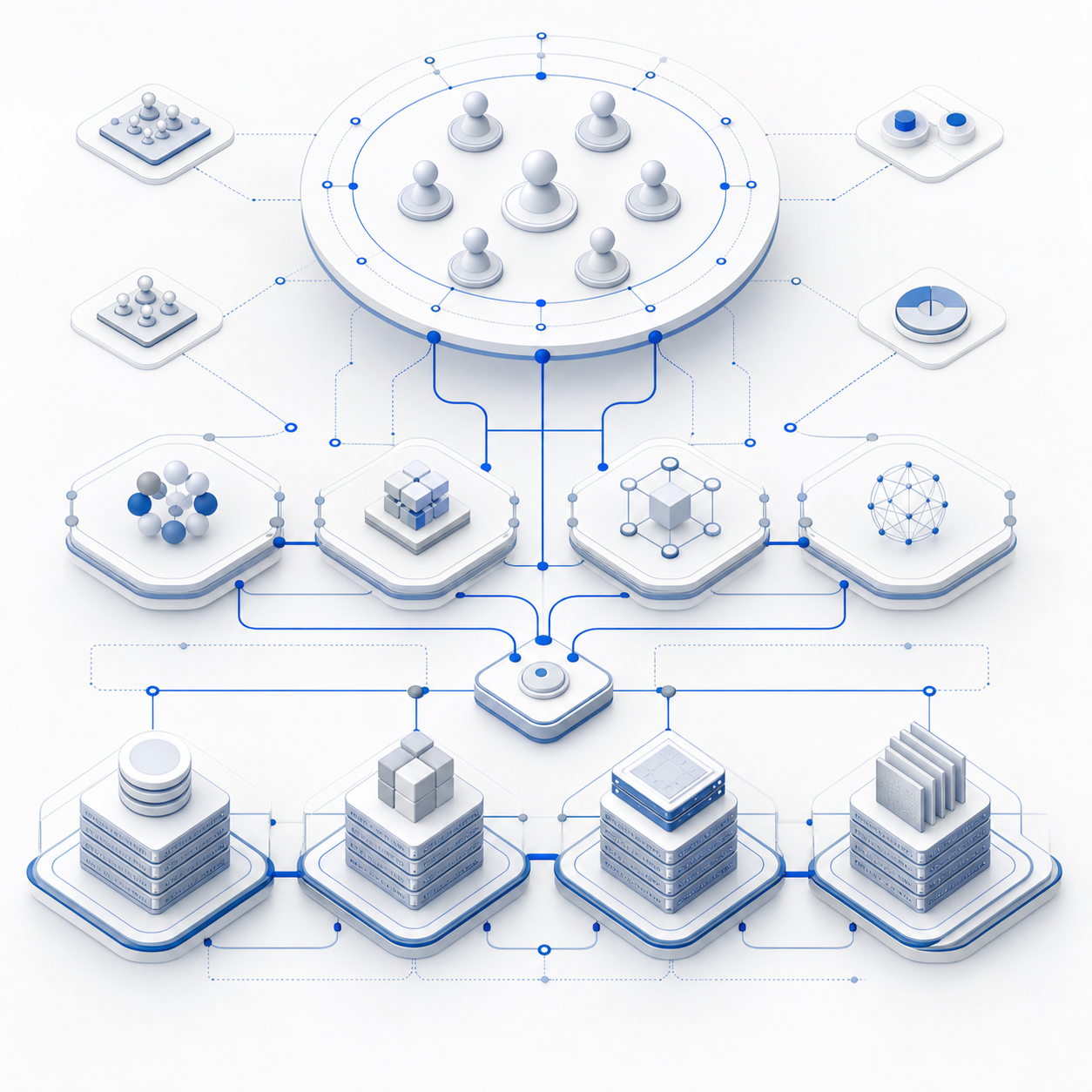
THE DECISION PATH
Agentic Enterprise / operating model- 01Workflow
- 02Context
- 03Control
- 04Evidence
Executive summary
Salesforce Agentforce reframes customer-facing automation as a human + agent operating model. The Model Context Protocol (MCP) is an emerging, transport-agnostic standard for exchanging context, tools, and notifications between AI hosts and context servers. For enterprise decision-makers the practical question is not whether agents and human/agent collaboration are strategic — they are — but how to operationalize them without fragmenting data access, breaking governance, or creating brittle point solutions. This Insight explains a concrete path to adopt Agentforce with an MCP-aware architecture, the minimum integration surface you must standardize, and the governance and telemetry decisions that will determine whether your pilot becomes a durable capability.
Why this matters now
Agentforce positions humans and AI agents as coordinated participants on the same platform: builders, voice, dev tools, operations, and a marketplace (AgentExchange) are all signaled as product components. MCP defines a clear machine-to-machine contract for context exchange (JSON‑RPC primitives, discovery, tools, resources, prompts, and notifications) and two transport choices (stdio for local processes; Streamable HTTP for remote servers). Together they let you move from multiple ad hoc connectors toward a composable, auditable fabric for agent context and tools.
That combination matters for enterprises that must:
- Keep regulated data within boundaries while enabling agents to act;
- Govern tool and system access from agents;
- Iterate agent behaviors fast without rewriting integration code;
- Maintain observability across human and agent actions.
Concrete decision for CX and automation leaders
Do this: run a 12‑week pilot that pairs Agentforce Builder with an MCP server layer rather than hard-wiring one-off connectors. The pilot should prove four outcomes: (1) safe context delivery (data minimization + auditable access), (2) tool governance (controls for tool discovery and execution), (3) latency and availability within SLA targets, and (4) traceable human/agent handoffs in your contact flows.
Minimum technical scope for the pilot
1) Context fabric: deploy an MCP server (local or remote) that exposes exactly the resources agents need — customer profile slices, recent transactions, and the single canonical case record — using MCP primitives (tools, resources, prompts). Use stdio transport only for tightly-coupled local agent runtimes; use Streamable HTTP for multi-tenant or remote MCP servers.
2) Agentforce integration: connect Agentforce Builder and Agentforce Dev Tools to the MCP server so agents discover and request context via MCP discovery and execution calls rather than bespoke APIs.
3) Governance & policy: add an access-control layer that intercepts MCP discovery and tool execution calls to approve or deny tool availability based on user role, data classification, and regulatory constraints.
4) Observability and auditing: log MCP notifications, tool executions, and the JSON‑RPC exchange, and surface them in your incident and compliance dashboards. Capture human approvals as events in the same stream.
Why these four components? They map directly to the promise in Agentforce (humans-with-agents working together) and to MCP’s design (a data layer of primitives plus two transport options). Treat MCP as the contract for context; treat Agentforce as the execution surface for agent behaviors and human/agent orchestration.
Implementation checklist (weeks 0–12)
Week 0–2: discovery and scope
- Map 2–3 high-value CX journeys (e.g., returns, billing dispute, onboarding).
- Define minimal context slices and tools each agent requires.
Week 3–6: build & connect
- Stand up the MCP server (choose local stdio for proof-of-concept or Streamable HTTP for remote shared instances).
- Implement MCP resources and tools exposing the minimal context.
- Configure Agentforce Builder to discover the MCP server and request resources.
Week 7–10: governance, telemetry, and safety
- Implement tool approval workflows and role-based access control on MCP discovery responses.
- Add logging of JSON‑RPC calls, tool executions, and notifications into your SIEM/compliance system.
Week 11–12: pilot validation and go/no-go
- Validate compliance requirements (data residency, retention).
- Measure business metrics (contact handle time, deflection, agent escalation rate).
- Decide whether to expand to additional journeys and scale MCP instances.
Headless 360 operating-model point of view
- Single product owner for the human+agent capability: Create a cross-functional product team that owns the agent fabric (Agentforce + MCP), not a single line-of-business. This ensures consistent policy, reuse of tools, and a prioritized backlog for agent skills.
- Catalog-first approach: Build a central registry of MCP tools and resources (an “Agent Catalog”) that is the source of truth for allowed agent actions. Integrate that registry with procurement, security, and legal reviews so new tools cannot be used until approved.
- Telemetry-as-policy: Treat telemetry as an operational control. Define the minimum event taxonomy (discovery, tool-execution, prompt, notification, human approval) and require any MCP server to emit those events to an enterprise observability plane.
- Iteration cadence: Move from monolithic releases to weekly skill rollouts. Agents improve fastest when business owners can iterate on prompts and small tool changes without long platform cycles.
Risk, compliance, and vendor considerations
- Data residency: MCP’s transport options let you localize context (stdio) or centralize it (Streamable HTTP). Choose based on your residency and latency requirements.
- Vendor lock-in: Using MCP as a contract reduces coupling to a single LLM or agent host; you can change model hosts while keeping the MCP server and resource contracts stable.
- Security: Use mTLS / OAuth for Streamable HTTP transports and enforce role-based discovery responses so agents only learn what they need at runtime.
Concise FAQ
Q: Do I need MCP to run Agentforce?
A: No — Agentforce can integrate with existing services — but adopting MCP provides a reusable, auditable contract for context exchange that reduces future integration costs and governance complexity.
Q: Which transport should I choose first, stdio or Streamable HTTP?
A: For single‑host proof-of-concept where latency and zero network trust matter, use stdio. For shared, remote, or multi-tenant deployments choose Streamable HTTP with OAuth/mTLS.
Q: How do I govern tools an agent can call?
A: Intercept MCP discovery and tool execution responses with an access-control layer that enforces roles, data classification, and a pre-approved tool catalog.
Q: What telemetry is non-negotiable?
A: At minimum emit discovery, tool-execution, prompt, notification, and human-approval events to a central observability system.
References
- Salesforce Agentforce MCP support: https://www.salesforce.com/agentforce/mcp-support/
- Model Context Protocol — Architecture overview: https://modelcontextprotocol.io/docs/learn/architecture
HEADLESS 360 OPPORTUNITY SESSION
Bring one workflow.
Leave with a clearer move.
KEEP READING


