Agentic Enterprise / HEADLESS 360
Operationalizing Agentforce with the Model Context Protocol: A pragmatic enterprise decision
A 90–180 day decision and roadmap for enterprises to standardize Agentforce integrations on the Model Context Protocol (MCP) to improve discoverability, security, and operational scale.
THE DECISION PATH
Agentic Enterprise / operating model- 01Workflow
- 02Context
- 03Control
- 04Evidence
# Operationalizing Agentforce with the Model Context Protocol: A pragmatic enterprise decision
Executive summary
Enterprises piloting or scaling Salesforce Agentforce should decide now to standardize the agent–context interface on the Model Context Protocol (MCP) for any custom context servers they run or integrate. Doing so preserves discoverability, reduces brittle point-to-point integrations, and gives security and platform teams a clear contract for governance. This recommendation uses two publicly available primary sources: Salesforce’s Agentforce/Agent literature and the MCP architecture documentation. (salesforce.com)
Why this decision matters now
Salesforce positions Agentforce as a platform that mixes human workflows and AI agents across Sales, Service, Commerce and other clouds; its News Explorer surface shows a steady stream of Agentforce- and agents-focused content and feature updates. Organizations are moving from experimental agents to operational agents that must reliably access contextual resources (databases, files, systems of record). Without a standard context protocol, each new agent or context source becomes a bespoke integration: slow, expensive, and risky to operate. (salesforce.com)
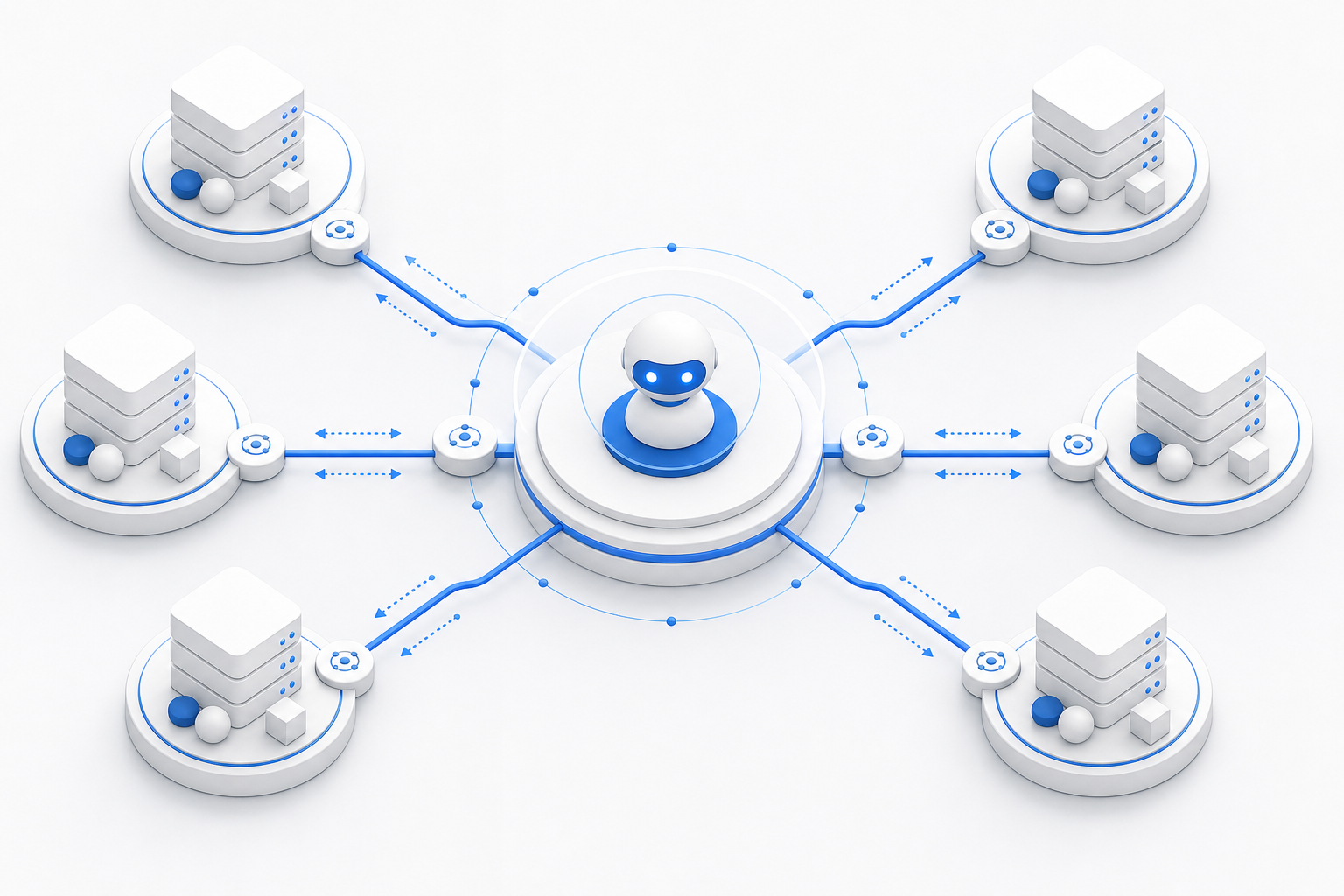
The Model Context Protocol (MCP) is explicitly designed as a JSON-RPC–based protocol to provide context and tool primitives to AI applications, with a clean separation between the data layer (discovery, tools, resources, notifications) and the transport layer (stdio or streamable HTTP). MCP documents discovery, capability negotiation, and two transport options (local STDIO and Streamable HTTP) and recommends standard auth patterns such as OAuth for remote servers. Using MCP aligns agent hosts and context servers to a common contract. (modelcontextprotocol.io)
The current operational decision (concrete)
Decision: For any enterprise project that will put Agentforce agents into production or into production-adjacent pilots, require MCP-compliant context servers for all non-trivial context sources. Implement a two-track deployment model:
- Track A — Local, low-latency context: implement MCP servers via STDIO for tightly coupled, single-host agents (e.g., on-premise data proxies or local indexing services). (modelcontextprotocol.io)
- Track B — Shared, audited context: implement MCP servers via Streamable HTTP for multi-tenant or shared services (use OAuth and standard HTTP auth, follow your ID and access governance). (modelcontextprotocol.io)
This enforces a discovery surface (server/discover) so Agentforce hosts or local agent runtimes can enumerate capabilities, tools, and resources instead of relying on out-of-band documentation. That reduces time-to-integrate and improves runtime robustness. (modelcontextprotocol.io)
Implementation roadmap (90–180 days)
- Governance & scoping (Weeks 0–2)
- - Catalog the top 10 context sources (CRM records, product catalog, legal snippets, knowledge base, inventory) that agents will need. Link catalog entries to ownership and compliance requirements. (No external claims; internal task.)
- Prototype MCP server (Weeks 2–6)
- - Build a minimal MCP server for one high-value context source (example: a knowledge-base search endpoint exposed as an MCP Resource/Tool). Use provided MCP SDKs or follow the MCP specification for data-layer messages and server/discover behavior. Test both discovery and tool execution flows. (modelcontextprotocol.io)
- Integrate with Agentforce pilot (Weeks 6–12)
- - Connect the MCP server to the Agentforce pilot agents. Validate discovery, capability negotiation, and end-to-end agent behavior. Measure integration time and error modes (timeouts, auth failures, schema mismatches). Cite Salesforce agent guidance for pilot expectations. (salesforce.com)
- Harden and scale (Weeks 12–24)
- - Harden transport security (TLS, OAuth tokens for Streamable HTTP), add observability (request logging, change notifications), and implement role-based controls for tool execution. Use MCP notifications for change subscriptions where supported. (modelcontextprotocol.io)
- Operationalize (Weeks 24–36)
- - Onboard additional context teams, publish an internal MCP registry of approved servers, and require MCP conformance checks in change control. Monitor cost, latency, and incident patterns.
Security, compliance & governance checklist
- Use Streamable HTTP + OAuth for any MCP server that is network-accessible; prefer STDIO for single-host local servers to reduce network exposure. (modelcontextprotocol.io)
- Require server/discover metadata include owner and contact fields so security teams can triage capability exposure. (modelcontextprotocol.io)
- Enforce RBAC for tool execution endpoints; treat tools that can mutate records as high-risk and put them behind additional approval flows. (Governance best practice — internal policy required.)
- Instrument MCP notifications for audit trails and to detect unusual subscriptions or tool calls. (modelcontextprotocol.io)
Headless 360 operating-model point of view
- Single contract, many providers: Treat MCP as the operating-contract that lets multiple internal teams (data, search, legal, product) expose capabilities without bilateral integrations. This reduces cognitive load for agent developers and centralizes governance.
- Platform-first integration: Make the MCP registry a first-class platform artifact. Platform engineering owns the registry and the conformance tests; product teams own the server implementations and SLAs.
- Iteration velocity with guardrails: Short pilot cycles (4–8 weeks) to prove MCP server value, with mandatory security checks before any server is added to the production registry.
- Metrics that matter: integration time per context source, mean time to revoke a tool, and production error rate for tool executions. Use those operational metrics to prioritize which servers move from pilot to production.
Practical trade-offs (decision framing)
- Upfront engineering vs long-term agility: Requiring MCP adds initial work (standards, servers, registry) but dramatically reduces integration cost as the agent estate grows.
- Local STDIO vs Streamable HTTP: STDIO gives minimal attack surface and low latency for single-host deployments; Streamable HTTP enables shared services and central auditing but requires stronger auth and networking controls. (modelcontextprotocol.io)
Concise FAQ
Q: Does Agentforce require MCP?
A: Salesforce’s materials do not mandate MCP; MCP is an independent protocol that can be adopted to standardize context servers for any agent platform, including Agentforce. Use MCP to reduce bespoke integrations. (salesforce.com)
Q: Which transport should I choose first?
A: For an initial production pilot where the context server runs alongside the agent host, STDIO is simplest. For shared services used across multiple agents or teams, Streamable HTTP with OAuth is the safer, auditable choice. (modelcontextprotocol.io)
Q: Will this change how we buy or license Agentforce?
A: No vendor licensing changes are implied by adopting MCP. This is an internal integration and governance decision; consult your Salesforce commercial contact for any product-level questions. (salesforce.com)
Q: What does ‘discovery’ buy us practically?
A: Discovery (server/discover) lets an agent runtime enumerate server capabilities at runtime, enabling dynamic capability negotiation and reducing fragile pre-configuration. (modelcontextprotocol.io)
References
- Salesforce News & Stories (Agentforce and agents coverage): https://www.salesforce.com/news/stories/ (salesforce.com)
- Model Context Protocol — Architecture overview: https://modelcontextprotocol.io/docs/learn/architecture (modelcontextprotocol.io)
HEADLESS 360 OPPORTUNITY SESSION
Bring one workflow.
Leave with a clearer move.
KEEP READING