
Agentic Enterprise / HEADLESS 360
Operational Playbook: Using MCP to Scale Salesforce Agentforce Safely
A tactical, enterprise-focused playbook for adopting Model Context Protocol (MCP) as the interoperability layer for Salesforce Agentforce—practical rollout steps, governance controls, and a Headless 360 operating-model point of view.
THE DECISION PATH
Agentic Enterprise / operating model- 01Workflow
- 02Context
- 03Control
- 04Evidence
# Operational Playbook: When and How to Adopt MCP for Salesforce Agentforce
Enterprises deploying agentic AI with Salesforce Agentforce now face a fork that matters for scale, security, and platform agility: rely on bespoke connectors for each capability, or standardize agent interoperability with the Model Context Protocol (MCP). The choice determines how fast teams can safely expand agent functionality, how much vendor lock-in they accept, and how governance scales across distributed systems.
This dispatch synthesizes the practical capabilities Salesforce advertises for Agentforce and the MCP architecture guidance to give decision-makers an actionable rollout path that minimizes integration complexity while preserving enterprise controls. (Sources: Salesforce Agentforce MCP Support; MCP Architecture documentation.)
The intact problem: trapped agents, bespoke work
Salesforce positions Agentforce as the enterprise gateway that "unlocks siloed data and agents" and provides a single, governed path to new tools and data sources. That promise answers a familiar CIO problem: every new agent capability traditionally required a bespoke integration that increases cost, risk, and maintenance burden over time. Agentforce's MCP support reframes that integration cost as a protocol problem: if agents and systems speak a shared handshake, capabilities can be discovered and invoked rather than custom-wired.
MCP, by design, is that handshake. Its documentation describes a minimal, transport-agnostic data layer (JSON-RPC 2.0) and two transport options (stdio for local, streamable HTTP for remote) that enable discovery, tool invocation, and resource access without embedding system-specific adapters inside every agent. MCP also codifies primitives—tools, resources, prompts—and a stateless discovery exchange that lets hosts learn what a server exposes per request.
A concrete decision for enterprise leaders
Decision: Adopt MCP as the canonical interoperability layer for new Agentforce agent capabilities, and require MCP-compatible connectors for any 3rd-party agent capability considered for production. Implement this in a three-quarter program: pilot (quarter 1–2), consolidate (quarter 3), govern (ongoing).
Why this is practical now
- Salesforce explicitly supports MCP as the interoperability standard inside Agentforce and plans a centralized MCP server registry, governance controls, and rate-management features that align with enterprise requirements. (Salesforce Agentforce MCP Support)
- MCP's specification already includes discovery, versioning, and transport rules that let teams trade off performance and security (stdio vs. streamable HTTP) depending on where a server runs. (MCP Architecture)
This is a confidence-level decision: it uses supported, documented protocol primitives rather than inventing an ad-hoc integration layer that becomes brittle as agent fleets grow.
Tactical rollout: 6 concrete steps
- Charter a cross-functional "Agent Interop" team.
- - Members: platform engineering, security, customer-support ops, and business owners.
- - Mission: run the pilot, maintain the MCP server registry, and own the interoperability policy.
- Run a focused pilot (8–12 weeks).
- - Pick 1–2 low-risk agent workflows (e.g., shipment ETA lookup, account merge suggestion) that benefit from external tools.
- - Require MCP servers for any external capability used in the pilot. Use stdio transport for on-premise servers and streamable HTTP for SaaS services where appropriate. (MCP Architecture)
- Use AgentExchange and AgentBuilder for partner discovery and fast deployment.
- - Vet MCP-enabled partners via AgentExchange; deploy initial agent builds with AgentBuilder to minimize bespoke engineering while the team learns governance controls. (Salesforce Agentforce MCP Support)
- Define a centralized MCP server registry and onboarding checklist.
- - Registry entries must include allowed primitives, supported protocol versions, authentication method, expected rate limits, and an owner contact. Salesforce describes this pattern as a control to ensure only authorized capabilities are discovered. (Salesforce Agentforce MCP Support)
- Harden governance and runtime controls.
- - Enforce granular access policies, authentication (OAuth where appropriate), and rate limiting to prevent resource exhaustion; MCP recommendations document transport-level auth patterns. (MCP Architecture; Salesforce Agentforce MCP Support)
- Measure and iterate on observability.
- - Track discovery failures, tool-execution errors, latency by transport, and policy violations. Feed these signals back into the registry lifecycle (onboard, upgrade, deprecate).
Headless 360 operating-model point of view
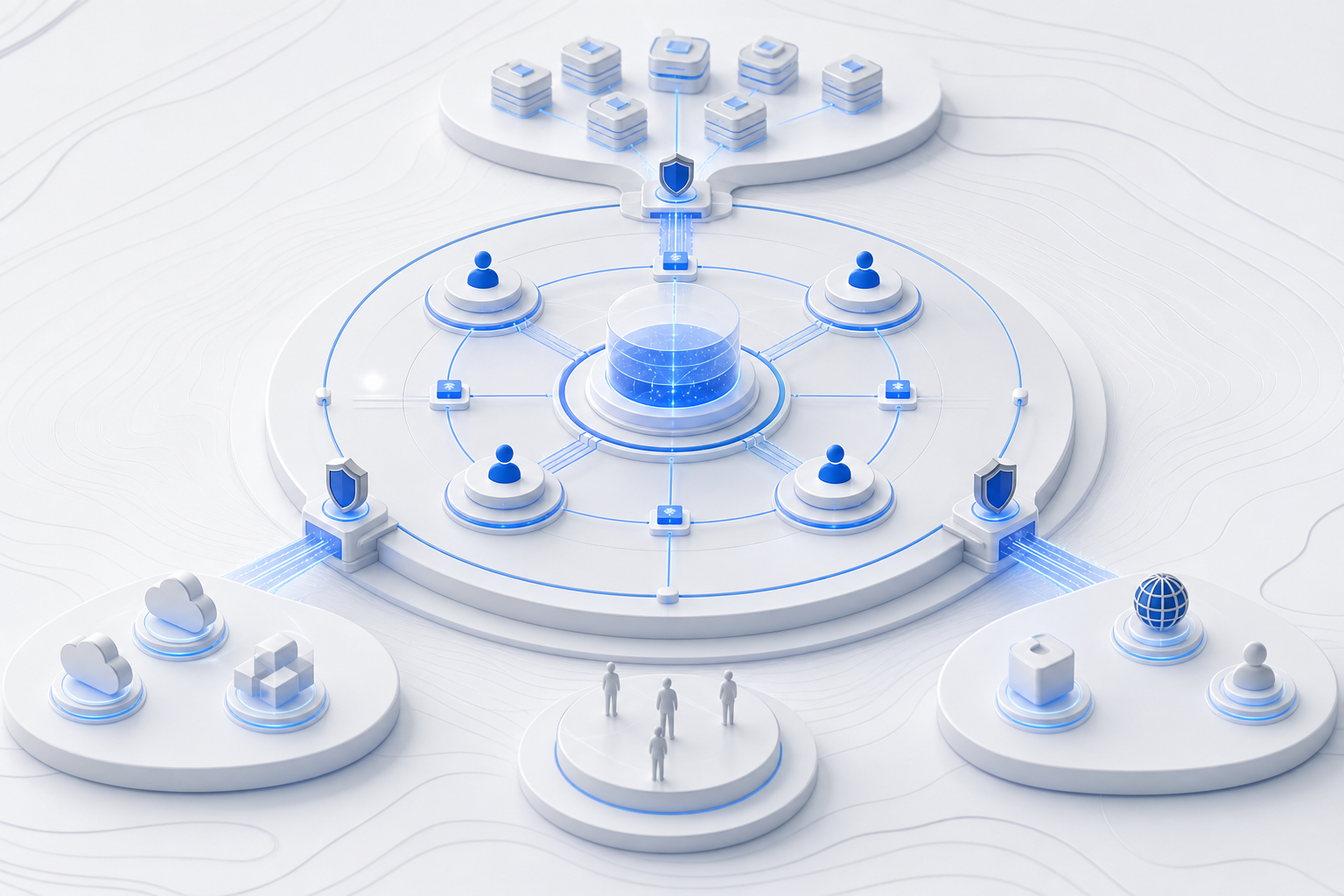
Headless 360 recommends treating Agentforce as the runtime host and MCP as the universal context-and-tool bus. That implies separating three concerns across teams and systems:
- Platform (Agentforce runtime and registry): central, security-first, responsible for policy enforcement and tenant-level isolation.
- Integrations (MCP servers): owned by product teams or vetted partners and published to the registry with explicit contract metadata (primitives, versions, auth, SLAs).
- Consumer agents and UX (headless UIs, Slack, or other front-ends): decoupled from integration specifics; they request capability via Agentforce and let MCP discovery determine available tools.
Operationally, that means:
- Push registry changes through a gated CI process.
- Treat MCP server contracts as first-class API products (document prompts, tools, and resource shapes).
- Use "Signal Cartography"—a lightweight mapping of agent signal flows (requests, tool invocations, responses, and telemetry) to visualize dependencies before they hit production.
This model reduces the blast radius of integration changes, accelerates new capability adoption, and keeps user-facing teams focused on outcomes instead of plumbing.
Risk checklist (quick)
- Security: enforce tokenized auth and least-privilege for MCP tool invocations.
- Compatibility: require explicit protocol-version fields in discovery to avoid silent incompatibilities. (MCP Architecture)
- Performance: define transport rules for latency-sensitive flows (favor local stdio or colocated servers where possible). (MCP Architecture)
- Governance: require registry approval for any new MCP server used in production. (Salesforce Agentforce MCP Support)
Concise FAQ
Q: What is MCP in one line?
A: MCP is an open standard that lets AI agents discover and use tools, data, and prompts from internal or external MCP servers via a defined handshake. (Salesforce Agentforce MCP Support)
Q: Do I have to replace existing APIs to use MCP?
A: No. MCP can wrap or proxy existing APIs (a server can expose tool primitives that invoke legacy services), but adopting MCP gives you a uniform discovery and governance surface. (MCP Architecture)
Q: Where should MCP servers run?
A: Depends on trust and latency: stdio is intended for local servers; streamable HTTP fits remote or multi-tenant servers. The MCP docs describe both transports. (MCP Architecture)
Q: How do we vet partners?
A: Use AgentExchange to find vetted MCP partners and require registry onboarding before production use. (Salesforce Agentforce MCP Support)
References
- Salesforce — Agentforce MCP Support: https://www.salesforce.com/agentforce/mcp-support/
- Model Context Protocol — Architecture overview: https://modelcontextprotocol.io/docs/learn/architecture
HEADLESS 360 OPPORTUNITY SESSION
Bring one workflow.
Leave with a clearer move.
KEEP READING


