Agentic Enterprise / HEADLESS 360
Approve a Pilot: Integrate Salesforce Agentforce with the Model Context Protocol (MCP)
A concrete enterprise decision: run a 10–12 week pilot integrating Salesforce Agentforce with an MCP server to validate tool discovery, controlled execution, and human-in-the-loop governance before scaling.
THE DECISION PATH
Agentic Enterprise / operating model- 01Workflow
- 02Context
- 03Control
- 04Evidence
# Integrating Agentforce with the Model Context Protocol: a decisive pilot for enterprise AI
Enterprises evaluating how to operationalize multi-agent AI face two distinct engineering and governance choices: (1) extend single-agent tooling and data paths around individual LLMs, or (2) adopt a protocol-first approach that standardizes how agents discover tools, exchange context, and surface human-in-the-loop controls. The primary-source dossier supplied for this Insight — Salesforce’s Agentforce MCP support page and the Model Context Protocol (MCP) architecture documentation — points clearly toward a protocol-led integration as the pragmatic next step for enterprises that must scale multiple specialized agents while keeping humans, security, and tool governance central.
This Insight gives a concrete decision for an enterprise digital board: approve a scoped, time-boxed pilot (10–12 weeks) that integrates Salesforce Agentforce with an MCP server, validates tool-discovery and execution workflows, and confirms human-in-the-loop escalation and auditability before any broad rollout.
Why this is a timely, concrete decision
- The Salesforce Agentforce materials present Agentforce as a product family that intentionally “brings humans and agents together” across builder, voice, dev tools, AgentExchange, and operations surfaces. That positioning signals that Salesforce expects enterprise deployments to mix human roles and agent behaviors rather than replace humans wholesale. (Source: Agentforce MCP support page.)
- The MCP documentation describes a JSON-RPC-based protocol whose core primitives (discovery, tools, resources, prompts, and notifications) are designed to provide context and safe tool execution patterns across both local (stdio) and remote (Streamable HTTP) transports. MCP is explicitly about making the context layer portable and discoverable for AI applications, which is precisely the capability enterprise agent fleets need to avoid brittle point integrations. (Source: MCP architecture docs.)
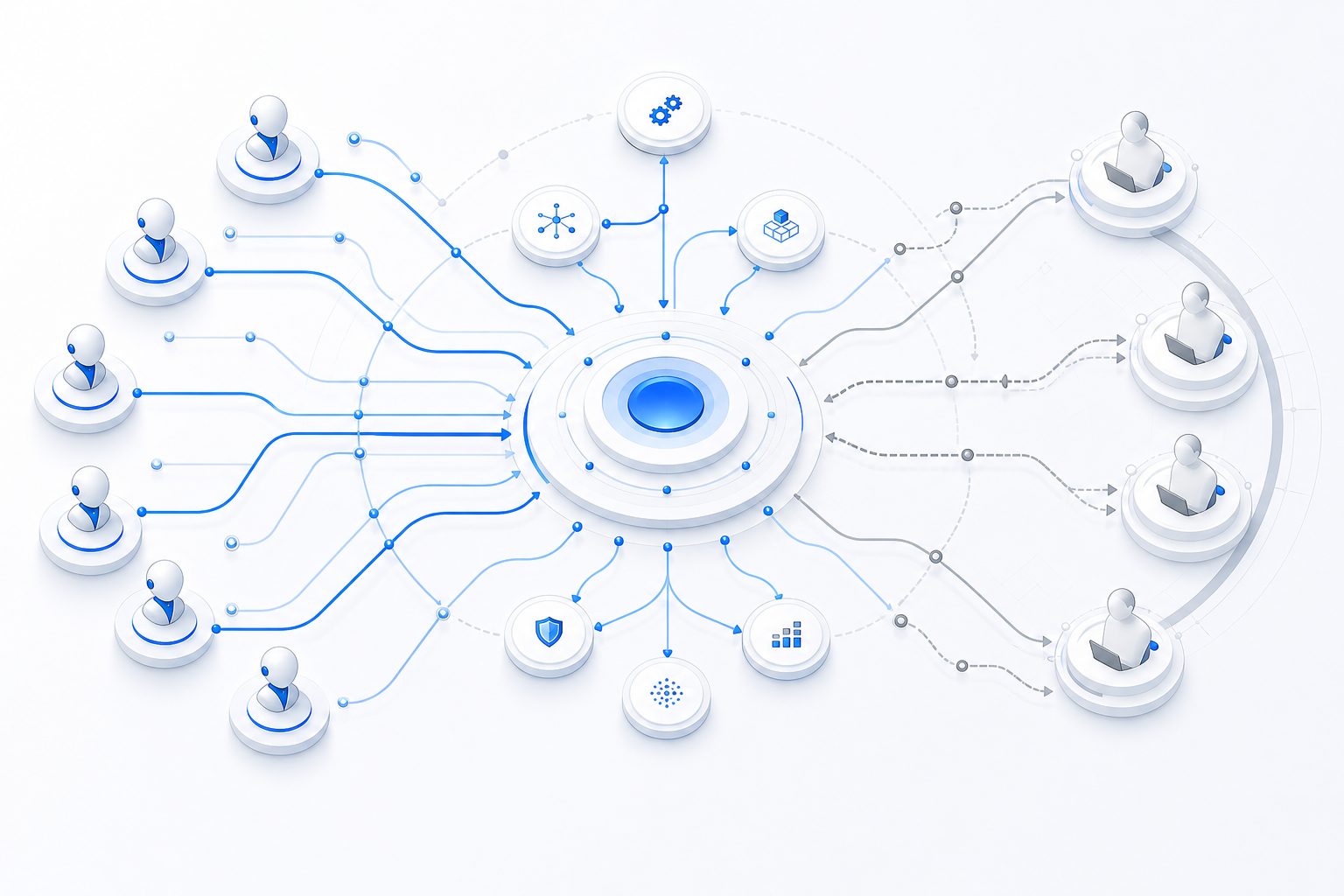
Taken together, these documents imply an implementation path where Agentforce acts as the enterprise agent runtime and UI surface while MCP provides the standard context and tool-execution layer that enables safe, auditable interactions across heterogeneous services and agent types.
The decision: approve a 10–12 week Agentforce + MCP pilot
Goal: Validate that an MCP-backed Agentforce deployment reliably supports
- tool discovery and capability negotiation (can agents discover and enumerate available tools and their contracts),
- secure tool execution on behalf of agents with human oversight and escalation,
- cross-agent context transfer (shared resources and prompts) without leaking sensitive context, and
- operational observability (notifications and progress reporting per MCP primitives).
Scope and constraints (recommended)
- Use a single business domain (suggested: contact-center/service workflow) where Agentforce already maps to existing human workflows.
- Provision an MCP server instance (on-prem or hosted) using Streamable HTTP if you expect multi-tenant or remote components; use stdio for any tightly coupled local tooling prototypes.
- Limit integrations to 3–5 “tools” initially (examples: CRM read/write, knowledge-base query, and an external ticketing webhook) to validate tool execution semantics and authorization flows.
- Design test cases that require agent-to-agent handoffs and explicit human escalation so you can observe discovery, execution, and notification behavior in real-world flows.
- Include legal, security, and compliance reviews in week 1 to set guardrails for what context can flow through MCP and what must be redacted.
Deliverables
- A working Agentforce instance wired to the MCP server with demonstrable discovery and tool-execution flows.
- A human-in-the-loop escalation playbook and audit log export demonstrating that MCP notifications and server-side telemetry are sufficient for compliance reviews.
- A short decision memo with recommended next steps: either scale, iterate, or pause with concrete reasons.
Architecture choices grounded in the dossier
- Use MCP’s discovery primitive as the canonical way for Agentforce agents to learn about available tools and their interface contracts. MCP’s discovery + tool list change notifications provide a structured way to manage evolving tool capabilities without hard-coding endpoints.
- For transport, prefer Streamable HTTP for any remote MCP servers that will serve multiple Agentforce clients; the MCP docs call out Streamable HTTP as the scalable transport that supports standard HTTP auth patterns. Reserve stdio when building tightly coupled local tool adapters or developer prototypes.
- Model agents as orchestrators that rely on MCP-provided “resources” (context bundles) rather than embedding broad context inside prompts. The MCP data-layer primitives are designed to separate resource delivery from LLM prompts which improves auditability and reduces prompt engineering surface area.
Governance and risk controls (must-haves)
- Define explicit context scoping rules (what fields may flow via MCP resources) and automate redaction at the MCP server layer.
- Require tool-level authorization tokens and granular permission checks for tool execution (MCP supports authenticated transports and token usage patterns).
- Instrument notifications and progress reporting per MCP utilities so the operations team can intercept long-running or anomalous executions.
- Keep human escalation paths mandatory for any action that modifies authoritative records (customer profile changes, contract amendments, refunds).
Headless 360 operating-model point of view
Headless 360 recommends treating the context-exchange layer as the company’s “signal cartography” — a machine-readable map of who can call what, when, and with which subset of context. That map should be versioned and discoverable (use MCP discovery), and Agentforce runtimes should consume the map rather than hard-code integrations. Operationally, this means embedding security, billing, and compliance checks at the protocol boundary and running small, measurable pilots that validate both technical integration and organizational decision loops before scaling.
Why “signal cartography”? Because enterprise-scale multi-agent systems become unmanageable if each agent owner draws their own informal signal paths. Standardizing around MCP turns siloed signals into a shared map that can be audited, instrumented, and incrementally extended.
Decision criteria: go/no-go at pilot end
Recommend these pass/fail checks for broad rollout:
- Discovery fidelity: agents can enumerate tools and their capabilities without manual configuration.
- Controlled execution: every tool call is authenticated, authorized, and logged.
- Human-in-the-loop effectiveness: operators can intercept, modify, or terminate agent actions with clear audit trails.
- Operational observability: notifications and progress reporting are sufficient to detect and diagnose failures.
If any of these fail, iterate on scope and governance and re-run a short second pilot focused on the failing dimension.
Concise FAQ
Q: Do I have to use MCP to run Agentforce?
A: No single requirement is mandated by Salesforce in these pages, but using a protocol like MCP aligns with the Agentforce architecture and simplifies multi-agent tool discovery and governance as described in the MCP docs.
Q: Which transport should we choose for an enterprise deployment?
A: Use Streamable HTTP for remote, multi-tenant MCP servers; use stdio only for local, single-client prototypes. The MCP architecture describes both options and their trade-offs.
Q: What’s the minimum viable scope for the pilot?
A: One business domain, 3–5 tools, instrumented audit/logging, and human escalation workflows — enough to validate discovery, execution, and notifications.
Q: What are the essential governance controls?
A: Context scoping and redaction, tool-level auth, mandatory human approval for record-changing actions, and notification-based observability.
References
- https://www.salesforce.com/agentforce/mcp-support/
- https://modelcontextprotocol.io/docs/learn/architecture
HEADLESS 360 OPPORTUNITY SESSION
Bring one workflow.
Leave with a clearer move.
KEEP READING