
Agentic Enterprise / HEADLESS 360
Decision brief: Pair Salesforce Agentforce with the Model Context Protocol (MCP)
A decision-focused briefing recommending enterprises pair Salesforce Agentforce with an MCP-compatible context server to scale governed agent workflows.
THE DECISION PATH
Agentic Enterprise / operating model- 01Workflow
- 02Context
- 03Control
- 04Evidence
# Integrating Agentforce with Model Context Protocol: a concrete decision for enterprise AI
Executive summary
Enterprises that run Salesforce and plan to operationalize AI agents face a common integration choice: adopt Salesforce Agentforce as the agent platform and pair it with a context-exchange standard (Model Context Protocol, MCP) — or keep agent implementations siloed inside individual apps. The dossier sources show Agentforce presents a bundled platform for building, operating, and exchanging agents inside the Salesforce portfolio, and MCP provides a transport-agnostic JSON-RPC protocol for delivering the contextual data, tools, and notifications agents require. Use these two technologies together when your goal is to scale agent-driven workflows across CRM, analytics, and bespoke backend systems while retaining centralized discovery, governance, and secure token-based transport.
Why this matters now
Agentic workflows depend on two things working reliably together: (1) an agent runtime and orchestration layer that coordinates human + agent collaboration, and (2) a dependable way to deliver live context and executable tools to agents where they run. Salesforce Agentforce focuses on the first (agents, builder/developer tools, AgentExchange, operations), while MCP is explicitly scoped to the second: a protocol for context exchange, discovery, and tool execution across local and remote servers. For decision-makers, the combined pattern converts scattered point-solutions into a platform with discoverable tools, auditable context flows, and standardized transport/auth approaches.
What Agentforce brings (from the dossier)
- A product framing that centers humans working with agents: “Humans with Agents drive customer success together.”
- A product family: Agentforce Builder, Agentforce Voice, Dev Tools, AgentExchange, and Agentforce Operations — all designed to create, deploy, and run agents inside Salesforce experiences.
- Surface area across Sales, Service, Marketing, Analytics and industry clouds so agents can be attached to customer, sales, and operational workflows.
(Agentforce product lines and positioning are described on the Agentforce product pages.)
What the Model Context Protocol (MCP) supplies
- A client–server protocol that separates the context/data layer from how agents call LLMs or make decisions. MCP defines a JSON-RPC 2.0 data layer for discovery, tools, resources, prompts, and notifications and a transport layer that supports both stdio (local) and Streamable HTTP (remote) transports.
- Discovery and resource primitives that let an agent runtime query a context server for available tools, resources, and prompts rather than hard-coding endpoints.
- A transport model that explicitly supports standard HTTP auth patterns and recommends OAuth for token acquisition; this enables secure remote context servers and corporate SSO integration.
(MCP documentation lays out the protocol, primitives, and recommended transports.)
Headless 360 operating-model point of view
Headless 360 recommends the following operating decision for enterprise leaders evaluating Agentforce + MCP:
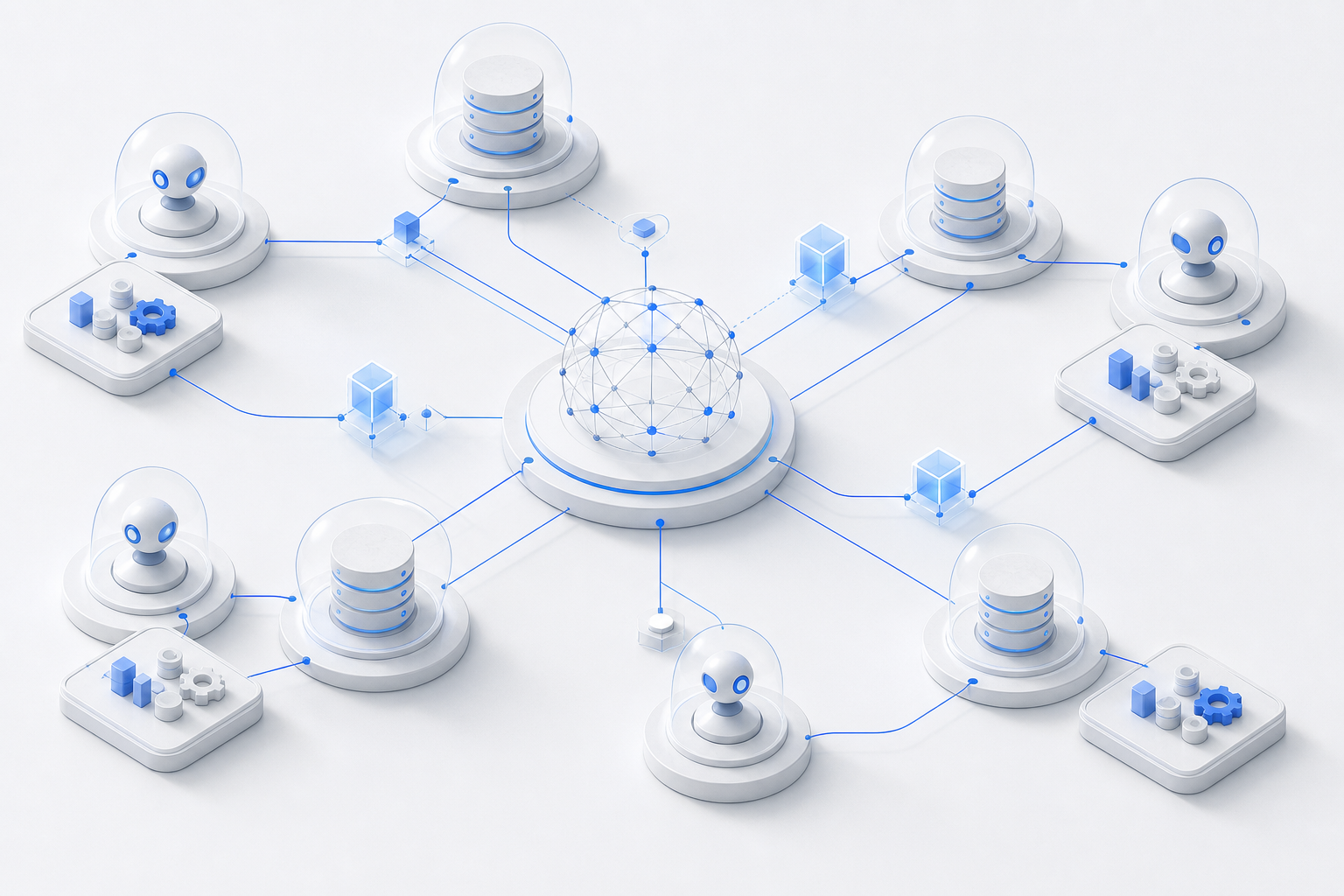
- Treat Agentforce as the orchestration and human-agent UX layer but do not let agent instances hard-code contextual access. Instead, front your internal systems with an MCP-compatible context server (or use MCP SDKs) so any agent runtime — inside Salesforce or elsewhere — can discover and invoke canonical tools and resources.
- This separation yields three business outcomes: faster agent onboarding (discovery, prompts, and tools are reusable), unified governance (centralized context permissions, token flows, and audit trails), and vendor independence for context-hosting (local stdio servers for on-premise data; Streamable HTTP for cloud-backed services).
In short: adopt Agentforce for orchestration and human-facing capabilities, and adopt MCP for context portability and secure, discoverable access to your systems.
A concrete decision — recommended next step for a CX/IT leadership team
Approve a pilot that pairs a narrow Agentforce rollout with an MCP-backed context server. Scope: one high-value, low-risk workflow (example: Sales opportunity qualification or a Tier-1 support triage flow) that requires CRM state + a knowledge-base search. Deliverables:
- An Agentforce agent built with Agentforce Builder that handles the agent orchestration and Slack/Service console experience.
- A local or cloud MCP server that exposes two tools/resources: (a) CRM read/write primitives (scoped least-privilege), (b) KB search resource.
- Authentication using OAuth tokens for the Streamable HTTP transport (or stdio for a local-only pilot) and audit logging of discovery and tool-execution events.
- Success criteria: (1) agent performs the workflow end-to-end without hard-coded endpoints; (2) audit trail shows context access and tool execution; (3) IT verifies token and data governance controls.
This pilot lets you validate developer velocity (Agentforce Builder + Dev Tools), context portability (MCP discovery and resources), and governance without sweeping changes.
Tactical 90-day plan (concise)
- Week 0–2: Sponsor alignment, select workflow, define data and least-privilege scopes.
- Week 3–6: Build Agentforce agent and MCP server interface for CRM + KB. Configure OAuth flows for HTTP transport or a secure stdio deployment for local-only data.
- Week 7–10: Integrate, run internal user testing, capture audit logs and tool-discovery traces.
- Week 11–12: Evaluate against success criteria; either expand to next workflow or harden governance based on lessons.
Risks and mitigations
- Risk: Token leakage or excessive data exposure. Mitigation: enforce least-privilege OAuth scopes, rotate keys frequently, and require audit logging for all tool executions.
- Risk: Vendor lock-in to a single agent runtime. Mitigation: rely on MCP for context delivery so alternate agent runtimes can reuse the same tool surface.
- Risk: Latency when using remote context servers. Mitigation: use stdio/local MCP servers for latency-sensitive paths or cache non-sensitive data at the agent side with strict TTLs.
Concise FAQ
Q: Do I need MCP to run Agentforce agents?
A: No. Agentforce provides its own agent runtime and developer tools. MCP is an orthogonal protocol focused on delivering context, discovery, and tool execution in a transport-agnostic way. You should adopt MCP when you need standardized, discoverable context and tool access across multiple agent runtimes or when governance requires a centralized context server. (Source: MCP documentation; Agentforce product pages.)
Q: Which transport should we use — stdio or Streamable HTTP?
A: Use stdio for local, single-host deployments (best for on-premise or restricted data). Use Streamable HTTP for remote, multi-tenant, or cloud-hosted MCP servers where standard HTTP auth and streaming are needed. MCP docs describe both transports and their trade-offs.
Q: How does authentication work?
A: MCP recommends using OAuth for transport authentication. Implement OAuth token issuance and scope-based access control for MCP endpoints and tools.
Q: Will this make agents vendor-neutral?
A: MCP increases context portability: if your agents rely on MCP discovery and tool execution, you can migrate agent runtimes without re-implementing context plumbing.
References
- https://www.salesforce.com/agentforce/mcp-support/
- https://modelcontextprotocol.io/docs/learn/architecture
HEADLESS 360 OPPORTUNITY SESSION
Bring one workflow.
Leave with a clearer move.
KEEP READING


