
Agentic Enterprise / HEADLESS 360
Agentforce + MCP: A concrete enterprise decision for agentic integration in 2026
A practical, vendor-aligned decision guide for integrating Salesforce Agentforce with the Model Context Protocol (MCP). Includes a concrete deployment posture, security considerations, and a 90-day pilot roadmap.
THE DECISION PATH
Agentic Enterprise / operating model- 01Workflow
- 02Context
- 03Control
- 04Evidence
# Executive summary
Enterprises building agentic systems today face two parallel but interdependent choices: which agent platform to adopt (here, Salesforce Agentforce) and how those agents will discover and safely use enterprise tools and data (Model Context Protocol — MCP). The dossier materials make one thing concrete: Agentforce provides the product surface and developer toolchain; MCP supplies a standardized, transport-agnostic protocol for sharing context, tool manifests, and notifications with AI hosts. The practical decision for an enterprise is not a theoretical embrace of "agents" — it's a specific integration architecture: adopt MCP-compatible context servers and pair them with Agentforce's Headless Toolkit and developer tooling so agents run with predictable discovery, authentication, and governance.
This Insight gives a tight, operational recommendation and a 6-point implementation checklist that CIOs and platform leads can sign off on within a single quarter.
Why this matters now
- Agentforce is positioned as Salesforce's carrier for humans-with-agents workflows and includes a Headless Toolkit and developer surfaces for building AI-driven apps. (Source: Salesforce Agentforce documentation.)
- MCP is an established protocol (versioned and documented) that formalizes how AI hosts and context servers exchange tool lists, resources, prompts, and notifications. The MCP architecture explicitly supports local stdio and a Streamable HTTP transport, and it recommends OAuth for secure authentication. (Source: Model Context Protocol architecture docs.)
Bringing them together reduces integration risk: Agentforce supplies the agent runtime and app patterns; MCP supplies a repeatable way to expose enterprise systems to those agents without point-to-point scripting.
The technical fit: what each side contributes
- Agentforce (Salesforce)
- - Product surfaces for builders: Agentforce Builder, Agentforce Voice, Dev Tools, AgentExchange, Headless Toolkit, and App Development guidance. These are the integration levers you will use to embed agents into Sales, Service, Marketing, or Industry clouds.
- MCP (Model Context Protocol)
- - A two-layer protocol: a JSON-RPC–style Data Layer (tools, resources, prompts, notifications) and a Transport Layer (stdio for local servers; Streamable HTTP for remote servers).
- - MCP is explicit about the discovery flow and the primitives that allow AI hosts to learn what tools and data a server exposes, and it recommends using OAuth for remote authentication.
Taken together: Agentforce runs agents and exposes extension points; MCP standardizes how those agents discover and call enterprise tools.
A concrete enterprise decision (recommended)
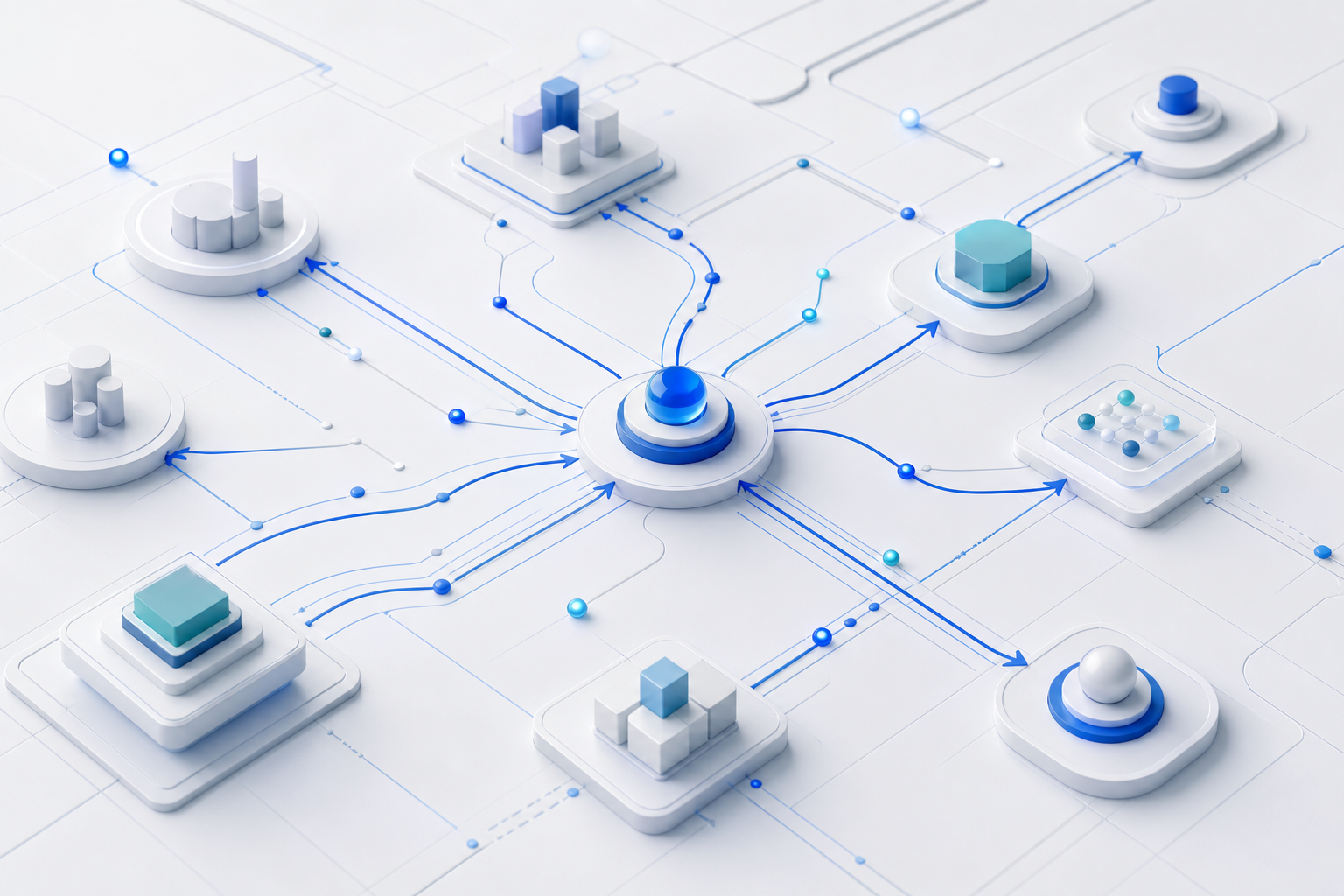
Adopt an MCP-first integration posture when connecting Agentforce agents to enterprise services: build or deploy MCP servers that surface enterprise tools and datasets, and register them as the canonical context layer for Agentforce-built agents. Concretely:
- Lock on MCP protocol version compatibility — use the documented MCP release as your spec for discovery, tool primitives, and notifications (the MCP docs identify versioning and a recommended latest version). This avoids bespoke tool-discovery code sitting inside agents.
- Choose a hybrid transport strategy: local stdio for high-sensitivity, single-host agents and Streamable HTTP for multi-tenant or remote MCP servers that must scale across the organization.
- Use OAuth for remote MCP authentication, and integrate the OAuth flow into Agentforce identity controls and your enterprise IAM.
- Surface enterprise tool manifests (CRUD, task APIs, long-running ops) via MCP tool primitives so Agentforce agents can discover capabilities without hard-coded endpoints.
- Apply notifications and progress-tracking primitives for long-running operations so agents can coordinate with humans and dashboards.
- Use Agentforce Headless Toolkit and Agentforce Dev Tools to build agent UIs and flows that consult the MCP discovery endpoint at runtime rather than shipping static logic.
These are implementation decisions, not product endorsements — they convert the MCP spec and Agentforce product pages into a repeatable enterprise integration blueprint.
Practical deployment choices (trade-offs)
- Local stdio MCP server: lowest network exposure, best for on-premise legacy systems, and simplest auth. Use when data residency and latency are primary constraints.
- Streamable HTTP MCP server: best for scale, third-party integrations, and SaaS-hosted MCP servers. Requires robust OAuth and network controls.
Map services to transport modes early. Treat the MCP server list as a policy boundary: which capabilities are allowed to be discovered by which agent class.
Security and governance
- Use OAuth for streamable HTTP transports and keep service tokens short-lived.
- Enforce tool-level authorization in the MCP server rather than in agents: treat the MCP server as the policy enforcement point for tool exposure, data redaction, and telemetry capture.
- Log discovery and execution requests for audit and explainability; the MCP notification model gives you hooks to emit progress and state changes.
Implementation roadmap (90-day pilot to production-ready guardrails)
Week 0–2: Align stakeholders (platform, security, business owners) and define the pilot scope: one Agentforce use case + 2–3 backend tools to expose via MCP.
Week 2–6: Implement an MCP server for the selected tools (choose stdio for single-host or Streamable HTTP for shared services). Publish tool manifests and basic notifications.
Week 6–10: Build Agentforce agent flows with the Headless Toolkit that call MCP discovery at runtime and test end-to-end with human approvals and audit logs.
Week 10–12: Harden auth (OAuth), RBAC, and logging; perform an operational runbook handover to platform ops.
Note: the MCP documentation explicitly describes the discovery and transport options and recommends OAuth for remote transport. The Agentforce product pages describe the Headless Toolkit, Agentforce Dev Tools, and AgentExchange as the surfaces you will use to build and extend agents.
Headless 360 operating-model point of view
Headless 360 recommends treating agents as platform consumers, not bespoke point solutions. Your operating model should:
- Centralize context and tool exposure in MCP servers (so agent teams do not reimplement discovery or access controls).
- Decentralize agent UX and business logic into Agentforce-built apps that consult the central MCP layer at runtime.
- Run platform ops that manage MCP server lifecycle, access policies, and telemetry, while product teams iterate on agent behavior using Agentforce developer tooling.
This split reduces duplication, accelerates secure rollout, and creates a single place to enforce governance and observability.
FAQ (concise)
Q: Do I have to rewrite existing integrations to use MCP?
A: No. Start by wrapping existing APIs with an MCP server adapter that publishes tool manifests and preserves your current endpoints.
Q: Which transport should we choose first?
A: If you need tight data control and low latency for a small set of agents, start with local stdio. If you need scale or multi-tenant access, use Streamable HTTP with OAuth.
Q: Will MCP replace my IAM and governance tools?
A: No. MCP is a protocol for exposing context and tools; use it alongside your IAM. MCP servers should enforce tool-level authorization using your IAM tokens.
Q: Is Agentforce required to use MCP?
A: Agentforce will run without MCP, but using MCP standardizes discovery and reduces bespoke integration work when agents must call many enterprise tools.
References
- https://www.salesforce.com/agentforce/mcp-support/
- https://modelcontextprotocol.io/docs/learn/architecture
HEADLESS 360 OPPORTUNITY SESSION
Bring one workflow.
Leave with a clearer move.
KEEP READING


