
Agentic Enterprise / HEADLESS 360
Run a 90-day dual-track: Agentforce quick-win + MCP portability proof
A Headless 360 decision brief: run a 90-day dual-track pilot that pairs a vendor-native Agentforce quick-win with a parallel MCP-based context-server integration to capture fast ROI while preserving portability.
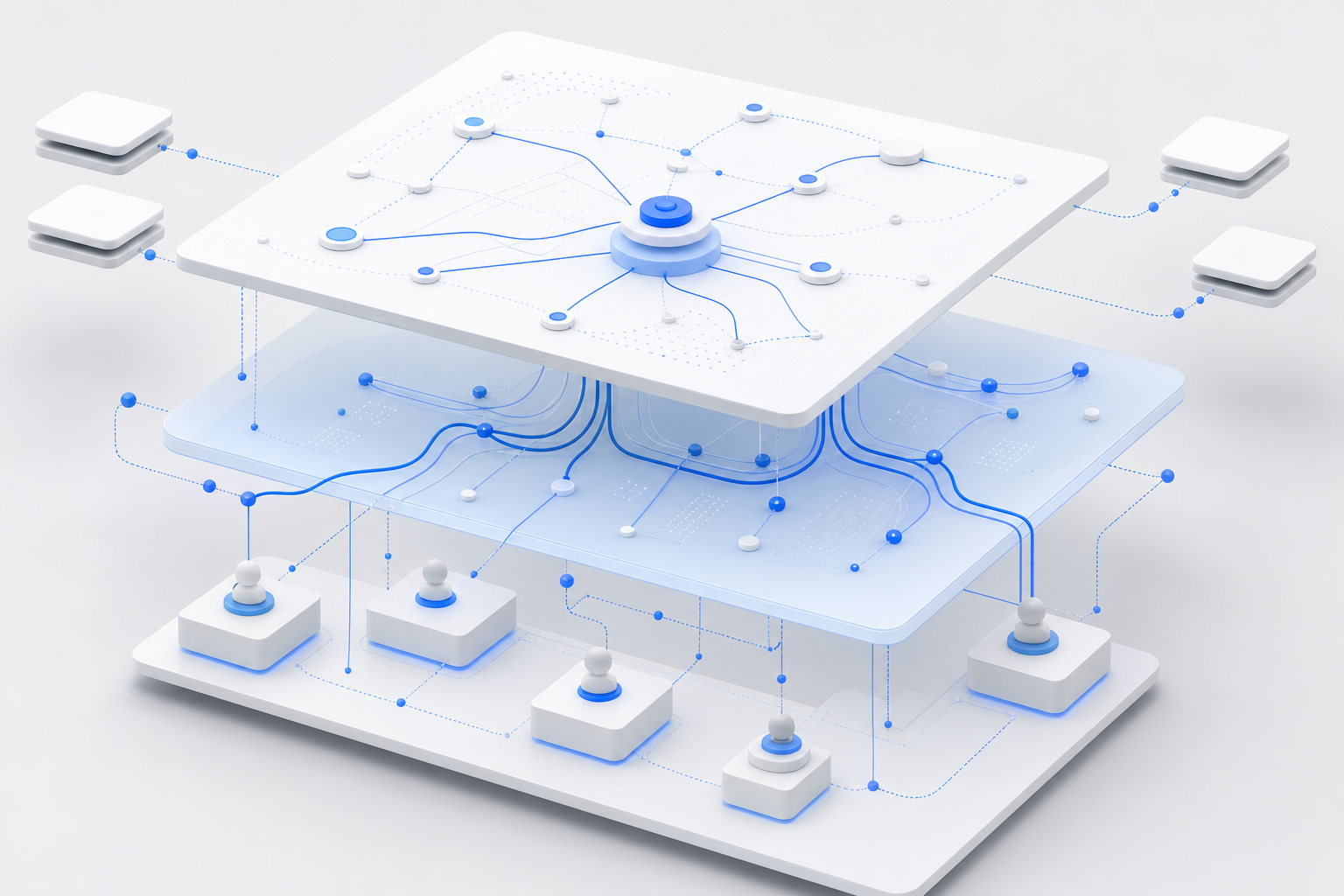
THE DECISION PATH
Agentic Enterprise / operating model- 01Workflow
- 02Context
- 03Control
- 04Evidence
# Why now: Agentforce at scale meets protocol-grade context
Enterprises face a clear fork: pick a single vendor-native agent stack and graft every line of business onto it, or build a decoupled, protocol-driven agent layer that lets teams swap models, data sources, and UI channels without re-architecting workflows. Salesforce’s recent newsroom activity — headlines from Dreamforce 2026 through summer 2026 emphasize Agentforce, Agentic Enterprise and rapid agent adoption — makes the vendor-native path compelling for speed and ecosystem access. (salesforce.com)
Meanwhile, the Model Context Protocol (MCP) provides a practical blueprint for the other path: a JSON-RPC based data layer and transport model that standardizes discovery, tools, resources and notifications so AI hosts and context servers can interoperate. MCP explicitly separates a data layer (primitives, discovery, notifications) from a transport layer (stdio and streamable HTTP), which is exactly the decoupling enterprise architects need to manage vendor risk and accelerate agent experiments. (modelcontextprotocol.io)
This Insight translates those two primary sources into a single, concrete decision for enterprise technology leaders: run a 90-day dual-track pilot that pairs a vendor-native Agentforce quick-win with a parallel MCP-based context-server integration. The objective: prove business outcomes fast while protecting long-term portability.
The evidence that matters (what we can cite)
- Salesforce’s public newsroom highlights Agentforce, Agentic Enterprise and Dreamforce 2026 announcements, indicating product focus and ecosystem storytelling that will accelerate partner and customer momentum. (See Dreamforce 2026 and Agentic Enterprise headlines on Salesforce News & Stories). (salesforce.com)
- MCP’s architecture documentation defines a client-server model, a JSON-RPC data layer (discovery, tools, resources, notifications) and two supported transports (stdio, streamable HTTP). These are practical building blocks for decoupling model hosts from context providers. (modelcontextprotocol.io)
Those two facts — accelerating vendor product momentum and a protocol for context exchange — create an operational trade-off that should shape a near-term enterprise decision.
A Headless 360 operating-model point of view
Headless 360 recommends a constrained, measurable dual-track pilot for any enterprise evaluating Agentforce or similar agent platforms:
- Speed track (0–90 days): Implement a single-line-of-business Agentforce deployment (customer service FAQ resolution, basic case routing, or sales lead qualification) to capture rapid ROI and stakeholder confidence. Use out-of-the-box connectors and prebuilt agents to accelerate time to value; validate metrics such as average handle time, deflection rate, and conversion lift against a short, agreed baseline. (Salesforce’s recent coverage shows the vendor is pushing scale and packaged agent capabilities; this is the speed route). (salesforce.com)
- Portability track (0–90 days, in parallel): Ingest the same datasets and metadata into an MCP-style context server (or a reference MCP implementation) so agents can access context through a protocol layer rather than a proprietary API. Use MCP’s discovery and resource primitives to expose the same tools and resources you’ll call from the Agentforce pilot. The goal is not immediate parity but to validate that context can be supplied, discovered, and versioned independently of the agent host. This reduces vendor lock-in risk and accelerates future model or host swaps. (modelcontextprotocol.io)
- Governance and control: Apply the same data governance, consent, and logging standards to both tracks so you can compare not only business metrics but also operational costs of compliance, auditability, and incident response.
Why this works: the speed track secures funding and buyer trust; the portability track buys optionality. Combining the two in one program keeps momentum without surrendering architecture control.
Practical milestones and success criteria (90-day plan)
- Day 0–14: Convene stakeholders, define the single LOB use case, and instrument baseline KPIs. Acquire limited Agentforce sandbox access and spin up or select an MCP reference server. (salesforce.com)
- Day 15–45: Launch Agentforce pilot with predefined metrics. In parallel, expose the same context (knowledge base, customer profile slices) through MCP discovery and resources. Track integration effort hours, latency, and errors.
- Day 46–75: Compare outcomes. Key decision inputs: business improvement (speed, NPS, conversions), integration cost and time-to-change, and governance overhead (audit logs, consent footprint).
- Day 76–90: Executive review and decision gate. Options: 1) Expand Agentforce where speed matters and maintain MCP adapters for portability; 2) Pursue a platform-agnostic agent mesh if multi-vendor flexibility becomes strategic.
Risks & mitigations
- Risk: Over-optimistic performance expectations for early agents. Mitigate with conservative KPI targets and a small, high-value pilot.
- Risk: Duplicate integration work across tracks. Mitigate by sharing data engineering, governance and instrumentation across both implementations.
- Risk: Organizational resistance to parallel tracks. Mitigate by making the portability track a risk-insurance budget line rather than a big new program.
(These risk mitigations are operational recommendations; they follow the architecture and ecosystem realities in the cited sources rather than assuming undocumented product features). (salesforce.com)
Concise FAQ
Q: Do you have to pick one approach? A: No — the recommended 90-day dual-track pilot explicitly runs vendor-native and protocol-driven approaches side-by-side so you can measure trade-offs before committing. (Headless 360 POV.)
Q: Is MCP production-ready? A: MCP’s documentation describes a mature architecture (JSON-RPC data layer, discovery, notifications, stdio and streamable HTTP transports). Enterprises should validate a reference implementation against their scale and security requirements before full production rollout. (modelcontextprotocol.io)
Q: Will choosing Agentforce today lock us in permanently? A: Salesforce’s product momentum and ecosystem can accelerate value capture; but a protocol layer (MCP-style) maintained by your engineering organization preserves future portability. The dual-track pilot is the pragmatic hedge. (salesforce.com)
Q: What team do we need to run the pilot? A: A small cross-functional squad: product owner, data engineer, security/compliance lead, one integration engineer, and a business analyst to validate KPIs.
Decision (one concrete current action)
Authorize a two-sprint (90-day) dual-track pilot with a fixed budget and explicit success criteria: run a vendor-native Agentforce quick-win to capture immediate ROI while simultaneously validating an MCP-based context server to protect portability. Deliverables: production-ready Agentforce pilot, MCP-based context adapter proof-of-concept, KPI comparison report, and an executive recommendation by day 90. (salesforce.com)
References
- Salesforce News & Stories — Agentic Enterprise and Dreamforce 2026 coverage: https://www.salesforce.com/news/stories/ . (salesforce.com)
- Model Context Protocol — Architecture overview (JSON-RPC data layer, transports, discovery and primitives): https://modelcontextprotocol.io/docs/learn/architecture . (modelcontextprotocol.io)
HEADLESS 360 OPPORTUNITY SESSION
Bring one workflow.
Leave with a clearer move.
KEEP READING


