
Agentic Enterprise / HEADLESS 360
Adopt MCP for Agentforce: A Headless 360 Decision
Why enterprises should adopt the Model Context Protocol (MCP) as the context-exchange standard for Salesforce Agentforce and how to operationalize a hybrid MCP topology under Headless 360 governance.
THE DECISION PATH
Agentic Enterprise / operating model- 01Workflow
- 02Context
- 03Control
- 04Evidence
# Operationalizing Agentic Agents: A Practical Decision for Enterprise Leaders
Enterprises building agentic systems face two simultaneous problems: how to reliably surface the right context to agents, and how to operate, secure, and scale those agents inside existing systems of record. Two primary sources in this dossier point to a concrete path: Salesforce’s Agentforce MCP support page and the Model Context Protocol (MCP) architecture documentation. Together they suggest a clear operational decision: for enterprise deployments of Agentforce, adopt MCP as the context-exchange standard and run a hybrid MCP topology (local stdio servers for latency-sensitive context, Streamable HTTP for remote services) governed by Headless 360 platform controls.
This Insight explains why that decision is actionable, what immediate implementation steps an enterprise should budget for, and the risks and governance controls that must accompany the rollout.
Why choose MCP for Agentforce integrations
- MCP is purpose-built to separate context delivery from model selection and inference. The MCP architecture defines a data layer of primitives (tools, resources, prompts, notifications) and a transport layer (stdio and Streamable HTTP). That separation lets you standardize how context is described and discovered while leaving AI model choices and orchestration local to your Agentforce instance. (See the MCP Architecture overview.)
- Salesforce’s Agentforce documentation includes an MCP-focused support surface and positions Agentforce as configurable through the Headless 360 platform. That implies practical integration points where MCP can be applied to feed Agentforce agents the contextual resources they need (tools, user records, and notifications) without hard-coding connectors for each backend. Use the Agentforce MCP support guidance as the product-side anchor for integration work.
Taken together, these two sources justify replacing brittle point-to-point context integrations with an MCP-based discovery and execution layer. That reduces coupling, speeds agent on-boarding, and centralizes the security model for context exchange.
The concrete decision (one sentence)
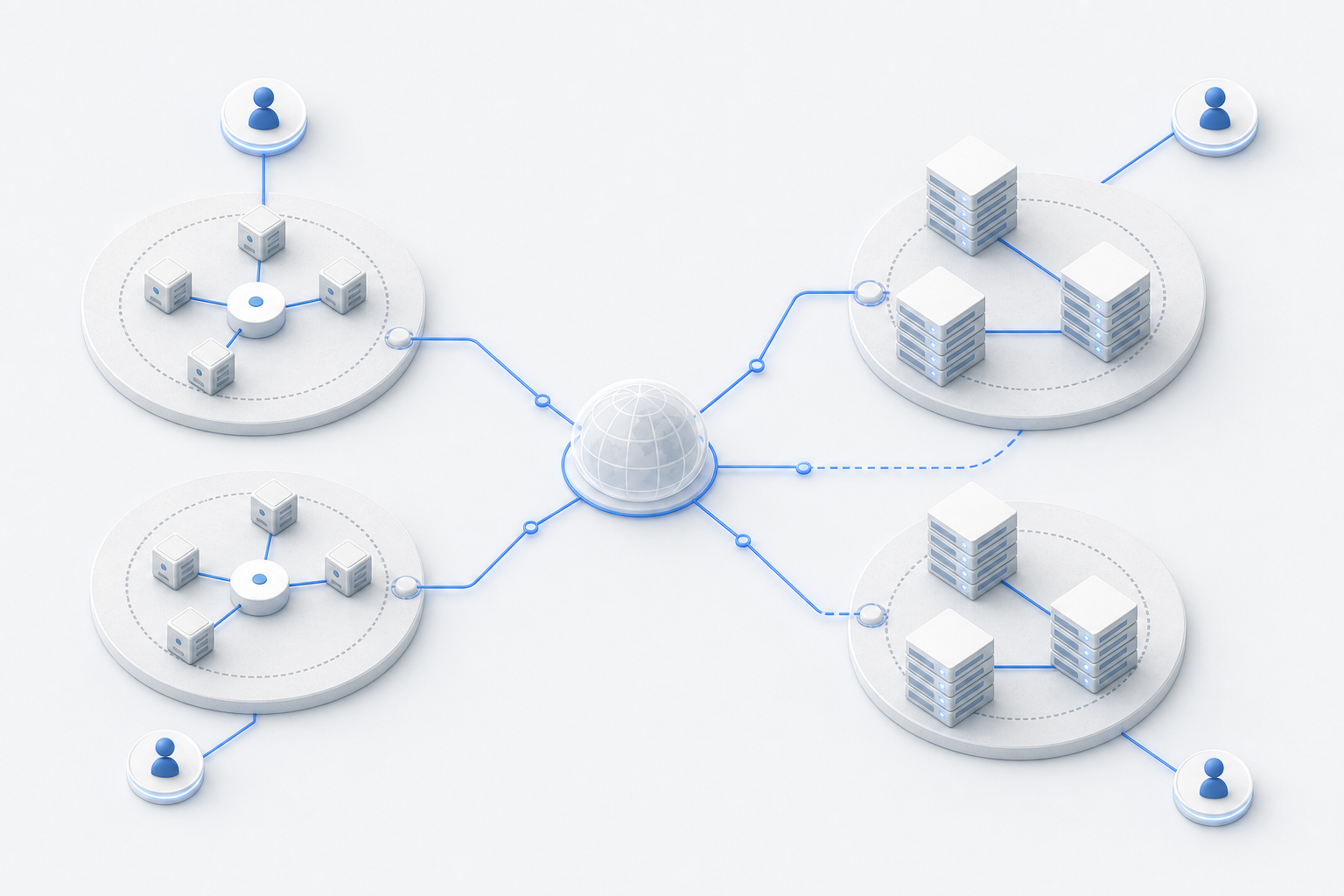
Adopt the Model Context Protocol as the enterprise standard for context exchange to Agentforce, and implement a hybrid MCP topology: local stdio MCP servers for latency- and privacy-sensitive data, and Streamable HTTP MCP servers for managed remote resources — all governed by Headless 360 policies and operator tooling.
Practical rollout plan (quarterly roadmap)
- Triage and pilot (0–3 months)
- - Inventory agent use cases and classify context sensitivity (private PII, high-frequency local telemetry, non-sensitive remote data).
- - Deploy an MCP reference server as a local stdio process for one latency-critical use case (e.g., internal support agents that require immediate user-session context).
- - Configure a single remote Streamable HTTP MCP server for lower-latency-tolerant external data sources (catalogs, marketing feeds).
- - Validate discovery and tool execution flows between a pilot Agentforce agent and both MCP endpoints.
- Expand and secure (3–9 months)
- - Implement Headless 360 controls to manage MCP client registrations and operator access to the MCP registry.
- - Add authorization tiers for MCP transports: local stdio servers rely on process-level controls; Streamable HTTP requires OAuth tokens and consistent token rotation policies.
- - Standardize primitive definitions (tools/resources/prompts) and register them in the MCP registry so new agents can discover capabilities without bespoke engineering.
- Operate and optimize (9–18 months)
- - Centralize logging, observability, and change notifications from MCP servers into your SIEM and Headless 360 dashboards.
- - Right-size your hybrid topology: move high-throughput read-only context to the remote Streamable HTTP servers, keep session-bound secrets and ephemeral context on local stdio servers.
- - Begin controlled migration of existing point-to-point connectors into MCP adapters to reduce maintenance burden.
Technical trade-offs explained
- Stdio transport (local): lowest network overhead and best for ephemeral, sensitive context. It is ideal for session-scoped data that should never leave the machine/process boundary. The trade-off is deployment complexity and per-host management.
- Streamable HTTP transport (remote): scalable, supports many MCP clients, and integrates with existing auth and secrets management. The trade-off is increased attack surface and latency variability; it must be hardened with OAuth and TLS and monitored closely.
MCP’s data-layer primitives let you keep uniform semantics across both transports, minimizing application-level change when you move a resource from local to remote.
Governance and risk controls (non-optional)
- Discovery gating: require operator approval in Headless 360 for any MCP server that advertises tools or resources marked as sensitive.
- Tokenization and secrets isolation: never expose long-term credentials in MCP resource descriptors. Use short-lived tokens and per-agent capability scopes.
- Audit and notification: configure MCP notifications to emit observable events for tool executions that touch regulated data; feed those events to compliance tooling.
- Change management: treat tool/resource schema changes as breaking API version changes in the MCP registry; require backward-compatible shims where necessary.
Headless 360 operating-model point of view
Headless 360 views agentic systems as compositions of three controllable vectors: capability discovery, context delivery, and policy enforcement. MCP standardizes capability discovery and context delivery. Headless 360’s role is to govern the lifecycle (approval, rollout, monitoring) of MCP endpoints and to provide operator-grade controls (access policies, observability pipelines, and lifecycle automation). Decision-makers should therefore treat MCP adoption not as a purely technical integration but as a platform operating-model change — one that moves work from ad-hoc engineering projects into a centrally governed set of platform capabilities.
Key operating-model implications:
- Create a dedicated "Context Platform" team responsible for MCP registry hygiene and operator approvals.
- Define SLA tiers for local vs remote MCP services and price internal consumption accordingly.
- Embed compliance reviewers in the context platform change workflow so that resource registration is a checkpoint in agent launches.
Short, concrete next-step for an executive meeting
Approve a 90-day pilot: fund a single FTE (platform engineer), a small infra budget for one local MCP server and one Streamable HTTP server, and a security review slot. Deliverables: an MCP-enabled Agentforce pilot, a Headless 360 operator playbook for discovery approvals, and an initial incident-playbook for MCP-related data exposures.
FAQ (concise)
Q: Will adopting MCP force us to change our agents?
A: No — MCP standardizes how context is offered. Agents that can call MCP clients will gain discovery benefits; existing agents can be adapted by adding an MCP client layer.
Q: Is MCP a security risk because it centralizes context?
A: It centralizes access control, which can be a net security improvement if you apply strict tokenization, discovery gating, and audit logging.
Q: Which transport should we start with?
A: Start with stdio for one latency- and privacy-sensitive pilot, and add Streamable HTTP for non-sensitive, high-scale resources.
Q: Who should own MCP in the organization?
A: A Context Platform or Headless 360 platform team should own the MCP registry, approvals, and operator policies.
References
- Salesforce — Agentforce MCP Support: https://www.salesforce.com/agentforce/mcp-support/
- Model Context Protocol — Architecture overview: https://modelcontextprotocol.io/docs/learn/architecture
HEADLESS 360 OPPORTUNITY SESSION
Bring one workflow.
Leave with a clearer move.
KEEP READING


