Agentic Enterprise / HEADLESS 360
Adopt MCP as the Interoperability Hinge for Agentforce: A 90–180 Day Plan
A 90–180 day decision and execution plan for adopting Model Context Protocol (MCP) as the enterprise interoperability standard for Salesforce Agentforce, with concrete implementation steps, operating‑model POV, and a concise FAQ.
THE DECISION PATH
Agentic Enterprise / operating model- 01Workflow
- 02Context
- 03Control
- 04Evidence
# Executive insight — When to treat MCP as the operational hinge for Agentforce
Enterprises deciding whether and how to extend Salesforce Agentforce beyond internal agents must choose an interoperability posture now. The concrete decision: make Model Context Protocol (MCP) the standard on-ramp for third‑party capabilities and enterprise data when you deploy Agentforce — or postpone cross‑system agent orchestration until you have fully resolved governance and tooling. This Insight explains the minimal, concrete steps to adopt MCP with Agentforce, what to expect technically, and the governance guardrails Headless 360 recommends.
Quick thesis
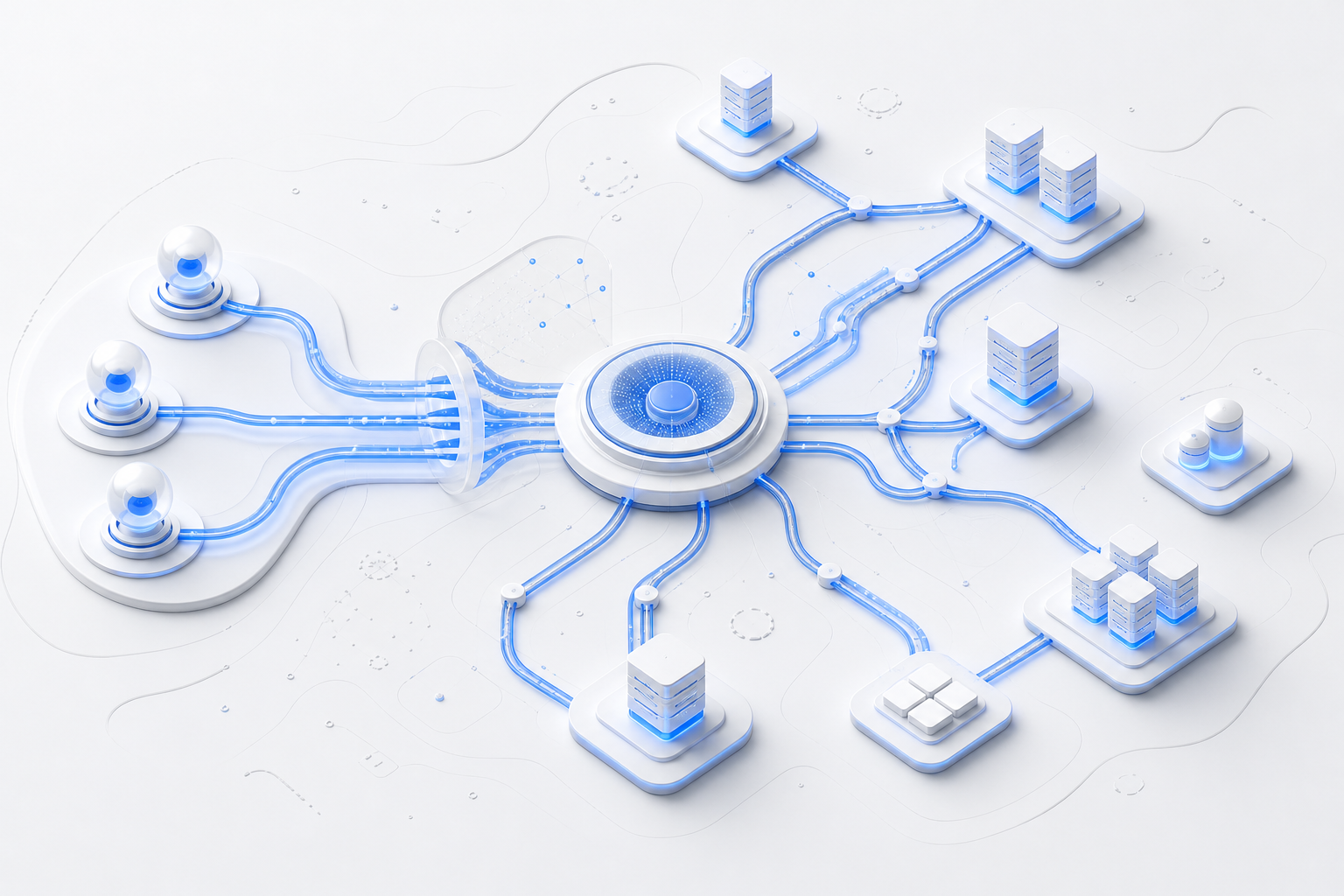
Salesforce positions Agentforce to be a native MCP client that discovers and uses external MCP servers for resources, tools, and prompts; this makes MCP the practical interoperability standard for enterprise agent ecosystems. If you plan to scale agent-to-agent or agent-to-system workflows across business units, adopt MCP as the default integration surface now — but implement a phased program that codifies discovery, authentication, rate controls, and an MCP server registry before broad rollout. (salesforce.com)
What the sources say (short)
- Agentforce will leverage Model Context Protocol to connect agents to external resources, tools, and prompts and to provide enterprise-grade interoperability and governance. (salesforce.com)
- MCP defines three core primitives — tools, resources, and prompts — and uses a JSON‑RPC 2.0 data layer with two transport options (stdio and Streamable HTTP), together with discovery and stateless per-request metadata. These protocol details determine how you will design connectivity, security, and observability. (modelcontextprotocol.io)
The concrete decision you must make this quarter
Adopt MCP as the official interoperability standard for Agentforce integrations across partner MCP servers and internal systems, and execute a three‑phase program in the next 90–180 days:
- Pilot and registry (30–60 days)
- - Stand up a controlled set of MCP servers (one or two) to expose a limited set of resources, tools, and prompts for a non‑production Agentforce pilot. Use the Agentforce MCP registry functionality to register and authorize those servers so discovery is controlled. (salesforce.com)
- - Use the MCP discovery flow to validate server capabilities and per‑request metadata handling (the protocol is stateless; every request carries its version and capability metadata). (modelcontextprotocol.io)
- Security and operationalization (60–120 days)
- - Enforce the authentication modes and transport choices aligned to your risk profile: for remote MCP servers use Streamable HTTP with OAuth or API keys as recommended; for tightly coupled local services consider stdio during development. Instrument and document which transport each registered MCP server uses. (modelcontextprotocol.io)
- - Configure Agentforce’s centralized MCP server registry and policy layer to restrict discovery to authorized servers and to enforce granular access controls for which agents may call which tools or resources. The registry is the single system of record for approved MCP capabilities. (salesforce.com)
- Scale and guardrails (90–180 days)
- - Implement rate limiting, monitoring, and resource quotas before wider rollout to prevent overload and ensure predictable resource usage across agent ecosystems. Agentforce calls out optimized resource management as a first‑order operational requirement. (salesforce.com)
- - Expand AgentExchange listings for vetted MCP partners to streamline procurement and reduce bespoke integration effort. Use AgentBuilder templates and curated prompts to shorten time to value while preserving reproducible governance. (salesforce.com)
Headless 360 operating‑model point of view
- Centralize discovery and governance: treat the Agentforce MCP server registry as part of the platform team’s system of record. All MCP servers must be registered, approved, and assigned risk classifications before any agent can discover them. (Operational control prevents “trapped agents” from accidentally reaching unmanaged services.) (salesforce.com)
- Standardize primitives and interfaces: require MCP partners and internal teams to publish Tools, Resources, and Prompts with explicit schemas and example exchanges. This lets product, security, and engineering teams validate behavior without reading proprietary code. MCP’s primitives model is directly suited to this. (modelcontextprotocol.io)
- Choose transports by lifecycle stage: prefer stdio for fast local development and the Streamable HTTP transport for production remote services; codify this choice in runbooks and CI pipelines. MCP’s transport model makes these tradeoffs explicit. (modelcontextprotocol.io)
- Operationalize statelessness and discovery: log per-request _meta fields and server/discover exchanges to the platform audit trail so you can forensically reconstruct agent actions while preserving the protocol’s stateless design. (modelcontextprotocol.io)
Minimal compliance checklist (for the CIO / Head of Platform)
- Have you registered an MCP server registry policy and onboarding workflow in Agentforce? (salesforce.com)
- Have you codified authentication policies (OAuth, API keys) for Streamable HTTP MCP servers? (modelcontextprotocol.io)
- Do your SLIs include MCP discovery latency, tool execution success rate, and rate limit violations? (Agentforce references optimized resource management.) (salesforce.com)
- Are prompts and tools cataloged with schemas and ownership in your internal developer portal? (modelcontextprotocol.io)
Implementation risks and mitigations
- Risk: Unvetted MCP servers expose sensitive data or commands. Mitigation: require registry approval and limit discovered capabilities via Agentforce governance controls. (salesforce.com)
- Risk: Unexpected load from agent orchestration across many MCP servers. Mitigation: implement rate limiting, quotas, and monitoring (Agentforce calls this out as an operational control). (salesforce.com)
- Risk: Misaligned transport or auth choices during development. Mitigation: document transport use in shiproom artifacts and mirror production Streamable HTTP security in staging environments. (modelcontextprotocol.io)
Concise FAQ
Q: What exactly does MCP supply Agentforce?
A: MCP supplies a protocol for discovery and exchange of three primitives — resources, tools, and prompts — so agents can access external capabilities using a standardized handshake. (salesforce.com)
Q: Is MCP a Salesforce invention?
A: No. MCP is an open standard (originally developed outside Salesforce) that Agentforce will leverage; Salesforce provides a native Agentforce MCP client and registry to integrate MCP servers in the enterprise. (modelcontextprotocol.io)
Q: Which transport should we use for production?
A: Streamable HTTP is the production transport for remote MCP servers (supports HTTP POST, SSE streaming, and standard auth mechanisms like OAuth); stdio is useful for local development. (modelcontextprotocol.io)
Q: Can we onboard third‑party MCP partners quickly?
A: Salesforce’s AgentExchange is presented as a curated catalog to discover vetted MCP partners and reduce bespoke integration work; use AgentBuilder to deploy no‑code where available. (salesforce.com)
Actionable next steps (30/60/90)
- 0–30 days: Convene platform, security, and CX owners; approve pilot scope and list of MCP servers to register. (salesforce.com)
- 30–60 days: Run the pilot, capture discovery and tool execution logs, and validate authentication and transport choices. (modelcontextprotocol.io)
- 60–90 days: Promote registry and governance to production, implement rate limits and monitoring, and publish developer contracts for tools/resources/prompts. (salesforce.com)
References
- Agentforce MCP Support — Salesforce. https://www.salesforce.com/agentforce/mcp-support/ (salesforce.com)
- Architecture overview — Model Context Protocol documentation. https://modelcontextprotocol.io/docs/learn/architecture (modelcontextprotocol.io)
HEADLESS 360 OPPORTUNITY SESSION
Bring one workflow.
Leave with a clearer move.
KEEP READING